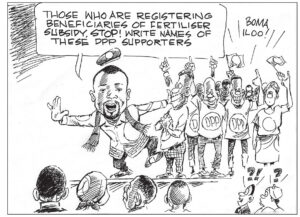
 In the early days of the Democratic Progressive Party (DPP) returning to power, many Malawians dared to hope.
The rhetoric that flowed from the party’s leadership, especially President Peter Mutharika and Secretary- General Peter Mukhito, was one of rebirth.
It was a promise that the past would not be repeated, that this time DPP would chart a different path; a path of unity, service and national development.
Mutharika himself proclaimed that this was not the time to eat but to serve. It was a powerful sentiment that resonated in a nation that had grown weary of the politics of entitlement and vengeance.
Yet, as the saying goes, the more things change, the more they remain the same.
- Advertisement -
Few recent events illustrate this painful truth better than the conduct and remarks of DPP’s Central Region vice president Alfred Gangata.
Gangata’s public statements, calling for loyal party members to be rewarded with government appointments and threatening to send boys to intimidate those he believes were wrongly appointed, stand in stark contradiction to the renewal Mutharika promised.
They reflect not only a reckless disregard for the President’s stated vision but also a deeper problem that continues to plague Malawian politics.
It is the insidious belief that public office exists not for national service but for partisan appeasement.
- Advertisement -
- Advertisement -
Gangata’s insistence that government positions must be reserved for those who fought for the party is the very definition of patronage politics, a practice many Malawians had hoped was slowly being dismantled.
Even more troubling is the suggestion that intimidation could be used to remove individuals who, in his view, were wrongly appointed.
Such rhetoric is both irresponsible and dangerous. It nurtures a climate of fear, entitlement and divisiveness at a time when the nation is desperately in need of cohesion.
What makes Gangata’s remarks even more disappointing is their disregard for the unity message consistently emphasised by the President.
Mutharika’s position has been clear. His leadership, appointments and distribution of state resources must reflect national inclusivity rather than partisan or tribal loyalty.
He has repeatedly positioned himself as a father of the entire nation rather than merely a party leader.
Yet instead of reinforcing the President’s stance, Gangata undermined it by feeding a different narrative that drags the nation backwards.
Then, there also are those who have publicly threatened to use their newfound power to get back at those they believe mistreated them during the previous administration.
Political transitions in Malawi have too often been accompanied by such vengeful undercurrents.
Parties ousted from government complain of exclusion; those returning to power justify new systems of exclusion as necessary payback.
It is a destructive cycle that prevents Malawi from building a mature democratic culture.
If Gangata’s remarks and those of his kind represent even a fraction of the mindset within segments of the DPP leadership, then the party risks betraying its own mandate.
The people did not vote for a replacement of one group of entitled elites with another.
They did not vote for a government that rewards loyalty over competence nor for one that weaponises state resources to settle old political scores.
The electorate voted for change, real change. They voted for the promise that this administration would do things differently.
The tragedy of Malawi’s political landscape is that parties often lose their sense of purpose once the euphoria of victory fades.
Instead of grounding themselves in their principles, they fall back into habits that have historically crippled governance.
This is precisely what Mutharika sought to caution against when he urged his Cabinet to resist the temptation of “eating”.
Yet here we are, only two months into a new administration and senior officials are already calling for access to the trough.
What DPP must understand is that moments like these define political legacies.
A single reckless statement from a senior figure, especially one threatening violence or advocating exclusion, can undo months of careful positioning.
If Mutharika’s so-called vision of a new Malawi is to be realised, then his leadership must be firm.
He must demand accountability from his own officials and reaffirm the principle that public office is a sacred trust rather than partisan spoil.
Malawi stands at a crossroads. It can either move forward, embracing unity, fairness and national development, or regress into factional entitlement and political vengeance.
Gangata’s conduct is a warning sign that the old order still lurks beneath the surface.
It is now up to DPP leadership to show Malawians that the promise of renewal was not merely a campaign slogan but a genuine commitment to doing better.