







By Jenipher Changwanda & Freddie Clayton:
Millions of Malawians are struggling with the impacts of back-to-back climate disasters that have deepened the poverty of subsistence farmers and undermined the ability of the cash-strapped government to help.
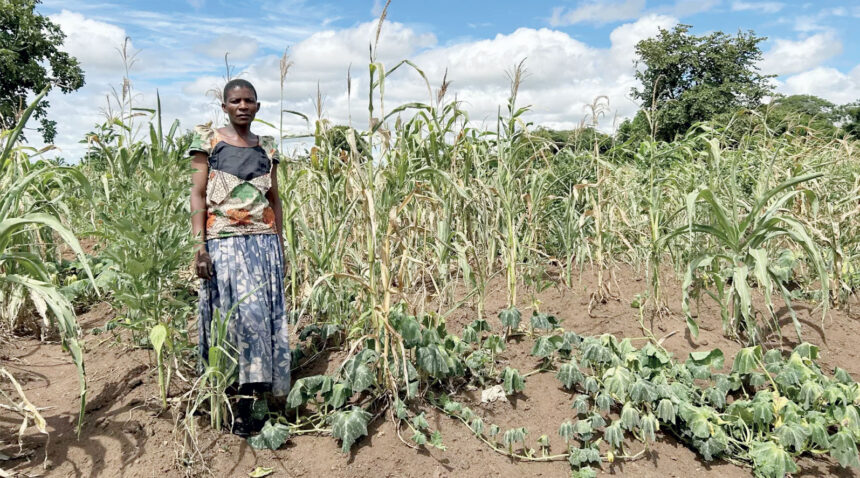
For Magrate Mustafa and her children, the hardship has been so extreme that they have been reduced to eating grass seeds, plucked from their fields in Najawa, a small village in southern Malawi’s Machinga district.
Mustafa pounds the seed in a mortar to separate the husk, then boils the grain in water to make a porridge for her family.
- Advertisement -

“The first time I made it my whole family suffered from diarrhoea and our urine ran dark yellow,” Mustafa, 32, told The New Humanitarian. “It’s not food, but we have nothing else to eat.”
- Advertisement -
Her husband can’t bear to watch them eat. He’s ashamed he cannot do better for his family, but there’s little any of them could have done to prepare for the last 12 months.
First came Cyclone Freddy, the strongest tropical cyclone ever recorded. In March 2023, the storm struck Malawi twice and six months’ worth of rain fell in just six days, inducing floods and landslides that killed 1,200 people and displaced almost 700,000. More than two million farmers lost their crops and 1.4 million livestock perished.
Mustafa’s home and farmland were destroyed. Her family spent five months living in an evacuation camp, surviving off government aid. In October, they rebuilt their home in a different village, fearing the floods might return.
But then came El Niño, a cyclical climate event that triggers drought in East Africa. The maize Mustafa and her husband planted in October wilted in November as the rainy season delayed. They planted again in December, but their crops didn’t survive a long dry spell in February. “Once again, we have nothing,” she said.
- Advertisement -
With more than 16 million people relying on rainfed agriculture, Malawi is dependent on a stable climate. But increasingly erratic rainfall, periods of drought, and five cyclones since 2019, have depleted its fragile food systems. When El Niño arrived in November, more than 4.4 million Malawians were already facing a food crisis.
The struggle to adapt
As climate heating threatens more extreme El Niños and more intense tropical cyclones, Malawi desperately needs effective adaptation measures. But the sheer frequency of these crises is undermining the nation’s capacity to recover and adapt, trapping its people in poverty and food insecurity.
Unlike Cyclone Freddy, the Malawian government knew El Niño would come. In October, the Department of Climate Change and Meteorological Services (DCCMS) forecast below average rainfall in November and dry spells in February. The Ministry of Agriculture issued mitigation advice, instructing farmers to plant drought-resistant crops, use organic manure to improve water retention, and grow early maturing plants.
But these early warnings often fail to reach the most rural and vulnerable communities like Najawa, and even when they do, many are unable to act. Farmers had scarcely begun to recover from the last disaster.
“The [DCCMS] warned us. They gave us the information. They said what will happen and when it will happen,” Steve Makungwa, a senior lecturer at Lilongwe University of Agriculture and Natural Resources, told The New Humanitarian.
“Even if the rains come now, nothing will happen because all my crops have been damaged.”
“But smallholders cannot utilise or acquire the resources that enable them to embrace these adaptive measures,” he said. “After [Cyclone Freddy], they have no reserves left with which to build or buy these things.”
Awalewale Samuel, 36, was already taking out loans to pay for fertiliser for her farm in Kwilasha village, Machinga. In previous years she’s paid the money back through selling her surplus rice, but last March her fields flooded during Cyclone Freddy, and this year they have dried up.
“Even if [the rains] come now, nothing will happen because all my crops have been damaged,” said Samuel. “How am I supposed to pay back the loan?”
As smallholders struggle to pay their debts or feed themselves and their family, some have been forced into more dangerous lines of work.
Climate’s worsening impact
The World Bank predicts that climate heating could trigger a 20 percent slump in Malawi’s GDP by 2040. The government acknowledges the danger: Its 2020 National Adaptation Plan Framework lays out the need to build resilience and disaster risk reduction.
But the bill is colossal – an estimated $1.5 billion annually. Given Malawi’s other pressing needs, it has been among the least funded of the priorities in the national budget.
That creates a chain reaction where resilience-building doesn’t happen fast enough, so money then has to be found to pay for expensive emergency recovery efforts. The government essentially suffers the same fate as its smallholders farmers – with each fresh disaster, its capacity to invest in adaptation is weakened.
Malawi’s Department for Disaster Management Affairs claims total loss and damage due to Cyclone Freddy has exceeded $1 billion – and the department is still paying to reconstruct houses, restore damaged farmland, and support displaced households.
The full impact of last year’s El Niño event is so far unclear, but historically two out of every three El Niños have led to a more than 22 percent fall in the maize harvest – a drop that would leave millions more requiring aid.
“It is possible that Malawi may find itself in a continuous cycle of response and recovery.”
Malawi is at the mercy of its donors and their interests, which limits its policy autonomy, notes researcher Blessings Chinsinga. Two months after Freddy, Malawi was forced to appeal for international help.
This year, the government’s Lean Season Food Insecurity Response Programme, which targets food insecure households with maize distribution and cash transfers between October and March, has cost an estimated $226 million, more than 75 percent of which was provided by foreign aid.
In fact, close to 26 percent of Malawi’s total revenue and grants comes from international aid and foreign governments, according to the latest budget.
“It is possible that [Malawi] may find itself in a continuous cycle of response and recovery,” Dickxie Kampani, principal secretary at Malawi’s Ministry of Agriculture, told The New Humanitarian.
“Efforts to address the immediate needs of affected populations and rebuild infrastructure may overlap, creating a situation where response actions often blend into recovery measures.”

But Lucy Mtilatila, DCCMS director, thinks the country can break the cycle.
“The climate is changing in Malawi, and a lot of resources have already gone into humanitarian support,” she explained. “But there is still a lot [Malawi] can do to enhance resilience, and it starts with proper planning.”
After Cyclone Freddy, the government committed $16 million to a five-year project aimed at helping 10,000 households adopt more climate-resilient livelihoods such as beekeeping, mushroom cultivation, and building sustainable briquettes and fisheries.
Unicef has supported the government in creating a first-of-its-kind impact-based warning system, whereby forecasts tell people of the specific threats that floods and droughts can have on their infrastructure, households, and livelihoods, so they can make informed decisions ahead of disasters.
The World Food Programme (WFP) says it has also helped 118,000 households adapt to climate heating with crop diversification, reforestation, and solar-powered irrigation.
But solutions like these, building on the lessons learned from Cyclone Freddy, were not in place in time for El Niño. And they are also not yet happening on a large enough scale to reach millions of people needing urgent and effective support in the face of a warming climate, including the residents of Najawa and Kwilasha. — The New Humanitarian


