





By September 2024, 25-year-old Jarson Phiri stood on the threshold of promise. He had secured a place at one of Lilongwe’s private universities, a hard-won achievement that carried with it the hopes of upward mobility and a better tomorrow.
January 2025 was meant to mark the beginning of that journey, a turning point etched with optimism and sacrifice.
But when the New Year arrived, reality proved unforgiving. A series of unforeseen challenges forced Phiri to postpone his studies. Rather than relinquish his academic dream entirely, he chose to reserve his place and return the following year.
In the meantime, he resolved to safeguard the K1 million he had saved, placing it in a bank savings account, a decision guided by trust in the formal financial system.
- Advertisement -
Twelve months later, Phiri returned to the bank, expecting his discipline to have borne meaningful fruit. Instead, he found that his K1 million had grown by only K40,000.
- Advertisement -
The interest earned hovered around 4.27 percent, an amount quickly eroded by inflation and rising living costs. As he prepared to pay tuition, it became painfully clear that the savings alone would not sustain him.
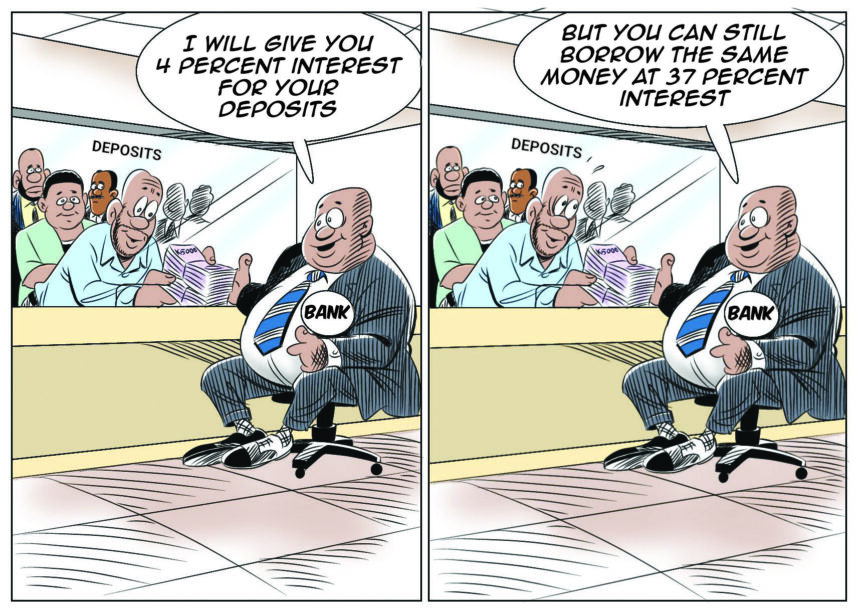
In a moment of necessity, Phiri approached the same bank for a K1 million loan. The response was swift and crushing: the loan would attract interest of around 38 percent per annum.
“That’s absolutely crazy. I kept my K1 million for the whole year with the bank and realised 4 percent interest and they are charging me 38 percent for borrowing a similar amount?” he said to himself.
Disillusioned and visibly shaken, Phiri walked out of the bank, carrying with him a sense of betrayal and injustice. For him, the banking system had ceased to be a partner in progress and instead appeared as an obstacle, one that rewards capital while punishing ambition.
- Advertisement -
The story of Jason is just a tip of an iceberg. Across Malawi, countless individuals and businesses are languishing under the weight of an extremely wide interest rate spread, a phenomenon that has become a defining feature of the country’s financial landscape.
Interest rate spread refers to the difference between what banks pay depositors and what they charge borrowers—a gap that, in Malawi’s case, has grown alarmingly wide.
Reserve Bank of Malawi Director of Economic Policy and Research Mark Lungu admits that Malawi has one of the widest interest rates spread in the region.
A regional comparison underscores the severity of the imbalance. In Botswana, lending rates stand at 7.16 percent while deposit rates are at 2.83 percent, translating into a spread of 4.34 percent.
Mauritius posts a spread of 6.46 percent, South Africa 3.09 percent, and Mozambique 11.46 percent. Zambia records a spread of 20.94 percent, still far narrower than Malawi’s.
Consumers Association of Malawi (Cama) Executive Director John Kapito argues that this extreme disparity has become a conduit for wealth extraction, enabling banks to post massive profits at the expense of ordinary Malawians whose savings earn little in return.
“This was deliberate to ensure that the gap between the rich is also widened to discourage people from borrowing and building their businesses and the more reason small scale industries have failed to grow and survive.
“This was influenced by international financial institutions that continue to treat the country’s economic recovery plan as a project. The more they have failed to close the gap between the official exchange rates and those on parallel market market,” he says.
Finance Minister Joseph Mwanamvekha has also raised concerns, openly questioning what type of business Malawians can realistically operate and still make a profit when lending rates reach as high as 37.27 percent.
According to Mwanamvekha something needs to be done to bring down the cost of borrowing to acceptable levels.
From the banking sector, Bankers Association of Malawi (Bam) President Phillip Madinga concedes that the interest rate spread is a pressing issue but maintains that it reflects deeper structural constraints within the financial system.
He attributes the gap to a complex mix of high operating costs, risk premiums, regulatory requirements , inflation, government borrowing, and monetary policy, factors that suppress deposit rates while driving lending rates upward.
According to Madinga, banks factor operational expenses such as staff salaries and infrastructure into lending rates, with weak infrastructure further inflating the cost of financial intermediation.
“Banks charge higher interest rates to compensate for the risk of loan defaults. As an example, it can as much as 36 months to conclude foreclosure of securities held by banks through the judiciary system.
“High reserve requirements and supervisory fees increase banks’ costs, which are then passed on to customers. The high policy rate, currently at 26 pery, also contributes to the high lending rates, as it serves as one of the reference points for the lending rates,” Madinga said.
He further observed that excessive government borrowing has crowded out private sector lending, driving up interest rates.
“High inflation rates have also contributed to higher interest rates as banks adjust to compensate for inflation premium. The Reserve Bank of Malawi’s policy rate influences lending rates, with hikes done in recent past aiming to stabilize inflation,” he said.
Madinga also pointed to limited savings mobilisation and declining competition in the sector, noting that Malawi now has only eight banks, down from about 14 a decade ago.
“Notwithstanding, Bam recognises these as systemic issues and remains committed to working with government, regulators, and stakeholders to address them. Our shared goal is to build a more resilient, inclusive, and competitive financial system that benefits both savers and borrowers,” he said.
Economics Association of Malawi President Bertha Bangala Chikadza situates the issue within a broader macroeconomic framework, arguing that a 33-percentage-point interest rate spread reflects deep structural and macroeconomic frictions in a high-risk environment.
“Our country is experiencing inflation volatility and exchange-rate instability which raise uncertainty about real returns. With asymmetric monetary policy transmission, policy tightening passes through quickly to lending rates but slowly to deposit rates.
“As such, lending rates jump as soon as there is a change in the policy rate, while deposit rates remain sticky. With savers having limited alternatives as it is outside Malawi, banks face little pressure to raise deposit rates,” Chikadza said.
She adds that banks price loans defensively to shield themselves from inflation shocks, foreign exchange volatility, and costly recovery processes, leaving deposit rates lagging behind.
Financial analyst Ferdinand Mchacha warns that unattractive savings rates are hollowing out the formal banking system itself.
“The majority of Malawians continue to keep cash at home as the banks interests are way below inflation rates and not attractive,” Mchacha says.
This, he notes, deprives banks of cheap capital that could otherwise fuel private-sector growth.
Scotland-based economist Velli Nyirongo paints a stark picture of the long-term implications of a 33 percent interest rate spread.
“First, it discourages saving and investment. When savings earn just over 4 percent while inflation remains high, households see little reason to save through the formal banking system.
“At the same time, borrowing at around 37 percent is prohibitively expensive for businesses, especially small and medium enterprises. This limits private sector investment, stifles innovation, and slows job creation,” Nyirongo says.
He adds that high lending rates weaken growth and diversification, forcing firms to postpone expansion, shrink operations, or rely on informal financing.
“Third, it worsens inequality and financial exclusion. Only large firms or well-connected borrowers can access credit at such high rates, while ordinary households and small entrepreneurs are locked out. This reinforces income inequality and undermines efforts to broaden financial inclusion.
“Fourth, it increases the cost of doing business and fuels inflationary pressures. Firms that do borrow often pass the high cost of credit onto consumers through higher prices, which can sustain inflation and further erode purchasing power,” he says.
Nyirongo o concludes that a persistently wide interest rate spread signals deeper structural and policy failures, ranging from excessive government borrowing and weak competition to macroeconomic instability.
“If not addressed, these conditions can trap Malawi in a low-growth cycle and weaken the effectiveness of monetary policy in supporting development,” he says.
For Malawians like Jarson Phiri, these are not abstract economic theories debated in boardrooms and policy papers; they are lived realities, felt in stalled ambitions, deferred dreams, and a banking system that too often appears indifferent to the very people it was meant to serve.