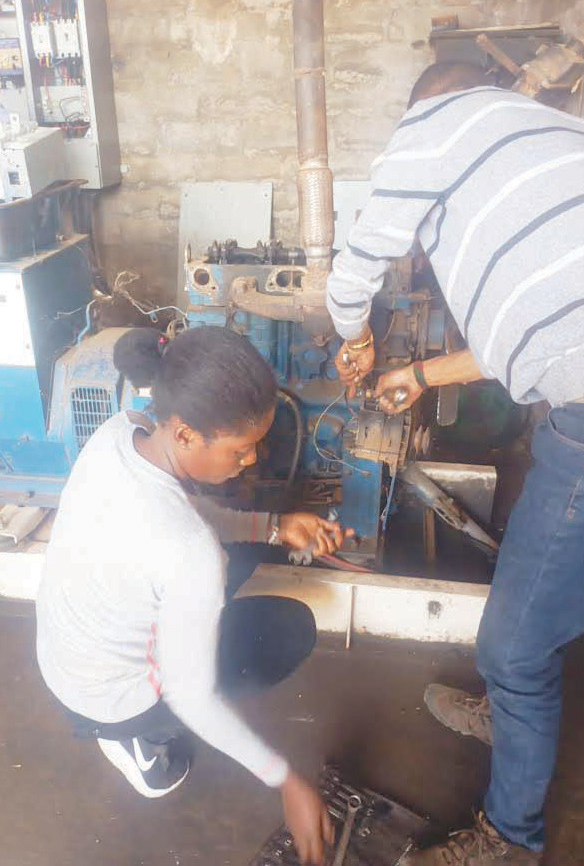
By Gresham Ngwira, contributor:
At first, she was hesitant about going ahead with her plans despite opportunities already opening up. Like her peers, she believed engineering was for men and boys, not for her.
Even after enrolling, her performance in the early days was poor because she still held the view that the programme was meant for men and boys.
“When I was going to university to study engineering, I was very afraid because some people were intimidating me, saying engineering is for men and boys,” Chisomo Mpasou, a police officer by profession, says.
She recalls that in the early stages, her performance was poor because of this mentality but little by little, things started improving until she successfully completed her studies.
- Advertisement -
Currently working in the radio communications department at Police Headquarters in Lilongwe, Mpasou says that with determination and self-confidence, women and girls can perform just as well as men and boys in science fields.
The holder of a Diploma in Engineering from the Malawi University of Business and Applied Sciences says many people, including women and girls themselves, believe science is for men and boys.
“I would like to encourage and assure my fellow women and girls that everything is possible with determination and hard work,” she says.
Mpasou, who intends to upgrade her qualification to degree level, says her department now trusts her and she is among those responsible for installing and ensuring the proper functioning of communication towers.
- Advertisement -
- Advertisement -

Education policy expert Charles Maluwa believes that despite some challenges, Malawi is striving to ensure that women and girls excel in science subjects and related careers.
Maluwa says deliberate initiatives by the government and non-governmental organisations attest to this commitment, aiming to provide equal opportunities regardless of gender.
“We have science girls’ camps in various learning institutions and we can therefore comfortably say that the government is committed to uplifting women and girls in science,” he says.
Maluwa admits that science education is expensive and says the government and other stakeholders should work together to mobilise adequate resources.
He adds that it is not enough for schools to have laboratories without sufficient and appropriate equipment and urges education authorities to address this.
He has since advised women and girls to stop underestimating themselves and strive for excellence, saying all people are equal regardless of gender.
“Sometimes it starts with boys who regard certain programmes or jobs as being for them and not for girls. But if we look around, we will find many women holding influential positions in science fields,” Maluwa says.
According to recent Unesco and UN reports, women make up only about 31 to 35 percent of the global scientific community, with progress stalling over the past decade.
The reports further say that despite representing over 45 percent of higher education graduates, women are underrepresented in science, technology, engineering and mathematics education (Stem), holding only 22 percent of Stem jobs in G20 countries and often facing gender-based discrimination, harassment and pay gaps.
The UN cites underrepresentation as one of the factors leading to biased outcomes, such as artificial intelligence that is apparently less effective at recognising women’s voices.
Executive Director of the Forum for African Women Educationalists in Malawi, Wesley Chabwera, believes that despite positive strides, men and boys still dominate science fields, widening the gender gap in Stem education.
Chabwera says it is unfortunate that some teachers discourage female students from taking science programmes.
“In fact, this is also influenced by tradition, which has long taught people that some things are only for men while others are for women,” he observes.
Chabwera agrees with Maluwa that if given equal opportunity, every person can excel in any field, including science.
He says there are many female engineers in various organisations and departments performing well, demonstrating that success depends on determination and hard work.
He commends the government and other stakeholders for promoting equal opportunities for women and girls, saying this contributes to national development.
He notes an increase in both intakes and bursaries for women and girls as a way of closing the gap and hopes they will seize these opportunities.
Chabwera says his organisation is implementing a seven-year programme with the MasterCard Foundation running from 2027 to 2030, which provides scholarships, bursaries and tuition support for marginalised youths, with 80 percent of beneficiaries being female.