By Kondwani Magombo:
When 16-year-old Shalom Chisepeya, a form 4 student at Mlanda Girls Secondary School in Ntcheu, shared a sad story with her classmate, the two girls didn’t know they were about to embark on a journey that would take them down the hall of fame.
The story was about Shalom’s aunt who had given birth to a premature baby and she had to apply kangaroo method to sustain the baby’s living.
Shalom’s aunt lost the baby, despite all her efforts.
The story left Shalom’s mate, 15-year-old Comfort Mwase, in discomfort, and it got her thinking, hard.
- Advertisement -
“Shalom’s story about her aunt and the baby prompted me to come up with an idea of devising an equipment that could help save the lives of premature babies,” Comfort said.
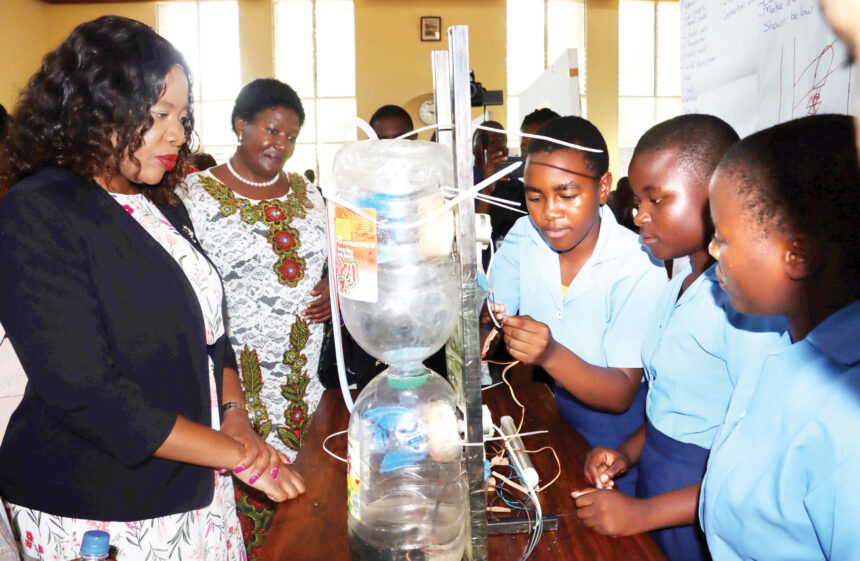
Comfort and Shalom embarked on a project, a baby incubator, which put Mlanda Girls Secondary School on the map at the 2023 National Schools Science and Innovation Fair that was hosted at Kamuzu Academy in Kasungu from 23 to 25 October.
The life-saving project came fourth in Category section, and it also scooped the first prize in Overall Winners section, bagging K250,000 and K450,000 for the respective achievements.
According to Comfort, they spent less than K90,000 to assemble the Baby Incubator, making it cost-effective and affordable at community level.
- Advertisement -
- Advertisement -
A total of 32 schools from across the country competed in this year’s Science and Innovation Fair and emerging fourth and first in the two respective sections left the two Mlanda Girls Secondary School girls and their teacher bubbling with joy.
“We’re very excited that we have ended up category winners and also overall winners — it’s the happiest moment in our lives,” Comfort said, while her colleague, Shalom, simply said: “We did not expect to emerge category and overall winners, given the number and quality of projects that competed in this year’s fair.”
The baby incubator prototype works by providing the required temperature needed to the baby’s body. It also provides optimum humidity that is required for the survival of the baby, according to the innovators.
“The level of humidity is such that it should not interfere with the respiratory system of the baby; too dump atmosphere would suffocate the baby, and too dry atmosphere would prevent the baby from getting the required amount of moisture from the air, leading to death,” said Comfort who dreams of becoming an engineer.
The 2023 Science and Innovation Fair had several other exciting and breath-taking projects under various categories, which also emerged winners in various positions.
The projects included portable solar food drier by Chankhomi Community Day Secondary School from Rumphi, which scooped position one under Value Addition and Preservation category, taking home K250,000; and water-driven water pump for sustainable irrigation system by Lilongwe-based Kuwala Christian Girls Secondary School, which came second under Energy category, carting home K250,000.
Chayamba Secondary School of Kasungu won third position with a project called home-made flood detector, under Environment and Climate Change category, while New Hope Secondary School of Nathenje, Lilongwe, carried the day with their project, albino security alarm vest, under Technology category. The two schools went away with K250,000 apiece.
Under Overall Winners, Mzimba Secondary School got fifth position with a project, improved organic manure, bagging K150,000; while Dzaleka and Chankhomi CDSS tied at position three, taking home K225,000 apiece, with their respective projects smart healp (Smart Health Passport), and portable solar food rrier.
Chayamba Secondary School, again, emerged second overall winner after Mlanda Girls Secondary School with a project, soyabean medicated soap, and the school went smiling with K300,000.
The quality of the exhibited projects at the 2023 National Schools Science and Innovation Fair impressed partners and stakeholders, among them, the line ministry, sponsors and the host, Kamuzu Academy.

INNOVATIONS—Kambauwa Wirima
“The quality of the projects is very outstanding – beyond what I expected to see at secondary school level,” said Minister of Education, Madalitso Kambauwa Wirima, adding: “For example, I’ve seen a project that can help ease the challenges faced in the health sector – an automated health passport; I’ve seen a project that can help protect people with albinism when they’re in remote areas and in danger by sending out an alarm, and be located for help.
“These are great innovations that are solutions to our problems and, if developed and scaled up, the MW2063 targets could be achieved even much earlier.”
Wirima urged the students, including those who did not win, to keep up the good innovations, saying it is not about the prizes, but the journey to take it all the way to fruition.
She pledged government’s commitment to the advancement of science and technology as one of the effective ways the country’s economy can be transformed, creating jobs for the youth.
Coordinator for the 2023 fair, Thomson Ngumbira, a teacher at the host school, Kamuzu Academy, marveled at the projects, most of which, he noted, had already been tried out in the communities and proved viable.
“This translates to making communities a better place to live; for instance, if the project that can make premature babies survive can be made available in communities, it would help reduce infant mortality rate,” said Ngumbira.
Besides the National Commission for Science and Technology (NCST), also eyeing the innovations with keen interest is the Department of Innovations and Creativity, an institution under Office of the President and Cabinet (OPC), with mandate to spearhead, promote and advocate for creativity, innovation and local technology development for commercialization.
Spokesperson for the department, Milca Chimbanga Manyozo, said her department, which co-sponsored the fair to the tune of K4.2 million alongside other sponsors, such as Press Trust, Kamuzu Academy, and NCST, remains committed to lobby for more support.
“Regarding the 2023 fair, the department is interested in some of the showcased innovations to be transitioned from prototypes to development, upscaling and commercialization. Some of them include: e-health passport, water propelled water pump, and gravity-based chemical sprayer,” she said.
Manyozo continued: “As the country’s population is youth based, with most of them in schools, these fairs foster innovations mindset in the youths and this will greatly contribute to the realization of the national development blueprint – the core mandate of our department.”
Similarly, NCST Chief Documentation and Information Services Officer Hambani Gausi said his Commission, which is key sponsor and organizer of the annual science fairs, is ready to take a step further in nurturing the exhibited projects.
“We have a whole section called technology transfer and commercialization which is working hand in hand with universities so that we improve such projects,” Gausi said.
He added: “Malawi University of Science and Technology (Must), and Malawi University of Business and Applied Science (Mubas) are looking at technologies that have potential to improve the well-being of people in communities, and polish them to serve the purpose.”
Such stakeholders’ eagerness to support the development of the projects and upscaling them is, perhaps, positive energy to charge the likes of Comfort and Shalom to find solutions to many “sad stories” that bother the country’s population.—Mana