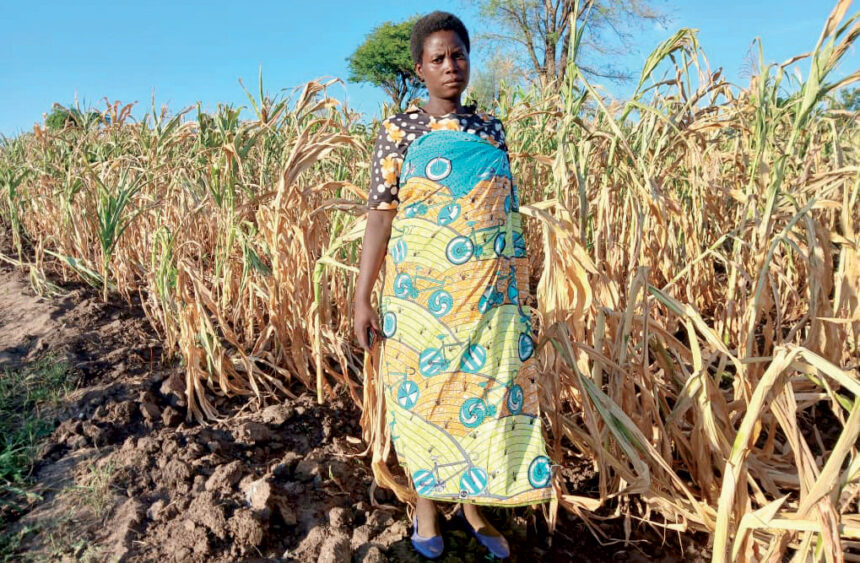
Tifabe Elias stands at the edge of her maize field in Mafuwa Village, in the area of Traditional Authority Ganya in Ntcheu District, watching a season collapse in slow motion.
The plants still stand, but they no longer promise life. Their leaves curl inward, conserving what little moisture remains, as if the crop itself has learned the hard lessons of scarcity.
Elias almost weeps, not loudly, not dramatically, but with the quiet devastation of someone who understands exactly what this loss means.
Just weeks ago, this field carried hope.
In December, the rains arrived on time and with generosity. Seeds germinated evenly. The maize shot up green and confident.
- Advertisement -
For a smallholder farmer like Elias, whose livelihood depends on a single rainy season, this was more than agriculture. It was assurance: of food on the table, of school fees paid, of survival.
Then the rains stopped.
For three critical weeks, at the tasseling stage when maize is most vulnerable, the skies remained stubbornly blue. The soil hardened. The plants wilted. And with that dry spell, an entire harvest quietly slipped away.
“It’s very sad,” Elias says, her voice flat with disbelief. “We will not even get maize to boil and eat. I am devastated.”
- Advertisement -
- Advertisement -
Her words echo far beyond Ntcheu. Across 19 districts of Malawi, farmers are confronting the same quiet catastrophe.
On January 31, 2026, the Department of Climate Change and Meteorological Services issued a dry spell advisory, warning that southern Malawi had already experienced a prolonged break in rainfall and that forecasts suggested at least another week of dry conditions.
The list of affected districts – Chikwawa, Nsanje, Blantyre, Thyolo, Mwanza, Neno, Zomba, Phalombe, Mulanje, Balaka, Machinga, Mangochi, Salima, Dedza, Ntcheu, parts of Lilongwe, Mchinji, Dowa and Ntchisi – reads like a roll call of national vulnerability.
Farmers were advised to conserve soil moisture and use irrigation where possible.
But that advice assumes something Malawi has systematically failed to build: stored water.
The tragedy here is not simply drought. It is missed opportunity.
Just weeks earlier, Malawi had an abundance of rain. Water surged across fields and homesteads, overwhelming drainage systems and spilling into rivers.
And, as always, it flowed away. None of it was captured.
In a country increasingly defined by climate extremes, floods followed by dry spells, this pattern has become dangerously familiar.
Malawi swings between too much water and too little, yet invests remarkably little in the one strategy that could soften both blows: rainwater harvesting.
Rainwater harvesting is the deliberate capture and storage of runoff from roofs, yards, and other surfaces for later use.
It can be as simple as a barrel beneath a gutter, or as sophisticated as large cisterns supplying households, gardens, and small-scale irrigation.
In many climate-vulnerable countries, it is a first line of defence, a disaster risk management tool as much as a water supply solution.
In Malawi, it remains marginal.

Agriculture commentator Leonard Chimwaza says Malawi has a Disaster Risk Management Strategy that provides guiding principles for preparedness and responsiveness to disasters.
According to Chimwaza, the existence of this policy is an acknowledgement that climate change-related disasters are here to stay.
“The only solution to these repeated disasters (dryspell, floods etc) is to implement resilient measures amidst them. There is need for a holistic / multisectoral approach in planning and implementing the disaster risk management plans.
“Early warning systems are vital in the development of disaster mitigation plans hence need for total adherence,” Chimwaza says.
He notes that rainwater harvesting technologies are among the best solutions for reducing the impacts of dry spell and floods.
“We need to have a policy in rain water harvesting so that proper financing models and strategies are developed.
“We need structures to capture, store and retain water which can be used in many ways. We need deliberate policies or acts to support disaster mitigation,” he says.
Another agriculture expert, Tamani Nkhono Mvula, says Malawi is not helpless when it comes to hedging against dry spells, noting that various policies already contain solutions to such challenges.
He acknowledges, however, that the main challenge has always been the implementation and prioritisation of investments.
“We are too short-sighted in terms of our investment. We don’t want to solve the problems that may come three or four years from now and solve them forever. Instead, we want to deal with the current problem, which we are failing to address decisively.
“I think investment in irrigation and investments in agricultural diversity are things that we should be seriously looking into,” Mvula said.
He observed that rainwater harvesting is a viable option.
He however added that rainwater harvesting has its challenges, as it may require farmers to construct reservoirs, which would need additional resources.
Speaking ahead of the Rainwater Harvesting Association of Malawi (RHAM) National Conference in November, the association’s chairperson, McPherson Nthala, framed the issue starkly.

Malawi, he said, is sitting on an untapped lifeline, one capable of protecting millions from chronic water shortages, crop failure, and climate-induced disasters.
Despite the country’s capacity to capture billions of litres of water each rainy season, Nthala noted, Malawi continues to suffer from extreme water variability.
Two decades of field experience, he argued, show that simple, low-cost technologies can keep crops alive during dry spells and provide water for domestic use long after the rains stop.
What is missing is scale and political prioritisation.
Instead, Malawi has doubled down on rain-fed agriculture, tying national food security almost entirely to the mood of the clouds.
Year after year, vast sums are poured into subsidised fertiliser programmes, interventions that assume rainfall will cooperate.
The investments are staggering, but often exposed by the dry spell. It shows that fertiliser cannot compensate for the absence of water.
Agriculture and Irrigation Minister Roza Mbilizi says irrigation has been identified in the DPP manifesto as a core function of her ministry.
The government, she says, is taking stock of Malawi’s estimated 80,000 hectares of irrigable land, with plans to use it for both seed production and food crops.
That is an important step. But irrigation schemes take time, capital, and institutional capacity. Rainwater harvesting does not require mega-projects or distant timelines.
It requires gutters, tanks, small dams, and a shift in mindset, from reacting to disaster to managing risk.
For farmers like Elias, the debate is no longer academic. She does not speak in the language of climate adaptation or disaster risk reduction.
She speaks in the language of loss. Standing in a field that once promised life, she is witnessing a failure that goes beyond weather.
The rain came. Malawi watched it run away.