






By Kennedy Gondwe:
Despite having the mighty Zambezi River and the vast Kariba Dam, Zambia is currently facing one of the worst electricity blackouts in its history.
Cities and towns across the country are sometimes left without power for up to three consecutive days, with residents feeling lucky if they get an hour or two of electricity.
This power crisis has come as a shock to the 43 percent of Zambians who have relied on electricity all their lives.
- Advertisement -

But one of the severest droughts in decades—caused by the El Niño weather phenomenon—has decimated Zambia’s power-generation capacity.
- Advertisement -
Nowadays, I sometimes go to bars and restaurants to find people not eating or drinking—they are there just to charge their phones amid the pounding noise of generators.
There is also a booming business of people making money by charging the phones of those without power.
Zambia sources up to 84 percent of its electricity from water reservoirs such as lakes and rivers, while only 13 percent comes from coal.
Contributions from solar, diesel and heavy fuel oil are even lower, accounting for three percent.
- Advertisement -
For several weeks, the crisis was compounded while the country’s only coal-fired power plant, Maamba Energy, was not operating at maximum capacity as it underwent routine maintenance work.
On Wednesday, there was finally some good news when Minister of Energy, Makozo Chikote, said the plant was now fully operational, and Zambians would have at least three hours of electricity a day.
President Hakainde Hichilema declared the drought a national disaster in February but the government has been unable to solve the energy crisis because Zambia is heavily reliant on the Kariba Dam for its electricity.
A financial crunch also severely restricted the government’s ability to import power as suppliers wanted payment upfront, though a spokesman for state-owned power utility Zesco, Matongo Maumbi, told the BBC’s Focus on Africa podcast that electricity was being imported from Mozambique and South Africa to ease the crisis, especially in the mining industry – Zambia’s main export earner and source of foreign currency.
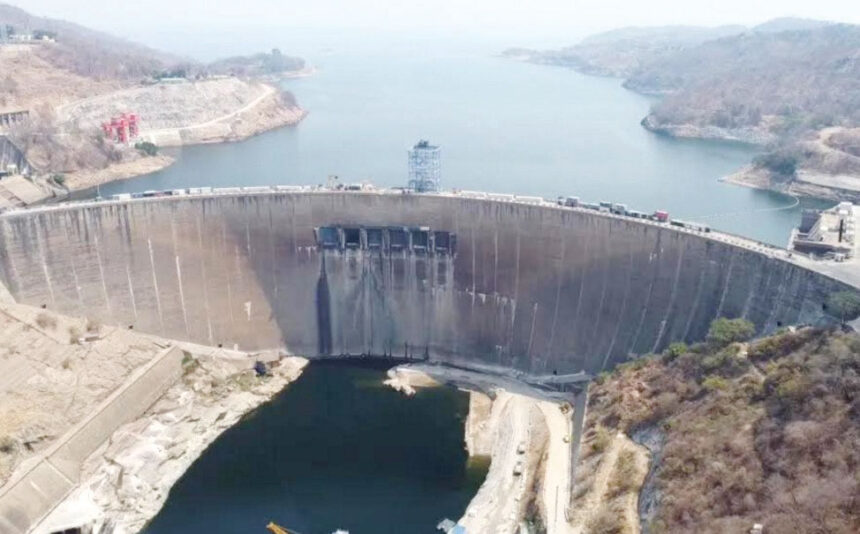
Located on the Zambezi, the fourth-longest river in Africa, Kariba was built in the 1950s and is the reservoir for the country’s largest underground power station, Kariba North Bank Power Station. A power station on the other bank serves Zimbabwe.
But because of the drought that has led to parts of the river drying up, only one of the six turbines at Zambia’s power station is operating, resulting in the generation of a paltry seven percent of the 1,080 MW installed at Kariba.
The dam retains the water of the Zambezi with a curving wall that is 128m (420ft) high, 579m (1,900ft) long and 21m (69ft) thick.
Engineer Cephas Museba – who has been working for Zesco for 19 years – says he has never seen water levels so low at Kariba.
“I think we stopped receiving the rains as early as February. It is supposed to rain up to April. If we compare the history of this basin, this is the lowest we have received,” he told me.
It has triggered an electricity crisis that is being felt in every business and home.
Some companies are opening for fewer hours, and retrenching staff.
It can even be difficult to find bread – bakeries are making fewer loaves because they find it too expensive to keep generators running.
Fortunately, the government has installed huge generators in some markets, government offices and hospitals, though stories are still being shared on social media of how kidney patients are struggling to cope.

Some patients need to be hooked up to a dialysis machine for up to three hours a day but power only gets restored for about an hour or two, sometimes after midnight.
On other occasions, there is no electricity at all for 72 hours in a row.
On those days, I wear the same clothes as the previous day, rather than a washed but wrinkled shirt that has not been ironed.
Life has become more difficult for everyone.
One day recently, I woke up to be greeted by a foul smell as blood flowed from under the fridge.
All the meat we had bought had gone off and we had to give it to our German Shepherd dog, the happiest member of our household these days.
The other day I bought relish from a supermarket – but when I opened the package at the dinner table I realised that it was more food for our dog.
My food budget, already tight because of the cost-of-living crisis, is now even tighter. Buying perishable items in bulk at a cheaper price is completely out of the question as they will just rot.
The government has been encouraging homes and businesses to switch to solar, and has scrapped import taxes for solar equipment to make it cheaper to buy.
But some people say their solar panels do not generate enough electricity when there is little sunlight – and they cannot afford to install more panels. Most Zambians cannot afford solar panels at all.
Now, many families have resorted to cooking and heating water on portable gas stoves – but shops have been running out of gas too because of high demand.
So in desperation and because it is cheaper, they buy charcoal to cook and heat water – despite its negative impact on the environment and the climate.
The electricity crisis has also had an impact on the boreholes that middle-class families have dug on their properties.
As boreholes work with electricity and solar-powered pumps, homes are now also without a constant supply of water, making it impossible to even flush the toilet.
In some schools, children are advised to take five litres of water each day to reduce the possibility of a sanitation crisis – and the outbreak of waterborne diseases like cholera, which hit the country at the start of the year.
Many families now fill buckets – or bath tubs – with water, hoping it will last until the lights are back, and toilets can be flushed.
All of this has left Zambians frustrated and angry. They point out that the blackouts highlight the failure of successive governments to plan ahead – something that President Hichilema’s administration has now pledged to do.
Mr Maumbi said that Zesco was investing in more energy sources, including solar plants, so that dependency on hydro-power falls to around 60%.
But Zambia’s focus is not only on green energy – coal is also in the mix.
In July, the energy regulator approved plans to build only the country’s second coal-fired power plant.
It is the dirtiest fossil fuel, producing the most greenhouse gases when burnt, but the government feels that to avoid a similar crisis in the future, it has little option but to press ahead.—BBC