





By Charles Mpaka:
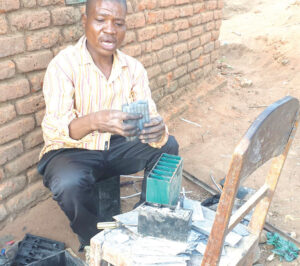
Outside his tiny, mud-brick shop along a dusty and busy street in BCA Township in Blantyre, Lagson Gumbo sorts pieces of plates he has retrieved from expired lead-acid batteries.
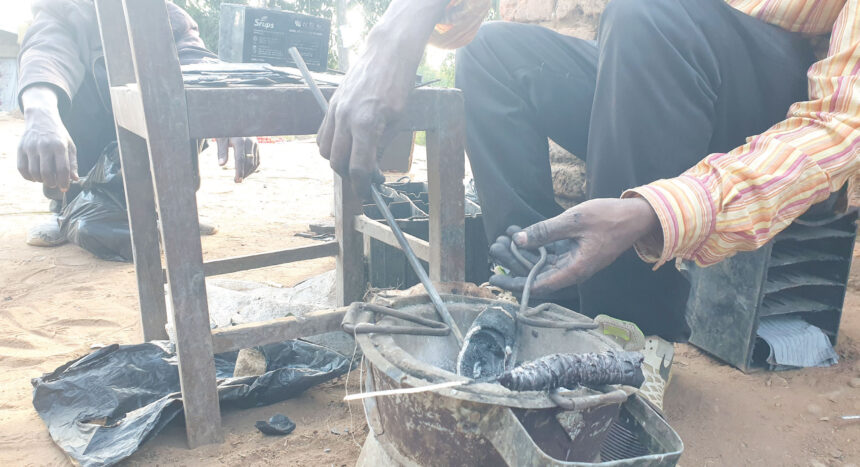
Before him is a smoldering charcoal stove and a plastic bag containing lead also extracted from batteries.
He puts the lead in a small tin container, pours acid chemical on it and heats the contents on the stove. This is part of the process of making new cells for dysfunctional batteries. Out of this he will make new electrodes for the batteries.
- Advertisement -

“These pieces were positive cells in the batteries,” he says about the battery plates he’s laid out on a small work table. “When a battery stops functioning, it is not the negative electrodes that have expired. It is the positives. So we remove the positive cells, fix them and restore the battery to life.”
- Advertisement -
Gumbo is among scores of self-made technicians found in high-density settlements and rural trading centres in Malawi and Sub-Saharan Africa who are remanufacturing expired lead-acid automotive and off-grid solar systems batteries.
However, their methods pose serious dangers to the ecosystems and human health, according to a research published in ScienceDirect in April.
The study finds that informal off-grid solar battery waste management practices like Gumbo’s are causing life-threatening quantities of lead pollution in Africa.
In the research, scientists from the University of Manchester in the United Kingdom found that such methods can release lethal volumes of lead doses into the environment from one battery and can cause impacts exceeding that of diesel generators.
- Advertisement -
Conducted in off-grid communities in Lilongwe, the study evaluated the lifetimes of batteries in photovoltaic systems which people are using.
It also assessed collection of materials through the informal scrap market, open dumping and burning of battery waste material and the informal recycling processes.
The scientists found that recyclers use rudimentary techniques and readily available tools to fabricate functioning batteries from used battery scrap. The battery remanufacturing process involves melting lead scrap, crushing positive battery plates and making improvised cells. The waste is then disposed into the local environment.
“A significant amount of lead was lost to the environment as dust or shrapnel from the moment the degraded lead cells were removed from the battery casing and throughout every stage in the recycling process,” finds the study.
According to the researchers, batteries used in off-grid systems in Malawi have a short life span of no more than one year as compared to 3 to 5 years of the expected lifetime. This results in rapid accumulation of waste –against unavailability of formal recycling processes – and heightened environmental contamination.
“Achieving extended battery lifetimes of three years combined with formal recycling can mitigate the toxicity of the current waste management practices and avoid excessive greenhouse gas emissions from these practices,” the study says.
Sub-Saharan Africa has become a vibrant market for off-grid solar systems due to low electricity access which stands at only about 42 percent. In Malawi, over 15 million people out of nearly 20 million live out of reach of the main electricity grid, according to the Malawi Renewable Energy Strategy.
To increase access to electricity, countries in the region are investing in solar home systems. In the case of Malawi, alongside private sector and non-governmental organisations projects, distribution of solar systems is among the initiatives under the Malawi Rural Electrification Programme (Marep).
Between 2019 and 2020, Marep electrified over 20,000 households in selected districts using solar home systems.
As rollout of off-grid solar systems rises, Gumbo’s business is booming.

Early in his 14-year-old career, he used to have batteries from cars and motorcycles only. In the last 10 years, he has seen a surge in solar system batteries at his shop such that he receives four or five such batteries in a week to fix, charging around K15,000 per battery “depending on the complexity of the work”.
The key tools of his open-air factory are basic: knives and pliers and screwdrivers to split batteries open, a blade of metal for scraping and scooping lead out of the batteries and a charcoal stove for smelting parts and heating the lead.
According to the study, these informal lead-acid battery remanufacturing processes release about 48 percent of a battery’s lead content into the surrounding environment, presenting “severe localized health risks and potential adverse effects on environment”.
It says off-grid systems present a pollution challenge in Africa particularly because the market is not regulated to enforce high standards of products being distributed.
Secondly, marketing of the products relies on low-income communities who can only afford substandard, counterfeit and short lifetime equipment. inadequate knowledge of design, installation and operation of these systems.
Together, these result in frequent system failures and rapid accumulation of waste.
An earlier study by the same researchers, published in August 2022, found that widespread adoption of off-grid solar products and their short lifetimes have resulted in rapid increase in waste volumes across Sub-Saharan Africa. In 2020, the region generated an estimated 12,000 tonnes of waste from off-grid solar systems. This was a 545 percent increase from 2016.
While electrical and electronic waste is accumulating, many countries in the region have no physical or legislative infrastructure to manage it, with South Africa and Kenya among the few that have lead-acid battery recycling facilities to prevent pollution.
In Gumbo’s BCA location, residents dump waste in gullies and any other site one finds convenient because the town does not have a formal waste management system.
Christopher Kinally, lead author of the study and post-doctoral researcher at the University of Manchester, says in these photovoltaic systems, lead-acid batteries are the most toxic component, compared to other parts which have long lifetimes and can be repaired easily without generating much waste.
He says while there is currently lack of adequate research to reveal the full scale of the impact that lead contamination has on living organisms in surrounding ecosystems, the bioaccumulation of lead in the food chain is a significant concern.
According to Kinally, with safe lead-acid battery recycling facilities, photovoltaic systems are a promising way to increase access to electricity in Africa.
“The market for photovoltaic systems is already very established and embedded into societies across the region. Therefore, the focus should be to support the solar market with the regulation and waste management infrastructure necessary to prevent environmental and health burdens,” he says.
Shanil Samarakoon, a research associate on energy and environmental markets at the University of New South Wales in Australia, says the findings of the study highlight “the broader energy injustice of placing deep reliance on households to provision their own sources of electricity”.
“Within this context, the environmental harms that flow on from the necessary mass adoption of these products – to alleviate energy poverty – represent a form of injustice. One that has negative impacts across species and generations,” says Samarakoon who has also conducted studies in Africa, including Malawi, on off-grid solar systems.
Ideally, subsidizing larger and more durable systems for household use would translate into greater social impact in productive uses of solar power beyond lighting and phone charging, he says. This would also help reduce waste that is accumulated through the replacement rate of successive small-scale solar products.
“However, this form of transition planning appears to grate against the impulses of market-driven solutions, which trade on increasing margins and sales volumes,” says Samarakoon who was not part of the study.
He suggests increased investment in public education on the use and maintenance of solar systems, “as well as nurturing a repair economy to provide livelihoods for technicians as well as extend the productive life of products which would reduce waste accumulation.”