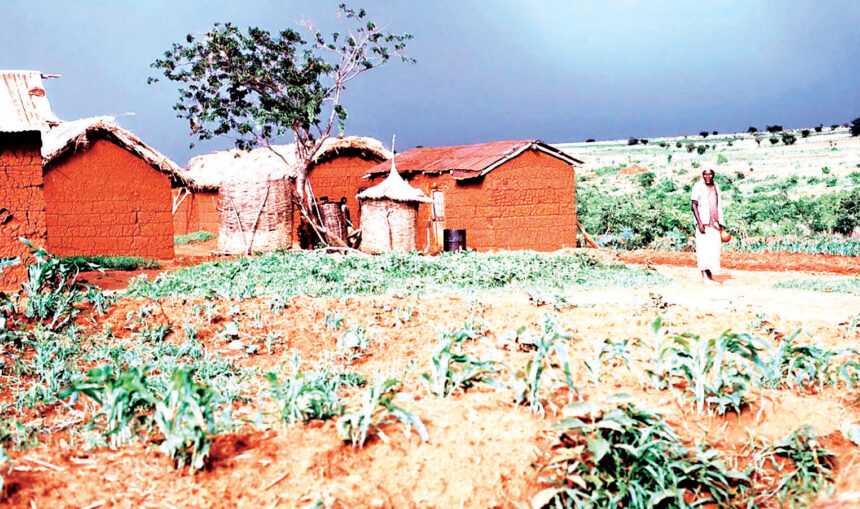
The sun is slowly drifting down beyond the hills on the western side of Nsanje District’s border with Mozambique, casting a fiery light over a school and villages near the western banks of the Shire River.
John Kambalame is a typical farmer, born and raised in the remote village of Chididi in Nsanje District.
Each day, he rises with the sun, the rooster’s crow echoing through the hilly fields as he prepares for another gruelling day of work.
He relies on the land for survival, yet even in this peaceful part of the world, the weight of life feels heavy.
Like many farmers in Chididi, Kambalame faces an unrelenting struggle against the high cost of living.
- Advertisement -
The prices of seeds, fertiliser and tools rise every year, while the income from his crops seems to shrink.
The maize and sorghum that he grows on his small piece of land are enough to feed his family, but there is rarely anything left over to sell.
“Life is an everyday struggle. In our country, the rich are getting richer while the poor, like me, are getting poorer. It makes me feel that all talk about economic equality is meaningless,” he grumbles as he lifts his hoe onto his shoulder.
Kambalame often bargains with local market vendors for food, knowing that the money spent on essentials— like maize flour and soap—could be used for something else, such as repairing his children’s school uniforms.
- Advertisement -
- Advertisement -
The price of cooking oil has skyrocketed recently and even other groceries have become more expensive.
“We no longer use cooking oil often. It is something we can only afford once in a while,” he says.
Kambalame’s family, like so many others in Chididi and across the country, is trapped in the grip of relentless economic pressure.
Despite collecting taxes from people like him through the goods he purchases, the government has provided few meaningful social services.
There is no public health centre nearby, so when someone falls ill, they must travel several hours to the nearest hospital at Nsanje Town Centre, often at huge expense.
The health centre close to their location is privately funded, owned by a church and operated under the Christian Health Association of Malawi.
Only minor services are available free of charge, through an agreement with the government.
“To us, there is no equality in the world. It is often painful to see rich people making laws that burden us further,” Kambalame says.
The Centre for Social Accountability and Transparency (Csat), with financial support from Oxfam Malawi, is mobilising people like him to demand greater accountability from the government, particularly regarding pressing socioeconomic issues.
Csat argues that the poor are often sidelined when it comes to economic policies and laws that directly affect their lives.
The organisation stresses the importance of engaging with those in power, especially for those most affected by taxes and other policies.
“Policies and laws designed by authorities, such as Members of Parliament and government officials, must not impinge on the rights of the poor.

“Taxes should not disproportionately affect those who are already struggling. We need policies that are fair, transparent and reflective of the realities on the ground,” Csat Executive Director Willy Kambwandira says.
He adds that Csat’s focus on these issues stems from its belief that citizens should have a say in the policies that directly impact their financial stability.
Kambwandira draws attention to Davos Week, the annual meeting of the World Economic Forum in the Swiss town of Davos, running from January 21 to 26 for this year.
During this week, participants engage in discussions, keynote speeches and panel sessions covering topics such as climate change, technological advancements, global health, inequality and economic policies.
“On economic policies, we hope Malawi can reflect deeply to reduce the gap between the rich and the poor.
“While we understand that the government needs more resources, it is also important to address poverty and inequality. The gap between the rich and the poor continues to grow,” Kambwandira says.
He stresses that authorities and civil society organisations must ensure that those affected by socioeconomic disparity are active participants in the change they wish to see.
“We are urging policymakers and lawmakers to ensure that the laws and policies being developed are favourable to the poor,” Kambwandira says.
Csat warns that the growing wealth gap perpetuates the cycle of poverty, limits social mobility and threatens stability, as the likelihood of protests, crime and other forms of unrest rises.
In its messages, Csat calls on Malawians, particularly women and youth, who are often most impacted by poor policies, to push for the implementation of laws that address the needs of the most vulnerable.
“They can advocate for policies that align with human rights principles and meet the needs of the poor,” the organisation says.
It insists that people like Kambalame must not be overlooked.
“They deserve protection, starting with laws that ensure they are not further punished by taxation,” Csat says.
For Kambalame, there is hope that one day, his rights will be respected and public policies and laws will no longer push him to the brink of despair.
He says that although promises of a better life have always been just that—empty words— when more poor people speak with one voice, change is possible.
“There are systems designed to keep people like me trapped in poverty. But we are gaining more motivation to fight on,” he says with resolve.