Neno has faced severe deforestation in recent years, with its once-lush landscapes now reduced to arid patches due to activities of charcoal producers.
The charcoal is primarily used by urban residents in Blantyre City, where most of the dirty fuel source from Neno is consumed.
“The trees are gone. We are grappling with problems caused by environmental damage,” Village Head Joliji, whose area now boasts a burgeoning communal forest, says.
He acknowledges that recent years have seen a dramatic decline in Neno’s forest cover, which was once renowned for its biodiversity and scenic beauty.
Malawi is experiencing massive deforestation, losing approximately 30,000 to 40,000 hectares of forest cover annually.
- Advertisement -
In rural areas, the situation is particularly dire, with vast areas of forestland being cleared for farming and charcoal production.
“It has been a troubling trend; trees are disappearing faster than they are growing. What remains now starkly reminds us of what we have lost,” Joliji, 55, says.
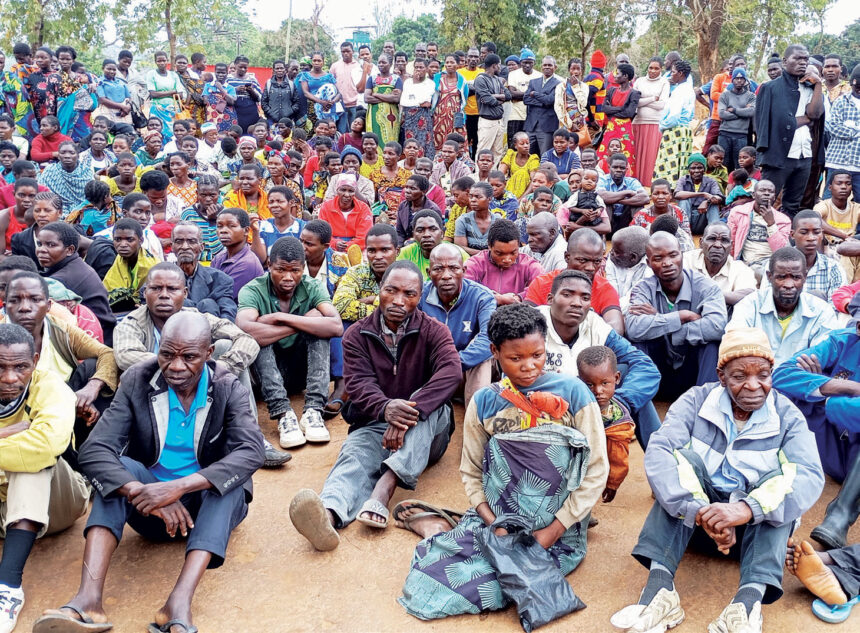
We meet him at Chikonde Model Primary School at Neno Town Centre, where he and other members of Chiwale Catchment are receiving their payments after a month of conservation work.
They are part of the Climate Smart Enhanced Public Works Programme (CS-EPWP), which aims to restore degraded landscapes and improve community livelihoods.
- Advertisement -
- Advertisement -
“We work for our families and future generations. In many areas where trees were cut, they are growing back. We are focusing on riverbanks, hills, crop fields and backyards,” Joliji explains.
He has received his monthly payment of K38,400 and hopes it will support his children, who are returning to school after the holidays.
The traditional leader admits that, despite being paid for conservation work, they are the greatest beneficiaries of the programme.
“We have been heavily impacted by droughts and damaging runoff. So, the conservation efforts are genuinely beneficial to us,” he says.
Joliji also reveals that to demonstrate his commitment to conserving trees on Nanzanga Hill in his village, he had a man who was caught illegally cutting trees arrested.

He could not stand by while someone undermined the collective efforts to restore the once-green landscape.
“He was taken to court, convicted and fined for his crime,” Joliji says, a note of satisfaction evident on his face.
Another participant, Tereza Wackson from Donda IV Village in Traditional Authority Chekucheku, speaks enthusiastically about their conservation efforts.
Wackson, a widow, used to worry about raising her children alone.
She appreciates her involvement in the conservation work, noting that the money helps with school fees and materials for her Form 2 son.
“Since we work and get paid monthly, it feels like having a job. However, we hope the monthly payments can be increased,” she says.
In Neno, as in many other parts of Malawi, extensive deforestation has led to soil erosion, reduced water retention and diminished biodiversity, making agriculture increasingly difficult.
“Forests are crucial for maintaining ecological balance. Their loss disrupts local climates and ecosystems, leading to issues such as reduced river flows and soil degradation. The impact on food production is immense,” environmental conservation expert Fred Moto says.
He adds that many rural communities are experiencing a decline in quality of life, as trees that once provided fruits, nuts and medicinal plants essential to local diets and health have vanished.
Wackson agrees.
“The loss of trees means fewer resources for our health and well-being. That is why we are determined to restore them.
“Our regeneration efforts are already showing results and some forests are recovering,” she says, pointing to a hill on the southwestern outskirts of the town centre, which is turning green again.
“Trees are not just resources; they are life. If we do not act now, we will be left with nothing but memories of what once was,” she adds poignantly.

Neno District Commissioner (DC) Rosemary Nawasha urges recipients of the CS-EPWP payments to use the funds wisely.
She advises them to avoid spending the money on alcohol and instead invest it in ways that will benefit them in the long term.
The DC reflects on the district’s past, recalling its once-vast vegetative cover and rich biodiversity, which has been severely impacted by charcoal producers and loggers.
“Many areas are now prone to soil erosion. It is encouraging to see the locals recognising the issues and actively working to address them,” Nawasha says.
She explains that through activities such as afforestation, creating contour marker ridges and gully reclamation under CS-EPWP, progress is being made in reversing the trend.
Nawasha adds that the council is implementing various measures to curb illegal and irresponsible tree cutting to restore lost vegetation.
“We are working closely with communities and their leaders to discourage deforestation. Additionally, we conduct regular patrols in collaboration with the police and forest officers to prevent environmental damage.
“We have seen the community come together in ways we had not anticipated. People are more engaged, motivated and connected to their environment,” she says.
Programme Facilitator for CS-EPWP in Neno, Chrissy Kamanga, explains that the programme aims not only to restore the district’s natural environment but also to improve the participants’ livelihoods so they can afford basic necessities.
Kamanga adds that Neno District has 14,228 participants working across 14 micro-catchments, contributing to environmental restoration and other community-driven activities.
CS-EPWP is a component of the Social Support for Resilient Livelihoods Programme, implemented by the Malawi Government through the National Local Government Finance Committee.
It is financed by the World Bank and the Social Protection Multi-Donor Trust Fund.
Joliji and Wackson are pleased that their community initiative is revitalising land that had become unproductive as fields dried up.
“Before we started planting trees, our fields were suffering. Now, with added protection, we have more reliable harvests and healthier crops,” Wackson declares, her eyes sparkling with optimism.