By Jimmy Chazama:
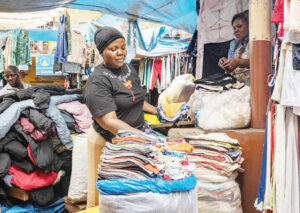
It is a Sunday morning at Chinamwali Market in Zomba District, where the air is thick with the voices of vendors and buyers haggling over second-hand clothes, locally known as kaunjika.
Amid the colour and commotion, two young men stand out, not for what they wear but for what they see. Their eyes are fixed not on the garments as they are but on what they could become.
Abdul Hafiz and his close friend Thokozani Katema, better known are transforming ordinary fabric into fashion worn by some of Malawi’s biggest music stars under the label Ma Set a (Smart) Clean.
What began as a modest hustle at the market has grown into one of the country’s most promising fashion stories.
- Advertisement -
Their journey started with just K6,000, used to buy second-hand clothes from Chinamwali Market. What many dismissed as scraps became the foundation of a rising fashion brand.
For Hafiz, the path to this moment was anything but smooth. Born in Machinga, he later moved to Zomba, where he met Katema. He failed his Standard 8 examinations, repeated the class and later enrolled at a private secondary school.
By 2021, he was in Zomba Rural before transferring to Zomba Islamic High School.
As a self-boarder, Hafiz survived by trading in kaunjika, buying clothes for K5,000 and reselling them at K8,000. His classmates nicknamed him ‘Happy Hour’ because of his habit of buying ordinary clothes from Dapp shops.
- Advertisement -
- Advertisement -
Unbeknown to many, those same clothes were sharpening his eye for design.
Katema’s story mirrors similar hardship. He dropped out of school due to lack of school fees, although his parents later embraced his passion for fashion.
The defining moment for the duo came when they admired a design worn by a Nigerian musician. After hiring a tailor who failed to deliver, they pleaded to use his sewing machine themselves.
What emerged caught attention. At first, their designs were ridiculed and their style mocked. But when celebrities began wearing their clothes, the laughter gave way to admiration.
Social media soon amplified their rise. Posting short videos on TikTok, they were surprised by the volume of views and likes their early clips attracted.
Encouraged, they continued sharing their work. Popular entertainment Facebook pages such as Mikozi and Umatha Daily later reposted their designs, significantly widening their reach. The growing online buzz translated into customers, turning digital attention into real business.
Today, Ma Set a (Smart) Clean has styled some of Malawi’s most popular artists including Black Nina, Zeze Kingston, Tuno, Malinga, Lady Aika and Trappy Beats. Their designs have also featured in music videos such as Black Nina’s Hello and Dyokhwe’s Mbuli Yotchena.
Musician Black Nina, known for hits such as ‘Anemwe’ and ‘Machenje’, praised the duo’s talent.
“It is interesting to see our fellow artists doing a great job in the fashion industry. Looking forward, I will work with them when I need them in my videos,” Black Nina, who is also an actor, said.
Celebrated artist Tuno, famed for ‘No One’ and ‘Munditenga’, described their work as distinctive.
“As musicians we are influencers and fashion is one of the areas we shape. Wearing designs created by Malawians is unique because it represents our identity rather than relying on clothes from abroad.
“These designers are talented, they create everything we wear in music videos and on stage and they are doing a great job,” he said.
Recognition soon followed. In 2025, Hafiz and Katema dominated the UMP Fashion Awards, scooping Fashion Designer of the Year, Best New Designer, Best Urban Streetwear Designer and Best Haute Couture Designer.
The accolades cemented their place as leading voices in Malawi’s fashion industry, marking their transition from kaunjika stalls to national prominence.

Director of Arts in the Ministry of Youth, Sports and Culture, Humphrey Mpondaminga, also described the duo as highly talented and in need of international exposure.
“Our youth need exposure beyond Malawi. They should be given opportunities to sell their products internationally as they have the potential to boost our creative economy. As a Ministry, we have structures in place to invest more funds in the sector to support artists including the duo,” he said.
Despite their success, Hafiz and Katema say their growth is limited by lack of equipment. They have appealed to government and organisations for sewing machines and materials.
“We can do more if we have our own machines and a proper place to work. Our dream is to establish a local company where celebrities and customers can easily access our designs,” they said.
Their appeal echoes recent pronouncements by the Ministry of Industrialisation, Business, Trade and Tourism, which has been rolling out interventions to support small and medium enterprises.
These include improving access to finance, easing collateral requirements and encouraging youth to form cooperatives to secure loans. Trade officers across districts have also been tasked with advising young entrepreneurs on how to tap into these opportunities.
The policy direction aligns with Malawi 2063, the country’s long-term development blueprint, which identifies youth as central agents of change and positions their economic empowerment as a catalyst for national transformation.
With more than 80 percent of the population under the age of 35, the creative industry is increasingly viewed as a driver of employment and cultural identity.
According to the National Planning Commission, small and medium enterprises account for over 60 percent of employment in Malawi, yet access to capital and equipment remains the biggest challenge for youth-led ventures.
In response, initiatives such as the Business Acceleration for Youth Project and the Youth Enterprise Development Fund have been introduced, particularly in districts like Zomba and Machinga.
For Hafiz’s mother, now based in Dedza, her son’s journey is deeply moving.
“I never imagined my child would reach this far. Seeing him help us with money and make a name in fashion is emotional and inspiring,” she said.
At just 22, Hafiz believes the lesson extends beyond fashion.
“Nowadays, money is a problem for many youths to finish school. It is about knowing yourself, seeing what you can do without school and exposing your talent. Think deeply, develop it and you can succeed,” he said.
Katema, 21, reflected on their journey with quiet resolve.
“We started with nothing but belief. People laughed at us but we kept going because we knew our designs could speak for themselves.
“Fashion is not just clothes, it is identity. If we get proper machines and space, we can show the world that Malawi’s style belongs on the red carpet,” he said.