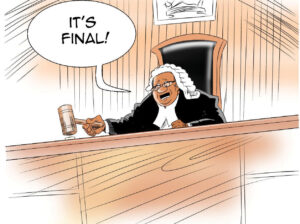
 A healthy and obviously emotive conversation is ongoing regarding the conduct of judicial officers in their duties in the wake of complaints that some decisions are unsound.
To begin with, it is imperative to recognise that judges, too, are human and can never be perfect, just like the rest of us.
Bearing that in mind, it is equally essential for them to acknowledge that they can make errors—or can be deemed to do so—and that, therefore, critiquing such errors must not be a crime.
For a long time, we have lived in a society that has placed judges on an aloof pedestal where everything they declare is taken as gospel truth and no one should question it.
Judges are crucial parties in interpreting the law, but, once again, they are human and subject to the same flaws and biases that any person can exhibit.
- Advertisement -
The raging debate on judicial accountability is simply augmenting what has been discussed before.
In fact, the fervent push for laws seeking to further reform the Judiciary is largely due to perceived incompetence and unprofessionalism among some judges.
The decisions judges make can have profound implications for individuals’ lives and the future of the country itself.
That is why the push for a Judiciary and judges who are fair and just must continue to make sense.
- Advertisement -
- Advertisement -
We have seen or heard about verdicts rendered by one judge being torn apart by others after an appeal, for apparently lacking legal substance and being based on wrong assumptions.
This, again, tells us that judges are not demigods who cannot err and therefore they must be subjected to all the necessary scrutiny available.
There have been clear instances where judges’ legal interpretations have been starkly influenced by their personal beliefs, biases and experiences, making justice a very unfair process.
Even when it is evident that a judge’s decision is unsound, we often choose not to openly critique it for fear of being punished if we end up before the same judge’s court.
In the closed circles of several professionals, including journalists and lawyers, discussions about the likelihood of certain judgements being influenced by bribes have taken place.
Of course, implicit conclusions have sometimes been made openly but not in a manner that clearly identifies someone as the initiator of the accusations.
It appears to be largely within academia, particularly in law schools, where judgments come under serious scrutiny and attendant flaws—including those clearly inspired by bribes—are exposed.
However, these analyses often emerge in the form of academic assignments that seldom find their way into the public domain.
Even where it is clear that a judge has limited expertise in an issue they are handling, leading to potential oversights, their shortcomings are often swept under the carpet.
The Judiciary has significantly opened up and all judgments are posted on a website where the general public can access them and draw their own conclusions about whether justice was indeed fully served in a particular case.
Still, the challenge remains that even when those who have accessed the judgments observe clear cases of injustice, there are few platforms where they can voice their concerns.
Some have expressed their discontent with certain judgments on social media but because society has held the belief for decades that judges do not err, important conversations about these opinions are often quietly stifled.
Ultimately, it is important for judges to be subjected to strict scrutiny just like any public officer. This, of course, should not interfere with their autonomy.
In fact, the existence of appellate courts demonstrates that lower courts can make decisions that, upon further review, may be found wanting.
Several judgements have been overturned by higher courts, signifying that it is never final—there is always more that can happen after a judgment has been delivered and there should perhaps be more that should occur even after the final court has rendered its verdict.
This could take the form of further public scrutiny, even though such scrutiny may not carry much weight if the final point to which a case could be taken has been reached.
Still, the strike of the hammer on the gavel should not imply the finality of justice. It should mean that justice is not a singular event, but a continuous process where a verdict opens the door to further questions.
The gavel’s authority should not be an end but a transition into more conversations about fairness and truth—a gateway to further inquiries.
No judgement should be final, essentially!