
President Arthur Peter Mutharika (APM) was born on 18 July 1940, which means he is 86 years old. At that age, he is certainly not a young man. Ageing brings with it realities that none of us can negotiate with, and health is one of them. This is not rocket science, nor is it witch-hunting. It is simply a fact of life.
We therefore need to be careful when discussing the issue pertaining to the President’s health. From a cultural, spiritual and umunthu perspective, every human being deserves dignity and privacy when dealing with personal matters, including illness. We should not turn somebody’s possible medical condition into political entertainment.
But there is a rather large “but”.
Professor Mutharika is not simply an 86-year-old Malawian man. He is the President of the Republic of Malawi and Head of State and Government. The government itself describes the presidency as the head of the Executive, with the President serving as both Head of State and Head of Government.
That distinction matters.
- Advertisement -
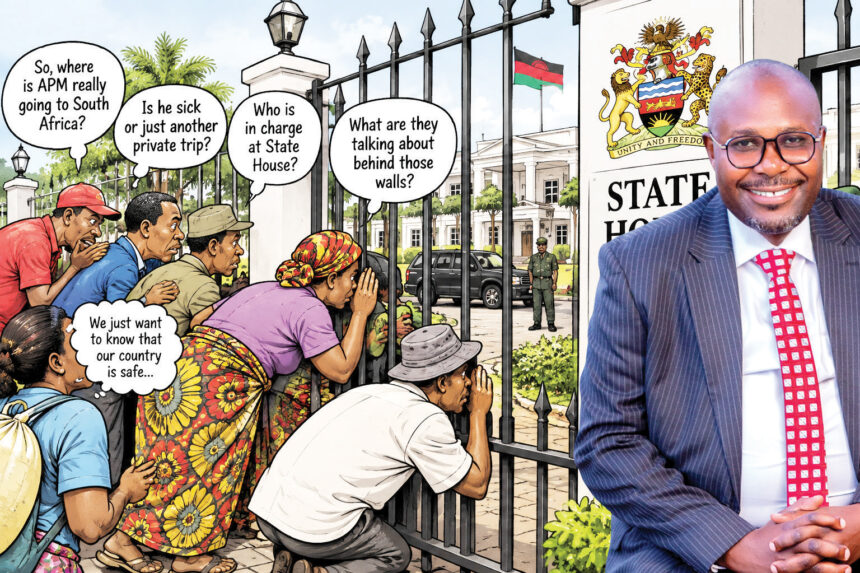
The President’s five private trips to South Africa have naturally attracted public attention. The government has consistently described these journeys as private and has not disclosed their purpose.
Now, let us be intellectually honest.
The public can ask questions about a pattern without being entitled to somebody’s medical file.
Those are two completely different things.
- Advertisement -
- Advertisement -
Malawians have every right to ask reasonable questions about the whereabouts and availability of their Head of State. The media has a legitimate role in reporting on presidential travel. But neither the public nor journalists should manufacture diagnoses, circulate rumours as facts or turn speculation into a national diagnosis.
Likewise, the government should not imagine that refusing to communicate creates a vacuum where nothing happens.
It does.
Rumours rush into empty spaces faster than a minibus rushing to fill a seat.
If government communication on presidential travel is too thin, people will fill the information gap themselves. Some will speculate about health. Others will speculate about politics. Others will speculate about succession. And some will simply invent stories.
That is why I have a concern about how the government communication machinery handles these private presidential journeys.
The issue is not that the government should announce what happens inside the President’s consulting room. That would be an unacceptable invasion of privacy. The issue is whether the government is communicating sufficiently to reassure the country that the affairs of State remain properly managed whenever the President is away.
There are at least three audiences the government must consider: Malawians, the international community and financial and economic actors.
Diplomatic partners need confidence that Malawi remains stable and that constitutional and governmental functions continue normally. Investors and financial-market participants watch issues pertaining to political and institutional stability closely because uncertainty can influence economic behaviour. And ordinary Malawians, who ultimately carry the consequences of economic and political uncertainty, deserve calm, mature and credible communication.
I have little sympathy for those who use a person’s health as ammunition for political warfare. There is something deeply unfortunate about celebrating another human being’s possible suffering simply because he happens to occupy the State House.
We should pray for the President’s health, whether we support his politics or oppose them.
At the same time, the government must understand that privacy does not mean creating a communication vacuum. There is a difference between protecting private medical information and protecting the public from unnecessary uncertainty.
And perhaps the most important point is this: Malawians have much bigger headaches.
They want a functioning economy. They want reliable electricity. They want fuel at filling stations. They want foreign exchange. They want affordable food. They want better roads and functioning public services. They want to wake up without wondering what economic crisis awaits them before lunchtime.
In such an environment, every unexplained presidential absence inevitably attracts more attention than it might otherwise receive.
APM can travel to South Africa whenever his private circumstances require it. That is his human right. But because he is President, his movements also have a public dimension.
The answer is therefore neither censorship nor sensationalism.
It is maturity.
The government must communicate responsibly. The media must report responsibly. The public must discuss responsibly.
We can respect APM’s privacy without pretending that the presidency is a private institution.
And we can a s k legitimate questions without inventing answers.
After all, President Mutharika is human. Like every human being, he can become unwell. Whether he is unwell or not is something we should not speculate about without evidence.
But the health of the President is not merely a political football; it is a matter of national interest.
And matters of national interest deserve something that Malawi desperately needs right now: less noise, more truth, and a lot more umunthu.