Malawi’s aspiration of achieving the Sustainable Development Goal of reducing maternal mortality to less than 70 per 100,000 live births by 2030 faces an uphill battle. BRIAN LIGOMEKA writes.
Sitting on the veranda of her house in Bangwe Township, Blantyre, 56-year-old Manesi Kamolo sheds tears as she narrates circumstances surrounding the death of her 17-year-old daughter.
The girl fell pregnant after being raped when she was returning from school, Kamolo says.
“The discovery of the pregnancy haunted her. She told me she never wanted to keep the pregnancy as she wanted to proceed with her education,” Kamolo explains.
She says one Wednesday night, she heard her daughter groaning in her room.
She rushed there and found her bleeding.
- Advertisement -
“I thought it was a miscarriage. It was at the hospital, after medical examination, where I learnt that my daughter had attempted to induce an abortion using some objects,” Kamolo says.
The girl died as healthcare workers were administering post-abortion treatment on her.
Kamolo wonders why the government outlaws the provision of safe abortion services to rape victims like her daughter, and only offers post-abortion treatment.
Kamolo’s daughter is not the only girl to die due to pregnancy-related causes in Malawi.
- Advertisement -
- Advertisement -
According to the Ministry of Health, for every 100,000 live births, 349 women and girls die due to pregnancy-related causes. Out of these maternal deaths, 18 percent are caused by unsafe abortions.
‘Staggering figures’
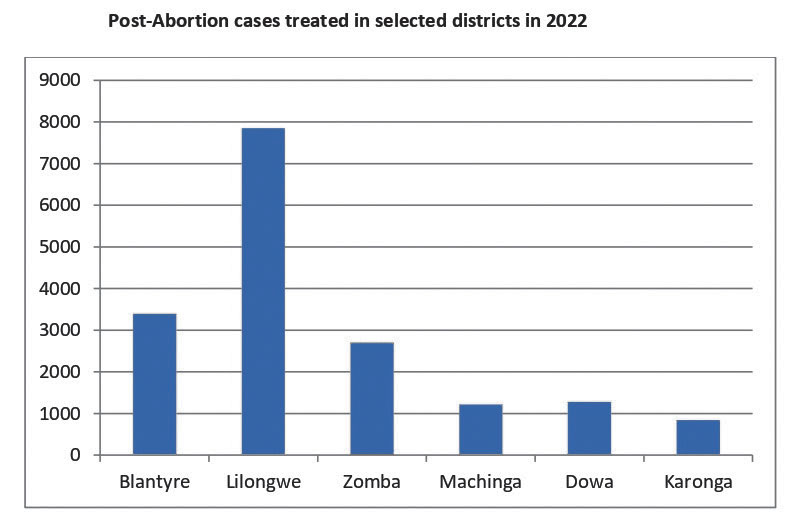
Data compiled by Ipas Malawi show that in 2022 alone 3,395 women and girls induced abortions unsafely and sought treatment at post-abortion clinics in Blantyre’s health facilities.
The increase in the number of those seeking post-abortion treatment is not unique to the district.
While health facilities in Blantyre provided post-abortion care to 665 women in 2020, the number rose to 1,144 in 2021 and to 3,395 in 2022.
The number of post-abortion cases was even higher in Lilongwe, which registered 1,098 cases in 2020, then 4,711 cases in 2021; and 7,851 cases in 2022.
The same trend is happening in districts such as Rumphi, which registered 327 post-abortion cases in 2020 and 448 cases in 2021, and 569 cases in 2022.
At national level, research conducted by the Guttmacher Institute and Malawi’s College of Medicine, now Kamuzu University of Health Sciences, showed that in 2015 alone, over 141,000 women and girls induced abortions in Malawi.
Reproductive health and rights activists attribute the upsurge in unsafe abortions to restrictive laws.
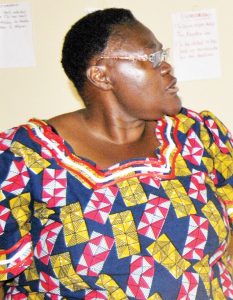
Coalition for the Prevention of Unsafe Abortion (Copua) Chairperson Emma Kaliya says it is the criminalisation of abortion in nearly all circumstances that pushes women and girls to seek unsafe measures to terminate pregnancies using risky means.
“Most of the time when women make up their minds to terminate unplanned pregnancies, barriers such as restrictive laws fail to stop them,” Kaliya says.
Way forward
Justifying the need for law reform on abortion, a foreword on the Report of the Law Commission on the Review of Unsafe Abortion reads: “For a long time, government has bemoaned the high prevalence of maternal mortality in Malawi and has identified unsafe abortion as one of the major contributing factors to this problem…
“In this regard, some commentators have faulted the restrictive law on abortion and the criminal sanctions that follow as contributing factors to the problem of unsafe abortion in Malawi apparently because women, for fear of the law, resort to clandestine and unsafe means to terminate unwanted pregnancies. Such commentators, including the Ministry of Health, called for a review of the law on termination of pregnancy.”
The government’s realisation of the magnitude of unsafe abortion resulted in the drafting of the Terminations of Pregnancy Bill as an effective response to maternal deaths caused by backstreet abortions.
Despite the process starting on a good note, with State actors such as the Ministry of Health and the Law Commission championing the abortion law reform process, gradually the government began growing cold feet as some religious leaders launched opposition to the process.
The reality of the problem remains and is conspicuous in the hospitals.
As the government dilly-dallies in the enactment of the bill, gynaecological wards are filled up with women and girls suffering, complications of backstreet abortions.
The emerging statistics of unsafe abortion mortalities and morbidities mock the government’s declaration that “no woman should suffer or die from complications of abortion in Malawi,” as is inscribed in the National Post Abortion Care Strategy.
The piecemeal solution in the form of post-abortion care for all women who suffer injuries during backstreet abortions is not adequate to prevent maternal deaths.
The draft abortion bill, which if enacted would allow women and girls access to safe abortion “to prevent injury to the physical and mental health of the pregnant women,” as well as in cases of severe foetal malformation, rape, incest and defilement, is gathering dust at the Ministry of Health offices.
Asked about prospects of the bill, Kaliya states: “In Malawi, all laws to do with women empowerment face stiff resistance and sometimes take years to be enacted.
“Patriarchal forces wearing the masks of culture, morality and even religion mount challenges to gender equality and equity reforms.”
Citing the Gender Equality Act, the Marriage, Divorce and Family Relations Act and the Prevention of Domestic Violence Act as some pieces of legislation that faced stiff resistance from dons of patriarchy in Malawi, Kaliya is still optimistic.
“Just as determination enabled us to push for the enactment of several gender equality laws, we will fight hard to ensure that the Termination of Pregnancy Bill is enacted. It may not be today or tomorrow but, one day, it will be enacted,” the long-time gender activist says.
But for Kamolo, the earlier the abortion law is liberalised, the better for women not to die prematurely from abortion-induced complications.
While Malawi has been reducing maternal mortality by addressing some causes, such as severe bleeding, infections, eclampsia and obstructed labour, it is yet to deal with unsafe abortions.