




By Serah Chilora and Feston Malekezo
The Office of the Ombudsman has given the Ministry of Agriculture a 14-day ultimatum to fix challenges that have marred the 2023-24 Affordable Inputs Programme (AIP).
It cites the unavailability of inputs, challenges to redeem inputs using national identity (ID) cards and unreliable network as some of the challenges it wants addressed.
In a letter dated December 20 2023— addressed to the ministry and Smallholder Farmers Fertiliser Revolving Fund of Malawi (SFFRFM) and signed by Ombudsman Grace Malera— the Ombudsman indicates that the two have been penned on the issue following AIP investigations the office conducted this month.
“In the course of spot checks, the Office of the Ombudsman has registered critical challenges that are hampering the effective implementation of the AIP. The challenges require immediate intervention by both the Ministry of Agriculture and Smallholder Farmers Fertiliser Revolving Fund of Malawi as key stakeholders in the implementation of the AIP,” the letter reads.
- Advertisement -
Office of the Ombudsman spokesperson Mandy Pondani confirmed the development.
“Kindly note that, since 2021, the Office of the Ombudsman launched systemic investigations into the implementation of the Affordable Inputs Programme following numerous complaints and concerns from the public and agriculture stakeholders. After completion of all the due processes, a report will be issued in due course,” she said.
The letter says a number of beneficiaries failed to redeem inputs as the system was showing that they had already redeemed their inputs and that other beneficiaries who had temporary IDs were being denied access to the inputs.
“It has [been] observed that individuals who do not have national identification cards but have the National Registration Bureau forms, commonly known as temporary IDs with barcodes, are being denied the opportunity to redeem their allocated farm inputs,” it reads.
- Advertisement -
- Advertisement -
In its investigations, the Office of the Ombudsman says it also found that the process has been marred by the problem of erratic network and poor transition of beneficiaries to non-beneficiaries.
“It has been established that some individuals whose names appeared on the beneficiaries’ list did not have farm inputs loaded on their cards, hence such cards generated invalid beneficiary error upon scanning their IDs.
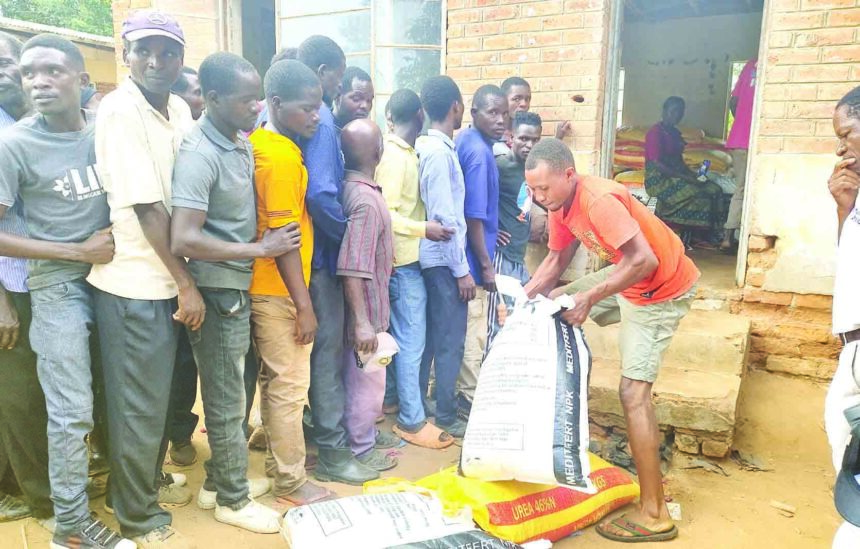
“The Office of the Ombudsman has also established that [there is] slow restock of considerable inputs, especially of Urea fertiliser, across all districts visited. This is worrisome and a cause for concern considering that, in some parts of the country, the rains commenced and that farmers are migrating into middle phases of crops[1]growing period,” it adds.
While indicating that he had not officially received the letter, Minister of Agriculture Sam Kawale said the letter does not contain anything new, indicating that his ministry pointed at such challenges at its November press conference.
He added that the issues are being handled. Kawale further said the ministry is being proactive in handling matters related to the programme as and when they happen.
“I wish they consulted [us because] almost everything has been addressed and [everything] is in the process of being addressed. There is nothing new that the letter is talking about; we already addressed some of these issues. We were the first people to point out those challenges and we addressed them. There is really nothing we can say because we were the first to point out those issues. We are proactive,” he said.
The Office of the Ombudsman conducted the systematic investigation in, among other districts, Zomba, Kasungu, Dedza, Ntchisi, Neno and Blantyre.
In a related development, Kawale disclosed yesterday that the government will not be able to meet the Christmas deadline it set to complete the distribution of fertiliser under AIP.
Kawale disclosed this at a press briefing in Nkhata Bay District, where he indicated that they have, so far, managed to supply 77 percent of the fertiliser under the programme.
Before yesterday’s announcement, Kawale had indicated— at a press briefing in Lilongwe— that, all things being equal, distribution of the inputs would be done by Christmas.
“(We will not manage) because all things have not been equal because Treasury has not funded us as planned, and we are still waiting,” he said.
As things stand, the government has to sweat to find forex for the purchase of 25,000 metric tonnes (mt) to cater for the remaining beneficiaries.
But how long will it take for the government to pay suppliers for the remaining fertiliser?
“That I cannot say because it all depends on the availability of forex. But we have been pressurising them to say ‘the rainy season is here; farmers have to plant; we are not supposed to go beyond December for the farmers to have access to the fertiliser’. So, they know the need; they know the figures and the urgency of the matter,” he said.
He added that they have since reached an agreement with Meridian—a group of companies that include Optichem, Farmers World and Malawi Fertiliser—to release 12,000mt whose distribution purportedly started yesterday.
Kawale also said they are waiting for 6000mt from Ifad, which, he said, would further narrow the remainder.
Meanwhile, Kawale has disclosed that the Anti-Corruption Bureau (ACB) is investigating 60 AIP-related cases.
He also said police have opened 15 cases involving 20 people who were, among others, asking for top-up money from AIP beneficiaries.
Early this year, ACB Director General Martha Chizuma said AIP-related cases have been inundating her office, vowing to take to book those involved in malpractices.
She said cases of some of the people engaged in AIP materials distribution continued to rise.
Meanwhile, Parliamentary Committee on Agriculture Chairperson Sameer Suleman has accused the government of failing to procure the required quantity of fertiliser within eight months, long after Parliament released funds for the programme.
“We gave them money in April when fertiliser prices were down; when there was no devaluation. They did not buy the fertiliser until now and now they are telling us that they are failing to buy the commodity. The President [Lazarus Chakwera] gave them a deadline and now they have failed to meet it, which is unfortunate,” he said.
However, Senior Chief Timbiri of Nkhata Bay District said yesterday that this year’s programme “is a bit better than that of last year”.
He said everything would have gone smoothly had it not been for delays to deliver fertiliser in time, citing NPK.
The government trimmed the number of beneficiaries from last year’s 2.5 million to 1.5 million.
“It’s only today that we have seen bags of NPK fertiliser after waiting for it. Maybe [we have seen the same] because the minister paid a visit to the selling point,” he said.
Out of the 1.5 million farming households, 1.49 million are expected to access two 50-kilogramme bags of NPK and Urea and a pack of seed each while 9,750 households will access two female goats each.
The farmers are supposed to contribute K15,000 for a bag and K3,500 per pack of seed.
Those accessing goats are paying K15,000 for each of them.