By Benadetta Chiwanda Mia:
The African Development Bank (AfDB) and the World Bank Group (WBG) have committed over $40 billion financing towards improving sustainable and affordable electricity access in Africa through the ‘Mission 300’ initiative.
This is a joint initiative by WBG and AfDB to increase electricity access to 300 million people in Africa by 2030.
Speaking at the Africa Heads of State Energy Summit in Dar es Salaam, Tanzania, AfDB President Akinwumi Adesina said access to electricity was critical for Africa’s economic growth.
“The African Development Bank and the World Bank will commit $40 billion towards Mission 300, of which $18.2 billion is from the African Development Bank and $22 billion [is] from the World Bank group,” Adesina said
- Advertisement -
He noted that the lack of adequate electricity reduces the GDP of Africa by 2 to 4 percent.
“The African Development Bank has supported over 25 million people to have access to electricity. However, despite the progress being made, Africa still has 571 million people with no access.
Adesina added that the number of people without electricity accounts for 83 percent of the global population without electricity, with over one billion people having no access to clean cooking solutions, which negatively impacts women’s health and children’s health and lives.
“Our collective effort is to support you, our heads of State and government, to develop and implement clear actions embedded in country-led national energy compacts to deliver on your visions for electricity in your respective countries,” he said.
- Advertisement -
- Advertisement -
World Bank Group President Ajay Banga highlighted the urgent need to address the energy gap for Africa to create jobs for youths.
“Over the next decade, 360 million young people in Africa will be ready to enter the workforce. That same decade, the African system is expected to offer jobs to 150 million of these, leaving three out of five young people without the opportunity of a job, which gives you not just earning but dignity,” Banga said.
At the summit, African heads of State signed the Dar es Salaam Declaration, outlining commitments and practical actions from African governments to reform the energy sector.
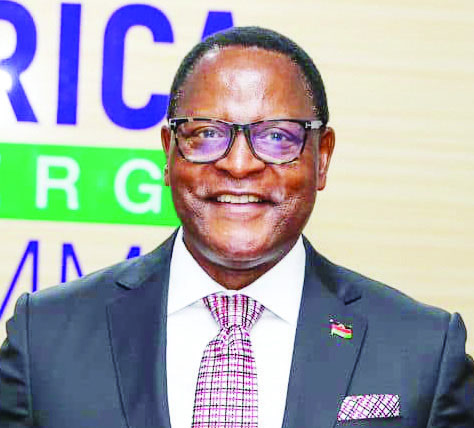
Malawi President Lazarus Chakwera emphasised the need for regional corporation towards meaningful investments in the energy sector, as the country is already making strides on the same.
“In Malawi, we have embarked on an ambitious journey to ensure energy access for all. Our National Energy Compact, aligned with the Africa Regional Compact and the United Nations Sustainable Development Goal 7, is a blueprint for transformation,” Chakwera said.
At the summit, the Government of Malawi has signed a $250.80 million grant from World Bank for the Accelerating Sustainable and Clean Energy Access Transformation (ASCENT) Malawi project.
The project is aimed to support Malawi increase access to electricity from 25 percent to 70 percent by 2030, as outlined in the Malawi 2063 vision.