
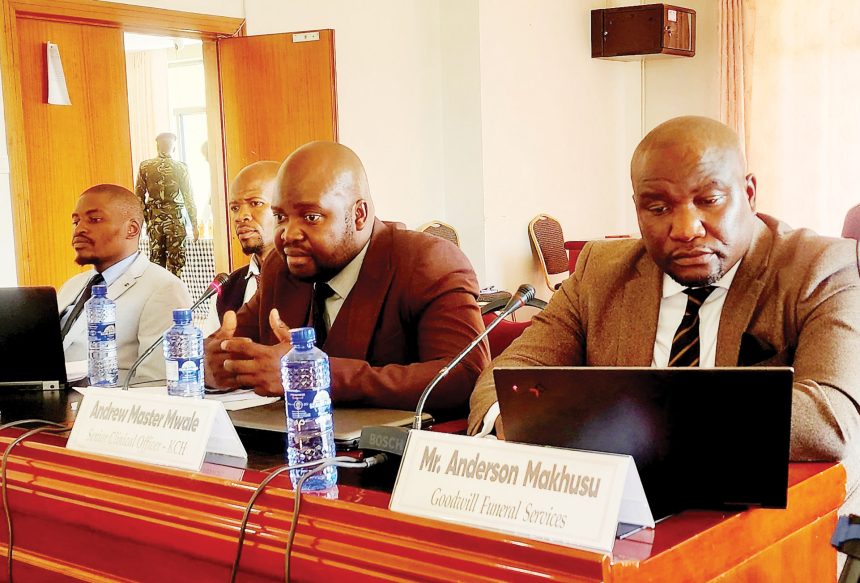
The disappearance of forensic samples and photographs collected during postmortems has raised serious questions about the credibility, transparency and completeness of the investigation into the June 10, 2024 plane crash that killed former vice-president Saulos Chilima and eight others.
The others who were in the plane are former first lady Patricia Shanil Dzimbiri, Ministry of Foreign Affairs deputy chief of staff Abdul Lapukeni, Chilima’s medical officer Dan Kanyemba, guard commander Lukas Kapheni, aide-de-camp Chisomo Chimaneni, operators of the aircraft, namely pilot-in-command Colonel Owen Sambalopa, second-in-command Major Flora Selemani- Ngwinjili and engineer Major Wallace Aidini.
The revelations, made during proceedings of the plane crash enquiry, have intensified concerns over how evidence was collected, stored and preserved following the tragic accident.
Senior medical officer at Kamuzu Central Hospital, Andrew Master Mwale, told the enquiry that he was surprised to learn that some of the forensic samples he had collected and stored at Sun Set Funeral Services could no longer be traced.
- Advertisement -

His revelation has raised concerns about the management of critical forensic evidence, particularly in an investigation where scientific examinations could help establish the identities of victims and clarify the circumstances surrounding their deaths.
- Advertisement -
“The disappearance of the samples raised questions, [especially] the fact that materials collected during such a sensitive investigation could go missing without a clear explanation,” Mwale said,
Mwale disclosed that eight bodies were kept at Sun Set Funeral Services, where security arrangements were reportedly inadequate compared to Goodwill Funeral Services, where Chilima’s body was kept under tight security.
Another concern pertained to the disappearance of photographs taken during the recovery and postmortems. Such photographs are important forensic records because they document the original condition, location and nature of injuries sustained by victims.
“Without these photographs, independent specialists could face difficulties reconstructing certain aspects of the recovery process and verifying earlier forensic observations,” Mwale said.
- Advertisement -
The enquiry also heard that substantial amounts of human tissue, including muscle tissue and a large fragment of backbone, were recovered by forensic teams.
However, some materials reportedly remain unaccounted for, including a large tissue sample believed to have belonged to Lapken.
Questions have also emerged regarding the identification of body parts believed to belong to Chilima, particularly an amputated leg and foot whose identity reportedly remained uncertain.
Mwale says the concerns make independent DNA testing increasingly important.
He said scientific examinations could establish whether recovered body fragments were correctly attributed to individual victims.
He proposed that laboratory examinations, potentially conducted in South Africa or Zambia, could include DNA profiling and forensic anthropology.
The enquiry also addressed controversial remarks describing Lapken as an extreme Muslim and suggesting possible links to terrorism.
Committee co-chairperson James Mpunga challenged Mwale to withdraw the description, particularly because allegations of terrorism had not been established through forensic evidence.
Mwale subsequently withdrew the allegations.”
“At present, the information presented does not establish that Lapken was involved in terrorism or that the crash resulted from deliberate sabotage,” mpunga said.
Medical observations presented during the investigation reportedly found no evidence of gunshot wounds among the examined remains. Instead, the injuries were consistent with extensive trauma, including severe fractures, traumatic amputations and fragmentation of body parts.
Meanwhile, Mwale has suggested that that Lapken’s remains should be exhumed to allow independent forensic specialists to conduct further examinations.