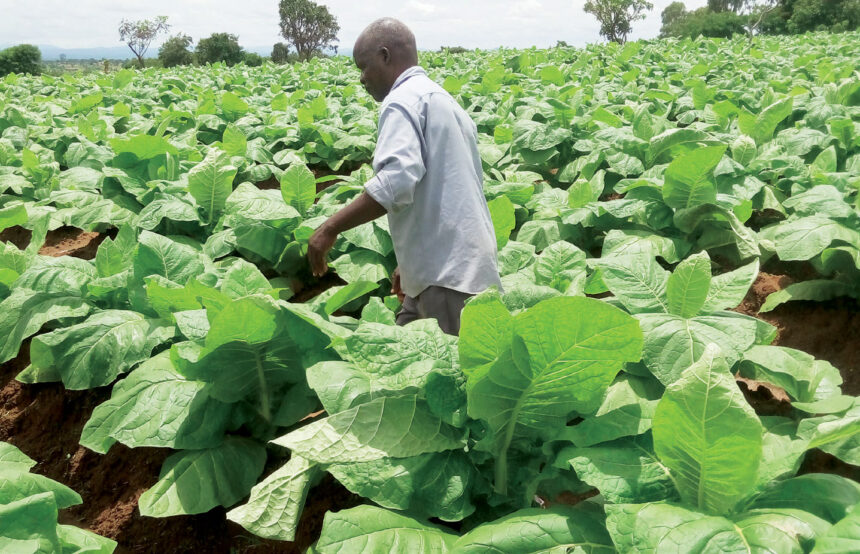
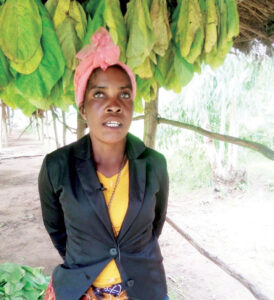
Ever since Margret Chikasima from Chiwengo Village, Senior Chief Wimbe, in Kasungu District deposited proceeds of tobacco Integrated Production System (IPS), also known as contract farming, into her bank account, she has never wanted to go back to the days when she could not be sure that her investment in tobacco farming would bear fruit once the crop reached the auction floors.
“I am talking of the time before I embraced IPS. I am talking of the time when I could produce tobacco on my own and sell it on my own, without signing any agreement with any tobacco buying company.
“The painful memory I have is about when I had nothing to eat and, yet, I had dozens of bales of tobacco in the house and dozens of other bales at the auction floors. Those were days of uncertainty as there was no guarantee that our tobacco would be sold, let alone sold at a reasonable price,” says the member of Tikondane Club.
The club’s members have a running agreement with Alliance One Tobacco, one of the tobacco buying companies in the country.
As part of the agreement, farmers that want loans for buying tobacco production-linked things are given loans.
- Advertisement -
“I believe that joining IPS is one of the best decisions I have made in my life. I, as a woman, have been economically empowered, such that I have bought a vehicle and constructed a house using proceeds of tobacco.
“Not only that. I have created job opportunities for others in that I employ five people. I usually employ workers in September and, in line with labour laws, pay them K50,000 per month or K1,923 per day, in line with acceptable labour practices,” she points out.
She is not the only one singing praises of IPS.
Backford Kadzakumanja—from Mbulanda Village Senior Chief Wimbe, Kasungu District—joined IPS in 2007, “and I have never regretted doing so at any point”.
- Advertisement -
- Advertisement -
He says once he was introduced to best practices, one of which prohibits those under IPS from employing children, the other one talks about fair remuneration, he has never looked back as he gets all the support from the tobacco production company.
“Among other things, I have been having a steady income from tobacco, such that I have managed to educate all my six children using proceeds of tobacco. One of my children went to Natural Resources College – now Lilongwe University of Agriculture and Natural Resources– one went to a technical school in Nkhata Bay, another one did tailoring, among other things.
“In have managed to buy four vehicles, including the one I have bought at K6 million this year,” Kadzakumanja says.
He adds that the policy that prohibits the engagement of children in farming has many advantages.
“For instance, instead of working in estates, the children go to school, thereby paving the way to a bright future. Again, because the children are not engaged in tobacco production, they do not get tired and use part of the evening to study, something that cannot happen when children are engaged in tobacco production because, by sunset, they are dead tired and cannot study,” Kadzakumanja, who is constructing a house using tobacco proceeds, points out.
The 63-year-old urges farmers who cultivate tobacco on their own to embrace IPS, saying those that produce tobacco on their own often follow short cuts that culminate in the production of poor leaf.
“And when the poor quality leaf attracts pitiable prices, they start complaining that tobacco buyers are being mean. That is not often true. Now the bad thing about poor quality tobacco is that it gives Malawi, as a country, a bad name.
“This does not happen with tobacco that is under IPS, as technicians employed by tobacco companies ensure that standards are being followed, a development that culminates in the production of quality tobacco,” the farmer, who has also embraced groundnuts farming, thanks to Alliance One Tobacco sister company Pixus Agriculture, says.
Kadzakumanja employs three workers and has constructed boys’ quarters that offer shelter to the workers and others.
“And, considering that last year’s prices were good, the future can only be bright,” he explains.
Other farmers are happy that, through IPS, they get fertiliser for both tobacco and maize— which Alliance One Tobacco and Pixus Agriculture promote as one way of promoting household and national food security—as well as pesticides.
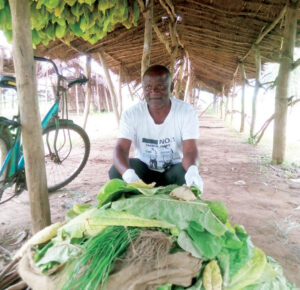
Another farmer, Samuel Mphandazaola of Kadzimete Village, TA Chilowamatambe, says he has transformed his life after producing 52 bales last year.
“Since I joined IPS in 2014, I have been having a fair view of how much I would earn from tobacco farming in a particular year. Because we agree on quality, and also agree to follow good practices, sales are easy and guaranteed. In the past, before I joined IPS, I endured periods when I had tobacco bales but they could not be bought.
“This is no longer the case. No wonder that in 2023, with the help of five workers I employ, we generated profits that will take us to the next tobacco sales season,” Mphandazaola, who says he now pays fees and buys laptops for children who are in tertiary education institutions, says.
He is a father of six.
“The other time, I bought a laptop worth K350,000 for my child, who is at one of the tertiary education institutions in the country. This is money I generated through tobacco production,” he asserts.
Enoch Tuzija, who is the chairperson for Chiwengo Alliance One zone and belongs to Umodzi Club, urges farmers who are yet to embrace IPS to do so.
He says, that way, they will benefit from the expertise of Bright Msokwa, who is the Alliance One Tobacco technician in the area.
What is happening in Kasungu has elated Ben Kaonga, Alliance One Tobacco Corporate Affairs Officer, who says the farmers could be singing praises of tobacco farming because IPS has taught them the correct way of doing things.
“Most importantly, we are happy that farmers are making profits. Farmers who have embraced IPS know fully well that whatever happens, all their tobacco will be bought. All we demand from them is that they follow the principles that we promote,” Kaonga explains.
Maybe that is how contracted farmers and those who, like stray bullets, do things on their own stand on opposite sides of the road to success.