





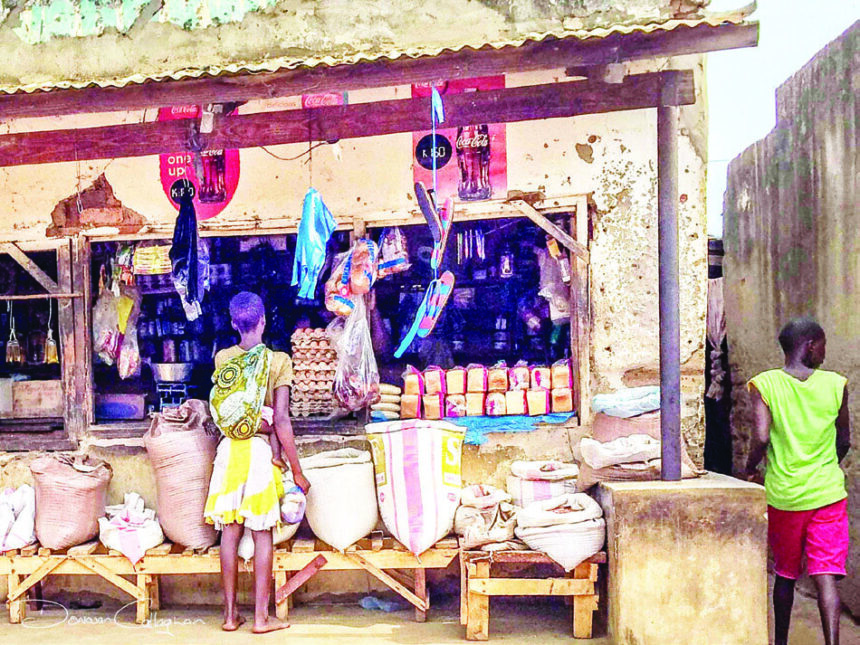
At Makata Market in Ndirande Township, Blantyre, Blessings Chitsalira carefully counts her money to buy food for her family of four.
Her budget is K7,000. With it, she hopes to buy the essentials for the day: tomatoes, vegetables, cooking oil, maize flour and relish.
Phiri says three bunches of small fish, at K1,000 each, are enough to cover lunch and dinner for the family. She also needs K3,000 for 1.5 maize flour, K1,000 for tomatoes, K1,000 for vegetables and another K1,000 for a tube of cooking oil. The total is K9,000, which is K2,000 more than what she has.
The items are already the bare minimum, yet the money is still not enough.
“Well, that is what I need for my family to eat today, but I will revisit my calculations and see what I am able to buy with what I have. Somehow it will be enough,” she said confidently, smiling like someone who has learned to survive on the minimal.
- Advertisement -
For many Malawians, this has become a daily reality, one of constantly adjusting household budgets to cope with the rising cost of living.
According to the latest Cost-of-Living Analysis Report by the Employers Consultative Association of Malawi, the total monthly cost of basic needs rose to K1.15 million in April from K1.06 million the previous month.
The figure remains far beyond the reach of most households, leaving many families in survival mode, forced to make painful compromises on food and other necessities.
At the same time, consumers’ purchasing power continues to shrink as high commodity prices persist, despite inflation showing signs of easing since the beginning of the year.
- Advertisement -
- Advertisement -
The government has set a target of reducing headline inflation—the rate at which commodity prices change at a given time in an economy—to 15 percent by the end of the 2026-27 fiscal year as part of efforts to restore macroeconomic stability and ease pressure on households.
Howeve, economists say the ambitious target will largely depend on Malawi’s ability to contain food prices, stabilise the exchange rate and manage rising energy and transport costs.
In its latest Economic Brief published on Monday, the Economics Association of Malawi (Ecama) says that although inflation has recently slowed, Malawi still remains among countries with the highest inflation rates in Sub-Saharan Africa.
The brief shows that inflation averaged 23.9 percent between 2021 and 2025 while year-on-year inflation declined from 27.7 percent in the fourth quarter of 2025 to 24.3 percent in the first quarter of 2026.
Ecama says achieving the 15 percent target will require coordinated action beyond monetary policy tightening alone.
“Monetary restraint alone cannot deliver the required disinflation. Easing production costs, stabilising the exchange rate, and managing administered prices prudently are all necessary conditions,” the brief reads.
According to the association, food remains the biggest driver of inflation, accounting for 53.7 percent of Malawi’s Consumer Price Index basket.
Food alone contributed 13.5 percentage points to the 23.4 percent headline inflation recorded in the first quarter of 2026, while housing, water and electricity contributed 6.2 percentage points, and transport contributed 1.2 percentage points.
The economic think-tank warns that to achieve the 15 percent target, food inflation would need to decline consistently by about 1.5 percentage points every quarter until March 2027.
Ecama President Bertha Chikadza stressed the importance of maintaining exchange rate stability to contain import prices.
“We must also contain fuel prices amid geopolitical tensions to ensure transport costs remain stable,” she said.