Local economists, under the Economics Association of Malawi (Ecama), meet next week to dissect economic trends and possible remedies to challenges rocking Malawi.
They would meet as the economic landscape remains volatile, riddled with myriad challenges including rocketing inflation, acute forex scarcity and local currency volatility.
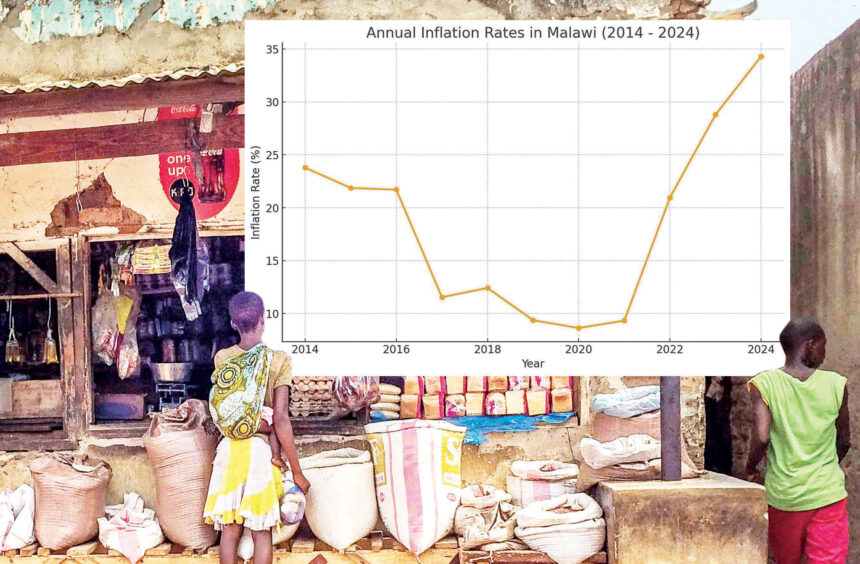
Inflation—the rate at which commodity prices change at a given period in an economy— has been on an upward spiral in recent months, rising to 34.3 percent, against a target of 23.4 percent.
The local unit, the Kwacha, has also been volatile, trading at about K1,751 in authorised dealer banks, with a yawning gap compared to the rate on the parallel market.
This is on the foot of an acute shortage in forex, with the balance of payment position narrowing to less than two months’ worth of imports.
- Advertisement -
The government budgetary operations are also not spared either, with glaring discrepancies between assumptions anchoring the financial plan and reality.
The fiscal space has faced intense pressure emanating from public expenditure overruns vis-à-vis inability to meet revenue generation targets.

To be held under the theme ‘Economic Priorities for a Vulnerable Economy’ from Wednesday next week, the economic think-tank’s indaba will attempt to recommend remedies according to Ecama Executive Committee Member Florence Kampani.
“We are at a point where as economists we are asking whether the current economic model that is driving the economic model is working for us; we have seen that the economy is getting more and more vulnerable.
- Advertisement -
- Advertisement -
“The shocks are getting more frequent and also the variety of the shocks is expanding. And we feel it is time we re-look at how we reorganise ourselves. Possibly, there are other models that we can consider or other ways of looking at the economy,” Kampani said.
She said the theme is coined to necessitate conversation of finding lasting remedies to challenges facing the local economy.
This Ecama indaba comes as the local economy has largely been volatile and faced with myriad challenges. Malawi has been affected by a series of shocks—both natural and exogenous— including an outbreak of cholera and Cyclone Freddy lately.
In its recent Economic Report, local investment and advisory firm, Bridgepath Capital said El Nino-induced drought conditions, which will lower the agricultural sector’s output, are expected to undermine growth.
But Minister of Finance Simplex Chithyola Banda recently said the government expects steady growth of the economy amid the structural challenges.
In the past three years, Malawi economy has had an annual growth rate of not more than two percent.
By 2030, just about six years away, Malawi aspires to become a lower middle-income economy in line with aspirations embedded in the MIP-1.
To hit the middle-income mark, Malawi needs to be growing by at least six percent per year for over 10 years.