By William Kumwembe in Addis Ababa, Ethiopia:
A fresh call has been made for African countries to leverage existing markets within the continent towards enhancing intra-regional trade.
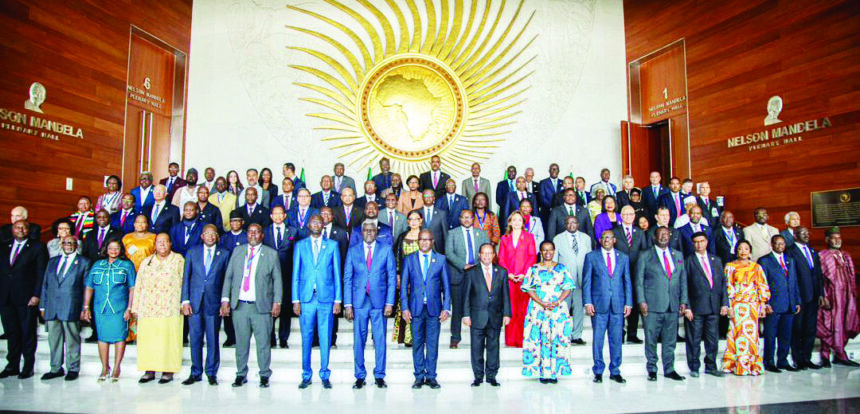
The call was made on the 14th of February in Addis Ababa, Ethiopia at the opening of the 44th Ordinary Session of the Executive Council of the African Union.
It comes as 31 African countries are earmarked to start trading under the Africa Continental Free Trade Area (AfCFTA)’s guided trade initiative this year.
- Advertisement -

Already, about seven countries started trading under the initiative in 2023.
- Advertisement -
Addressing delegates at the summit, Ethiopian Minister of Foreign Affairs Taye Atske Selassie said countries needed to enhance strides towards trading under the AfCFTA pact.
“Africa has immense potential for economic prosperity. We must, therefore, remain resolute to implement provisions of the AfCFTA in enhancing trade,” he said.
In his address, United Nations Under-Secretary- General and Executive Secretary of the Economic Commission for Africa Claver Gatete said there is a need for streamlining the education system and labour market needs towards enhancing activities.
He said governments should foster partnerships between industries and educational institutions so that curricula align with job markets.
- Advertisement -
AU Commission Chairperson Moussa Faki Mahamat said the continent should continue leveraging strategic partnership it has beyond the continent in an attempt to enhance its relevance.
“Our membership in the G20, for which we carried out intense advocacy, imposes on us greater rationality, method and constant alertness in the tormented sphere of international relations of the moment,” he said.
The AfCFTA—the continent’s single biggest trading bloc—is among the African Union’s (AU) flagship projects for implementation of its ‘Agenda 2063: The Africa We Want,’ and is aimed at bringing together all the 55 member states of the AU in an intra-African continental free trade area.
It would create a market of more than 1.3 billion people and a combined gross domestic product of up to $3.4 trillion.
If fully implemented, the AfCFTA could leverage intra-African trade and increase trade among member states by up to 110 percent.
In addition, the AfCFTA could lift up to 30 million people out of extreme poverty and up to 68 million people out of moderate poverty.