






Every football administration is ultimately judged by two ledgers: the one written in trophies and the one written in trust.
Fleetwood Haiya, who rose to the helm of the Football Association of Malawi (Fam) in December 2023, now stands in the final stretch of his third year with one more to run.
The books are open, and they make for fascinating, contradictory reading.
Haiya arrived from Super League of Malawi (Sulom) with a reputation for commercial alchemy. There he lifted the league’s title sponsorship from a modest K150 million to K500 million a season, with club subventions rising accordingly from K1 million to over K7 million.
He carried that instinct to Lilongwe, and his first move was to renegotiate sponsorship for the domestic cups, the low-hanging fruit that bought him momentum and credibility.
- Advertisement -
What followed was a rare thing in Malawian football: promises that became structures.
The Luwinga Project, long a perennial budget line and a monument to deferred intention, finally saw daylight when Fam commissioned the Luwinga Inclusive Academy on July 17, 2024 with an intake of 42 players.
The kit and equipment deal with Admiral has ended the indignity of national teams scrounging for gear, and an equal bonus structure across the Flames, Scorchers and Beach Soccer side has given welfare a principle rather than a postscript.
The women’s game: From footnote to headline
- Advertisement -
- Advertisement -
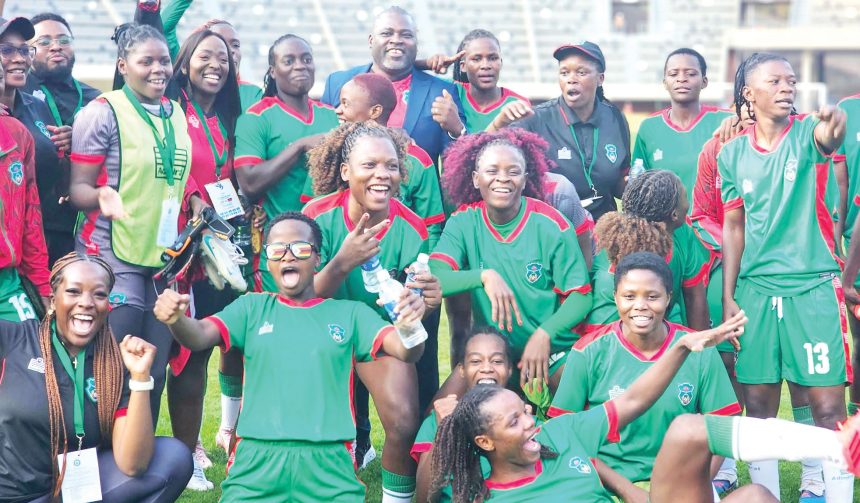
Nothing in the Haiya portfolio shines brighter than women’s football. The Scorchers, once content to participate at the Cosafa level, reached the final of the Women’s Africa Cup of Nations (Wafcon) in their inaugural appearance in July and have now stepped onto the global stage.
That ascent was no accident. It was the product of deliberate investment: an influx of friendlies and a reinforced technical panel in June, including the addition of Sudesh Singh.
The architecture beneath is equally notable, from the NBM Women’s Premiership to the forthcoming National Bank Under-23 Championship.
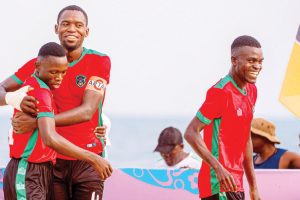
Beach Soccer tells a similar story of renaissance. Malawi has now reached the Africa Cup of Nations finals back to back, a feat never achieved under the previous administration.
The league that stopped being a rumour
For two decades the National Division League (NDL) was a conversation without a conclusion, a perpetual “next year” of Malawian football.
Under Haiya, it exists. For the first time, a properly run second tier will feed the FDH Bank Premiership, with the NBS Bank-sponsored competition producing the country’s top three teams for promotion.
Together with the FDH Bank and NBS Bank partnerships and sponsorships of regional leagues, it points to something more important than any single deal: corporate confidence in the beautiful game.
Participation, too, has been transformed. Where the past decade saw only a handful of national teams at regional competitions, the seniors, the Under-23s, the Under-20s and the Under-15s now turn up consistently, as do the Scorchers, the women’s Under-20 side and the Beach Soccer team. The calendar has been honoured with an almost ergonomic efficiency, with chartered flights at times trimming transit and fatigue. The pool of qualified coaches has also grown, with more holding Caf A, B, C and D licences.
Yet Shakespeare’s observation that “the evil that men do lives after them” has a mirror image in football: the failures of the present have a habit of eclipsing its triumphs.
The Haiya administration’s shortcomings are not footnotes. They go to the heart of the football pyramid.
The Flames are flickering
The paradox of the Scorchers’ brilliance is that it has illuminated the men’s decline.
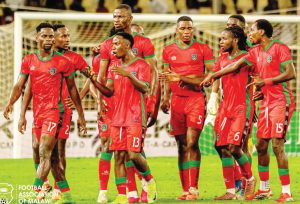
“The success of the Scorchers and the recently christened Hustlers have exposed the downward spiral of the Flames, who have won twice in their last 10 competitive games under Kalisto Pasuwa,” observes analyst Rodney Phiri.
The junior sides offer little consolation: none has progressed beyond the semi-final stage at Cosafa tournaments, casting a long shadow over the senior team’s future.
The under-23 side, which assembles only every four years for the All Africa Games and Olympic qualifiers, may be forgiven its latest setback, but the junior pattern is testimony to a pipeline that is leaking.
Fam is spending heavily on air tickets for foreign-based players who are scouted, summoned, and then not used.
Pasuwa must either integrate them or stop calling them up. Football cannot afford sentiment on the balance sheet.
The relationship with women’s football leadership remains strained, a persistent dent in the image of the association.
The same is true of the National Youth Football Association, whose feud with Fam has delayed district and regional league kick-offs.
One wonders how grassroots structures can be strengthened when the body that runs the junior leagues and holds the youth database is estranged. Players should cascade naturally from Under-15 to Under-17 to Under-20, and that cannot happen amid bad blood.
The legal wrangle between the Northern Region Football Association (NRFA) and the National Football Association (NFCA) also still awaits a lasting solution, and the appointment of an Affiliate Liaison Manager, Higger Mkandawire, has evidently not been the balm it was meant to be.
The exits of Marketing Director Tulipo Mwenelupembe, General Secretary Gift Gunda, Technical Director Benjamin Kumwenda, and others including Patuma Tonex and Club Licensing Manager Casper Jangale raise a legitimate question about institutional memory.
Critics allege that most were frustrated out or not renewed because of perceived closeness to the previous president, the sort of politics that does football no favours
Supporter patronage at FDH Bank Premiership matches remains thin, which depresses gate revenue and, by extension, club finances.
Finally, there is the curious matter of Sulom. Haiya’s recent public backing of Sulom president Major General Gilbert Mittawa has puzzled observers, coming after the charges levelled against the league body in August.
Whether those charges will be resolved, or have simply been quietly shelved, is a question the football public is entitled to ask.
Haiya has proved that Malawian football can be commercially credible, structurally ambitious and, at least among the women, internationally competitive.
But administration is not an art of selective excellence.
A federation that thrives at the top of the women’s game while the men’s pyramid sags and the affiliates seethe is a building with a handsome façade and a trembling foundation.
With a year remaining, the task is clear: mend the affiliate relationships, stabilise the secretariat, rescue the Flames, and fill the stands.
If he does, the blueprint may yet become silverware. If not, history may remember a builder who forgot to reinforce the walls.
