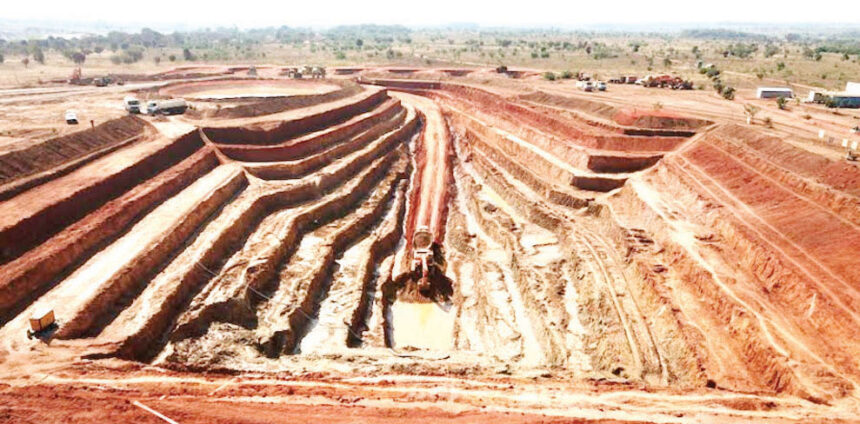
Last week, representatives of Sovereign Metals, the Australian mining firm exploring rutile and graphite at the Kasiya Rutile-Graphite Project in Lilongwe, met officials from Traxys North America LLC to sign a Memorandum of Understanding (MoU) for the marketing of Kasiya graphite.
Conspicuously absent from the signing ceremony were Malawian officials, the custodians of the country’s mineral resources.
This has prompted questions about Malawi’s role in the Kasiya graphite transaction.
And civil society organisations have since called for full transparency and parliamentary oversight following the signing of the non-binding Memorandum of Understanding between Sovereign Metals and Traxys North America LLC.
Signed on the sidelines of the Mining Indaba in Cape Town, the agreement positions Traxys as a prospective marketing partner for graphite production, which Sovereign is developing through its local subsidiary.
- Advertisement -
Under the arrangement, Traxys is expected to initially market an estimated 40,000 tonnes of graphite annually, with volumes projected to increase to 80,000 tonnes as production scales up.
The graphite is targeted at global markets for defence, aerospace, advanced manufacturing and battery industries.
The agreement follows Traxys’s appointment as one of only three trading houses selected to procure critical minerals under the United States Government’s US$12 billion Project Vault, an initiative designed to secure supply chains for minerals considered vital to US national and economic security.
Sovereign Metals Managing Director Frank Eagar said his firm is pleased with the appointment of Traxys as a potential graphite marketing partner.
- Advertisement -
- Advertisement -
Eager said graphite is designated as a US Critical Mineral and is squarely in the crosshairs of US policy to reduce dependence on Chinese-dominated supply chains.
He said Traxys’s direct involvement in Project Vault, combined with its extensive network of industrial customers globally, positions Kasiya’s potential graphite production to serve both strategic government procurement programmes and established commercial markets.
According to Eagar, the MoU demonstrates growing confidence from major global commodity players in Kasiya’s ability to potentially deliver critical minerals at scale from a globally strategic, genuine Tier 1 project.
Commenting on the appointment, Traxys CEO Mark Kristoff said his firm is proud to be a critical minerals supplier for Project Vault.
Kristoff said the groundbreaking initiative… bolsters the supply chain of critical minerals for American manufacturers and enhances national economic security.
But why is Malawi not in the picture around this MoU?
Minister of Mining Jean Mathanga was not immediately available for comment Friday.
Malawi Investment and Trade Centre (MITC) described it as a milestone for Malawi’s mining sector and a signal of rising international confidence in the country’s mineral investment prospects.
Economic analyst Velli Nyirongo said that while the Kasiya Project enhances Malawi’s geopolitical and economic relevance, financial transparency must underpin its implementation.
“For Malawi to benefit meaningfully, there must be clear disclosure of revenue flows, tax arrangements, royalty structures, and community development agreements.
“Without this, mineral wealth risks failing to translate into sustainable national development,” Nyirongo said.
Nyirongo also called for local value addition, arguing that processing graphite domestically into battery-grade materials would generate skilled employment, promote technology transfer, and strengthen Malawi’s industrial base.
He further underscored the potential for mining-related infrastructure to stimulate broader economic activity if integrated into national development strategies.
National Advocacy Platform (Nap) chairperson Benedicto Kondowe said Malawi warned that poorly negotiated or opaque agreements risk entrenching poverty amid resource abundance.
“The country must ensure mineral deals are corruption-free, transparent, and concluded strictly in the national interest—translating natural resources into jobs, infrastructure, and long-term economic transformation,” Kondowe said.
As debate intensifies, CSOs maintain that the Kasiya Rutile- Graphite Project represents both a strategic opportunity and a critical test of Malawi’s commitment to transparency, accountability and sound governance in the mining sector.
In his State of the Nation Address last Friday, President Peter Mutharika highlighted the importance of mining to Malawi’s economic growth.
Late in 2024, a video circulated online reportedly of Sovereign Metals officials making a presentation of their Kasiya rutile exploration findings, apparently to potential investors.
The event took place outside Malawi but here is the summary of that presentation:
- The project in Malawi is the largest rutile (a form of titanium) resource on planet Earth today. It is the cleanest form of titanium mineral you can find.
- The project is also the second largest graphite resource in the world
- A pre-feasibility study which Sovereign Metals released showed that the project could generate revenue of up to $654 million a year for 25 years.
- The mineral is needed in defence and aerospace, coatings, pigments, sunscreen and welding, among others.
Malawi News has not independently verified the clip.