




By Alick Ponje in Belem, Brazil:
The first week of the 30th United Nations Climate Change Conference (COP30) ended on Friday after intense negotiations, consultations and high-level meetings that showed both progress and the complexity of global climate talks.
“These negotiations are like a roller coaster. Sometimes they go up, sometimes they go down with setbacks and advancements,” Lilian Chagas, Brazil’s COP30 negotiator, said.
Delegates addressed 145 agenda items covering climate finance, adaptation, the just transition and the global stocktake of the Paris Agreement, the treaty that aims to curb warming.
The week closed with technical work handed over to the COP presidency, preparing the ground for ministerial engagement during the high-level segment starting Monday.
- Advertisement -
Recognising indigenous and local voices
COP30 has also been promoting inclusivity and the role of local communities.
“COP30 is a positive agenda for indigenous peoples and we want to increase recognition of their work as guardians of these extraordinary forests,” COP30 president Andrea Corrêa do Lago said, in reference to the communities from the Amazon.
He and COP30 CEO Ana Toni briefed the press on the week’s developments, alongside Chagas.
- Advertisement -
- Advertisement -
Earlier, Brazilian ministers Marina Silva and Sônia Guajajara met indigenous representatives, underscoring efforts to bridge the gap between events in the official negotiation area and affected communities.
“We are the ones who protect the climate and the Amazon cannot continue to be destroyed to enrich big companies,” the Munduruku Indigenous group said.
Early climate finance and disbursements
Observers noted tangible developments. The Loss and Damage Fund, created at COP27 and operational since COP29, issued its first requests for funds this week.
It has released $250 million for the initial phase focusing on the most vulnerable countries.
Malawi’s Director of Environment Taonga Mbale Luka hopes her country, currently experiencing a dry spell-induced hunger crisis affecting nearly a third of its population, will be among the early beneficiaries.
“Our people are living with climate impacts now and we cannot wait for support that is vital to safeguard our homes, crops and futures,” she said.
She described severe droughts and floods, saying farmers are struggling to harvest and communities face daily threats to food.
Mbale Luka added that the government is stretched and needs urgent international support to prevent further losses.
“Every day without action leaves our communities exposed to worsening floods, droughts and loss of livelihoods,” she said.
Discussions continued on fossil fuel transition pathways, climate finance strategies and updates on Nationally Determined Contributions (NDCs), which have risen to over 110 submissions from fewer than 70 previously.
Chagas said technical discussions would run alongside high-level consultations next week, with ministers from nearly 160 countries due to deliver statements and inject political momentum into negotiations.
Flashpoints on adaptation and forest protection
Observers believe this balance will define the second week, where stakes are expected to be high.
“The groundwork laid in the first week will be critical in shaping agreements on finance, adaptation and the global climate agenda for the years ahead,” Malawian climate activist Julius Ng’oma said.
Brazil has highlighted its “Tropical Forests Forever Facility”, a market-style fund designed to reward tropical nations, the majority of whom are in Africa followed by Central America and the Caribbean, for preserving forests.
Pledges reportedly exceed $5 billion. Brazilian Finance Minister Fernando Haddad says the aim of $10 billion in the first year is achievable if wealthy countries contribute further.
Analysts point out that rapid disbursement and real benefits for indigenous and local communities will be essential.
Rising tensions and vulnerable countries’ demands
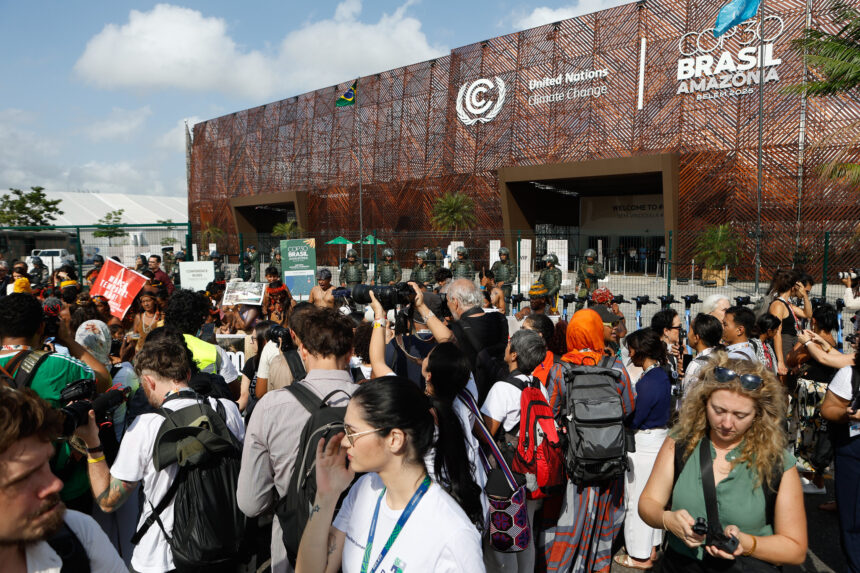
Tensions have been visible on the ground. At least twice, indigenous groups have disrupted access to the venue, demanding land rights, compensation and stronger protections, especially in the Amazon.
Another major sticking point has been the Global Goal on Adaptation, which aims to strengthen resilience but requires adequate funding.
On Friday, developing countries, mainly African, called for clearer indicators and dedicated finance while wealthier countries resisted binding commitments.
The impasse has pushed talks into next week and may delay final decisions until 2027, when Ethiopia hosts COP32, where Africa feels it could secure better terms.
For the 44 Least Developed Countries (LDCs), 36 of them in Africa, finance remains the priority.
Evans Njewa of Malawi, the LDC chair, warned: “Climate finance is not charity; it’s an obligation. Our countries did not light this fire yet we are burning in its heat. The smoke will not stop at our borders.”
He urged real action, secured financing and improved access to adaptation support.
Small Island Developing States (SIDS) and other vulnerable nations echoed these concerns.
Toiata Apelu-Uili of the Alliance of Small Island States said: “Small island states are here to demand we honour 1.5°C. This is a lifeline for our survival.”
Manjeet Dhakal, an LDC negotiator, said adaptation finance should come mainly as grants and must be tripled.
Regional development banks are trying to help bridge the gap for the most vulnerable countries.
“At the African Development Bank, adaptation and mitigation are at the heart of our climate interventions,” AfDB’s Kevin Kariuki said, pointing to a new ‘Climate Action Window’.
This is the bank’s funding mechanism that provides targeted grants and concessional finance to help the continent’s most vulnerable countries respond to climate change.
What to watch in week two
As COP30 enters its decisive second week, negotiators face a crowded agenda that will test both political will and the pace of technical progress.
A key priority is agreeing on indicators for the Global Goal on Adaptation, which countries have been unable to finalise for years.
Delegates are also expected to push to secure predictable, grant-based climate finance, particularly for adaptation, which, according to assessments, remains chronically underfunded compared with mitigation.
With tensions already visible, negotiators say the next few days will determine whether COP30 delivers meaningful advances or defers difficult decisions to future summits.
“This is the moment when political leaders need to rise above technical delays and show courage.
“If week two does not unlock finance and adaptation progress, then vulnerable countries will leave Belem with more promises than protection,” the Malawian activist Ng’oma said.
This story was produced as part of the 2025 Climate Change Media Partnership, a journalism fellowship organised by Internews’ Earth Journalism Network and the Stanley Center for Peace and Security.