




Sifati Mailosi, 19, from Traditional Authority Nkoola in Machinga District, had big dreams. She wanted to become a paediatric nurse at Machinga District Hospital.
But 2020, when schools closed in the wake of the Covid pandemic, marked the beginning of problems for Sifati.
“I was in the middle of my first term in Standard 7 when the government closed schools. I thought my school would reopen within a couple of weeks, but months went by and schools were still closed,” Sifati said.
Sifati and her two sisters then moved to their uncle’s house after the death of their parents. Under her uncle’s care, life was not easy for them. The girls would often only eat one meal a day, and Sifati would have to work long hours farming to earn money for necessities.
Sifati and her sisters became vulnerable, not knowing their uncle had plans for them.
- Advertisement -
Sifati said her dream of becoming a nurse was shattered when her uncle decided all the girls would marry.
“My uncle found men and married us off. I could not believe it. He felt he couldn’t take care of all of us. Since he depends on rain-fed agriculture, he struggles to harvest enough food for the whole year. We had no choice but to comply with his idea of marrying us off. It seems he collected some money from these men,” Sifati said.
Sifati’s and her sisters got pregnant and had children. The story of child marriage is just one of many inequalities that run deep in a largely patriarchal society in Malawi.
A lot of school-going girls are pushed into early marriages and unplanned pregnancies, resulting in child poverty.
- Advertisement -
- Advertisement -
Statistics show half of the girls in Malawi are married before their 18th birthday. Child marriages and teen pregnancies are common in Machinga District, with 11 percent of girls being pushed into early marriages, according to a 2016 baseline study by Plan International and Amref.
This is now changing in Machinga District, thanks to the European Union (EU)- funded Spotlight Initiative. The Forum for Youth Development (Foyode), through UN Women, has been implementing the Spotlight Initiative to prevent early and forced marriages as well as early pregnancies.
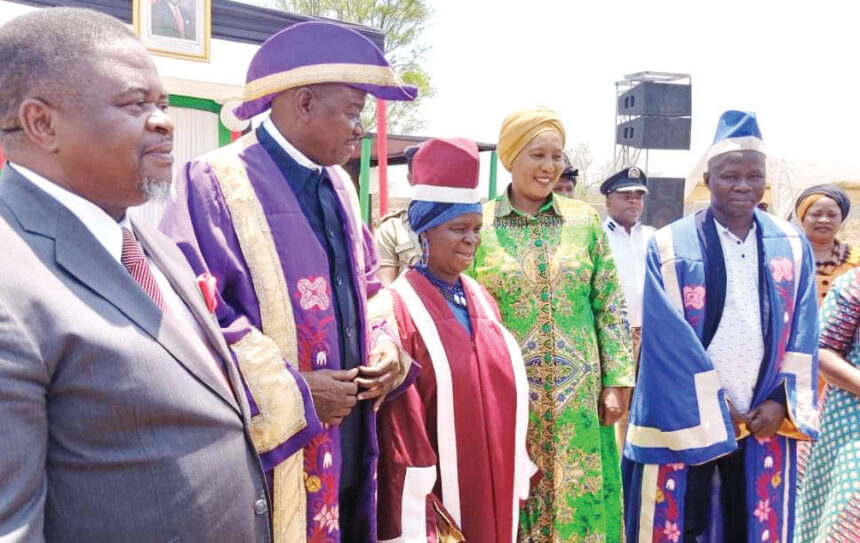
Chiefs, faith leaders, parliamentarians, and key community leaders have been trained in championing the fight against early marriages.

Member of Parliament for Machinga East Esther Jolobala says harmful practices that violate the rights of women and girls are being challenged through community engagement.
“In Machinga, including in my constituency, chiefs have a platform to sensitise the parents of adolescents who they married off for the sake of money. As such, they were made aware of the need to annul the child marriages they arranged,” Jolobala said.
Sub-Traditional Ngunga, the only lady chief in the area who rescued Sifati and her sisters from early marriage, has been part of a door-to-door campaign credited with decreasing child marriages in the area.
Sifati was rescued through a largely successful sweeping exercise.
“When I heard about Sifati and her sister’s marriages, I immediately reported the matter to the police. The Police Victim Support Unit (VSU) investigated the matter and arrested the uncle,” said Sub Traditional Ngunga.
“At the VSU, the marriages were annulled, and the girls were referred to a one-stop centre at Machinga District for pregnancy tests, sexually transmitted infection screening, treatment and counselling, she added.
Spotlight Initiative has been empowering community leaders in six districts to play a proactive role in the welfare of vulnerable groups like young women.
James Dzonzi, not his real name, is a street kid in Lilongwe. He is 14 years old. He was born to a mother who was also a street kid but died of Covid in early 2020.
He does not know his father or any relative from his mother’s side; he feels he will forever be a street kid because he does not believe there is going to be a proper family to take care of him.
“I sleep anywhere I can find a place to sleep. Sometimes we sleep in Airtel or TNM Money booths. We collect big cartoons from shops so that we can use them as marts,” he says.
James attributes all this to his upbringing because, since he was born, he has never been to school and does not know how to read or write.
James is among a population of street kids you can find in the streets of Lilongwe and Blantyre, who are causing havoc in the cities.
A day cannot pass without people telling a story about how a street kid ambushed them and how unbearable the situation was.
Judith Jeke, a standard five learner at Chambu Primary School in LIlongwe, was once almost hopeless before going to Temwani Chilenga’s orphanage in Area 25.
Her parents died when she was young. Judith met her teacher, Temwani Chilenga, when she was living with her grandmother, who had no source of income.
“We used to sleep on an empty stomach. At that time, I was in Standard Two and never thought I would finish my studies and achieve my dream of becoming a pilot. All thanks to my teacher, who made it possible for me to have food on a daily basis,” she narrates.
Judith is among the population suffering from childhood poverty, which, if not addressed, could be a recipe for disaster.
Alick Nyasulu, a statistician, says high street crime by young people attests to the negative consequences of high population growth.
“In my view, population growth should be declared a disaster and laws put in place that can forbid families to reduce the number of children. The high street crime by young people attests to the negative consequences of high population growth,” said Nyasulu.
According to Nyasulu, what is also more critical is the need to change the mindset of political leaders, public servants, and some development partners in such a way that any planning and execution of public infrastructure projects like roads, rail lines, housing, hospitals, airports, schools, universities, energy, and telecommunications, among others, should be forward-looking, taking into consideration the population that may grow.
“This mindset is poverty-centric and must stop, and cross-generational planning and thinking should be the norm and an obsession. This is how successful countries have planned and developed, accompanied by a strong system of laws and zero tolerance for corruption,” he adds.
According to the World Bank, Malawi’s population growth rate was 2.7% in 2020, one of the highest in the world. With a population of about 19.6 million, Malawi is projected to reach 43.6 million by 2050, putting immense pressure on its limited resources and infrastructure.
Malawi’s population growth is driven by a combination of factors, including low mortality rates, high fertility rates, and limited access to education and family planning services. Poverty, which affects about half of the population, also contributes to higher birth rates as people lack the means and knowledge to control their family size.