By Isaac Salima:
Political scientists have questioned parties for lacking set criteria on how to elect presidential running mates who end up becoming State vice presidents.
The political scientists, under the banner of Political Science Association, have further faulted procedures used for coming up with a running mate, saying the power to choose one seems to rest in presidential candidates.
They raised the sentiments during their biennial conference in Mangochi over the weekend, when they reflected on Malawi governance, politics and development.
In his presentation, Blessings Chinsinga questioned the criteria which parties use to appoint a running mate for a presidential candidate.
- Advertisement -
He said, mostly, presidential candidates are given the mandate to elect their running mate, such that party members only endorse the individuals without necessarily scrutinising the person’s suitability for the position.
He also said the country has not benefitted much from the position of State Vice President.
“Looking at what we have encountered [in recent years], we might be tempted to abolish the vice presidency,” Chinsinga said.

Kizito Tenthani of the Centre for Multiparty Democracy also wondered as to who makes the decision on appointment of a party vice president, saying there was a need for laid down procedures on the issue since party vice presidents are State vice presidents-in-waiting.
- Advertisement -
- Advertisement -
“Certainly, they [presidential candidates] handpick who they can work with. If there is a team that is involved in the appointment of the [individual who ends up serving as State] vice president, we can only assume,” Tenthani said.
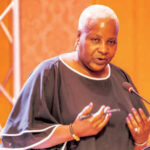
In her keynote address, Nandini Patel of Institute for Policy Interaction also questioned the legality of a sitting State vice president forming a political party after winning the seat.
“The practice of vice presidents forming new parties after winning seats on another party’s ticket has not been challenged. The SC [Supreme Court of Appeal] ruling of 2008 on floor crossing is clear that the principle applies to the presidency as well,” she said.
The country has previously seen sitting vice presidents Joyce Banda and Saulos Chilima forming their parties.
Banda formed the People’s Party while Chilima came up with UTM.
“We are not debating or criticising this as we do with other issues. If they [sitting vice presidents] want to form [political] parties, let them resign and seek a fresh mandate if they would like to come back into power,” Patel said.
Patel also looked at the country’s governance structure, where she cited lack of fiscal, administrative and political capacity to deliver services.
“The three decades of democracy in Malawi have seen progressions and reversals. It would be fair to say that the core institutions of democracy, such as periodic elections, media freedom, civil and political rights, have gained ground.
“However, the performance of institutions as accountable, accessible and able to deliver essential services remains a far cry,” she said.

UTM spokesperson Felix Njawala said every party has its own constitution, which has provisions that shed light on how to elect a presidential running mate and that they will always go by that.
“What the parties are doing is also in line with our constitution, where the presidential candidate who makes it into power goes with their running mate who also eventually becomes the State vice president. The presidential candidate appoints a running mate. Yes it is a decision made by an individual but we cannot conclude that it is arrived at without consultation,” he said.
People’s Party publicist Ackson Kalaile Banda agreed with the political scientists, saying there is a need to reconsider how presidential running mates are selected.
“It is a valid reason because running mates are solely handpicked by presidential candidates. We need to revisit this and come up with proper procedures for electing a State vice president. The president of a party is elected through a convention but there is no way a vice president can only be handpicked by a single person because the party vice president who becomes State vice president is a president-in-waiting,” he said.
Former State president Peter Mutharika surprised many people, including those from his Democratic Progressive Party, when he handpicked his running mate in the 2019 presidential election.
The man he opted for is Everton Chimulirenji.
Mutharika was mandated to nominate his running mate but it became apparent that Chimulirenji’s selection came as a surprise to many people.
Meanwhile, political analyst Victor Chipofya has said there is no way the country can expect positive change if it continues to repeat mistakes.
“The President [Lazarus Chakwera] told us that the State Vice President’s office would not be a delegated office but that he would, rather, have its prescribed activities. That has not happened up to now. On the campaign trail, they told us that the State vice president would be a deputy president and that remains a mere promise as the current position holder is just a figurehead,” Chipofya said.