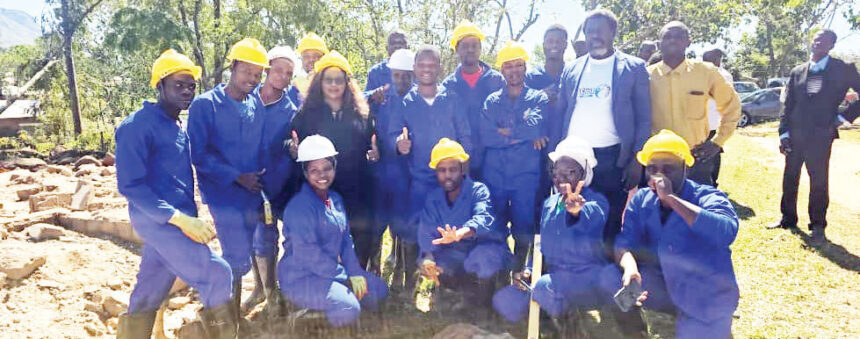

From the Malawi University of Science and Technology (Must) Turn-Off in Thyolo District, the tarred road descends to Goliati Trading Centre, from where, a stone throw away, lies Goliati Community Day Secondary School (CDSS).
Ironically, the CDSS’ administrative block and classrooms are hidden from public view, tucked between one dusty and lengthy path and maize fields that lead to nowhere.
Needless to say Goliati CDSS is hidden from the touch of technology, too— as it remains unscathed by the firm hand of information, communication and technology (ICT) despite being neighbours with Malawi’s premium technology-savvy public university; that is Must.
It is a typical case of an affluent institution being situated in an impoverished neighbourhood, a neighbourhood deprived of what is on offer at Must, “where excellence reigns”.

And yet, when the institution was officially opened on October 24 2014, one Charles Jussab, then young but now a student at Goliati CDSS, had hoped that he and other community youths would at least scramble for the crumbs of technology that would fall off from the table of their giant academic neighbour.
- Advertisement -
It was not to be, such that he and other students still have no access to one of the children of technology, namely ICT.
One could, therefore, not fault him for waxing lyrical about ICT when he, and other students, gathered at the CDSS campus to witness the ground-breaking ceremony of ICT laboratory construction works.
“We welcome you, ICT,” he said in a poem, as if ICT were the long-lost piece of the academic puzzle he has been trying to find.
Jussab, who is in form three, added that the opening of the ICT laboratory, which is expected to take place in the next three months, after the completion of construction works, would open the world up to students as Goliati CDSS.
- Advertisement -
- Advertisement -
It is a point some female students reiterated in a song composed for the occasion.
They said because they are “another kind of learner”, they need the right tools with which to unlock their future.
[I am] another kind of learner/
That’s my name/
I have the key to open my future…
That is how the seven female students, who seemed to represent the views of all when they sang, put it.

Speaking on Friday last week, when Malawi Communications Regulatory Authority (Macra) Postal Services Manager Madalo Phiri visited the CDSS for the ICT laboratory ground-breaking ceremony, head teacher Aubrey Kamwendo said they could not wait for the next term, when the facility would be open for use, to tap from knowledge generated across the globe.
“Most importantly, the laboratory will bridge the ICT gap that is there between students in urban and peri-urban areas and those that are based in rural areas such as Goliati.
“As such, we are happy that, finally, students here will have access to ICT services through the laboratory. It all started as a dream on November 8 last year, when officials from the Ministry [of Information and Digitalisation] and Macra came here and informed us that we were one of the secondary schools earmarked for the ICT laboratory project,” he said.
Kamwendo added that the laboratory would help improve learners’ performance.
“We are happy that 90 days from today, the facility will be operational and our students will become ‘international’, as they will be connected to the international super highway through the ICT laboratory. That way, passing national examinations with flying colours will become easy because internet access will ease challenges associated with research, as students will be able search for information using Google and other tools.
“Since the school was established in 1987, this will be the first time it has ICT facilities in time for the first term in September 2024. Goliati CDSS is on course to becoming a centre of excellence,” he explained.
His sense of optimism was echoed by Group Village Headman Katundu, who claimed that most community members fail to make informed decisions because they have limited access to sources of information and, by extension, knowledge.
“We will, therefore, do our best to support the initiative, which will go a long way in improving literacy levels in my area. Enlightened children will contribute positively to community, district, national and international development,” Katundu emphasised.

According to Thyolo East Member of Parliament Masauko White, access to resources and tools makes the difference in knowledge acquired between students in urban and peri-urban areas and those in rural areas.
“I do not believe that some students are dull. That cannot be. The truth is that some students, notably those in urban and peri-urban areas, have access to more resources than those in rural areas, and this makes the difference during national examinations as those in urban areas do well in ICT and other subjects than those in rural areas.
“Therefore, ICT laboratories like the one earmarked for Goliati CDSS are key to bridging that gap. By utilising information gathered through the ICT laboratory, students in rural areas will perform as satisfactorily as those in urban areas. I am excited for the initiative because, apart from students, community members will also benefit from the same by utilising ICT services,” White pointed out.
The lawmaker added that students from rural areas should stop looking down upon themselves, saying, slowly but surely, they are getting connected to the international super highway.
“You, students, are on course to joining the global community through connectivity to ICT services. Information will be at your fingertips,” he said.
On her part, Phiri said construction of the facility is an indication that Macra is aware of the existence of a digital divide that negatively affects access to ICT services.
“As the regulator for communication services in our nation, this event is evidence that Macra stands firm on the principle of inclusivity and the belief that no one should be left behind when it comes to accessing digital services and technologies.
“It is this belief that has driven the launch of the ‘Connect-A-School Project through the Universal Service Fund (USF). This project, the first of its kind in Malawi, will bring to life the National ICT Policy and align with the Malawi 2063 vision, which is youth-centric and puts digitalisation at the heart of our nation’s transformation,” Phiri pointed out.
She said the move is also aimed at transforming Malawi into a digitally empowered nation.
This is happening at a time the government has cited youth empowerment, education and technological advancement as pillars for national development.
“The laboratories project aligns perfectly with the vision by providing students with the essential tools and skills needed to thrive in the 21st century. This initiative not only bridges the digital divide but also fosters an inclusive and forward-thinking educational environment, thereby laying a robust foundation for Malawi’s socio-economic growth and ensuring that no child is left behind in the digital era.
“During the conception of the project, Macra partnered with the Ministry of Education to conduct a needs assessment of our education sector. This revealed that over six million school-going children in both government primary and secondary schools do not have access to ICT services. The assessment highlighted a significant digital divide between students in government schools and those in private institutions, mainly due to the lack of computer laboratories in government schools,” Phiri said.
In the first phase of the project, Macra is constructing laboratories in 75 schools, including 73 community day secondary schools, one national government secondary school and one pilot primary school. Each of the facilities will have the capacity of holding up to 60 computers.
“In the first phase, each laboratory will be provided with 20 computers and each school will be connected to the internet for three years. While the targeted numbers may seem like a small step towards ensuring every student is connected, it is the hope of everyone that more support from various key industry players will come in, ensuring that every student in Malawi has access to ICT services and technology.
“The ICT facilities in our schools will be beneficial if we also adapt a school curriculum befitting the new educational landscape. Macra is also championing the review of the curricula for both primary and secondary schools to include coding and computer science as subjects. In the authority’s commitment to leaving no one behind, Macra is also re-skilling, upskilling and building the capacity of our teachers with ICT knowledge and skills,” Phiri pointed out.

In June last year, when Information and Digitisation Minister Moses Kunkuyu attended the
International Telecommunication Union Global Symposium for Regulators in Sharm El-Sheikh, Egypt, he said the government is, through Macra, enhancing digital literacy and internet connectivity.
He cited the ‘Connect-A-School’ initiative, saying, under it, 7,000 schools were enjoying internet connectivity in Malawi.
“The Malawi Government is also pushing for low data costs through diplomatic data corridors, an intervention that aims at obtaining bandwidth from undersea cables from sea coasts, and transiting it through State-owned infrastructure to significantly lower the landing cost into landlocked Malawi,” Kunkuyu said.
He then disclosed that Malawi would be signing memoranda of understanding with Tanzania, Mozambique, Zambia and Namibia in the first phase of the project.
“We have seen how ICT stepped in when the Covid pandemic struck; everything and everyone turned to digital solutions. Those in underserved communities suffered as the outbreak period caused a gap in their lives. We must connect the whole world if we are to be realistic with the global digitalisation agenda,” Kunkuyu stressed.
It is that prospect of becoming part of the global digitalisation agenda that Goliati CDSS students celebrated, through dance and song, the bridging of the historical divide between ICT darkness and light.