
The Treasury has conceded facing intense pressure in its quest to narrowing the ever yawning budget deficit due to prevailing mismatches between public revenue and expenditure.
According to the Secretary to Treasury Macdonald Mafuta Mwale, the country has a long way to go to achieve a zero-rated budget—where available resources tally expenditure needs.
Mwale said mandatory expenditures such as wages and social services costs continue to pile pressure on the government budget lines.
“We will still implement deficit budgets unless we work seriously hard on the revenue side to see how we can generate enough revenue to cover our own budget without borrowing,” Mwale said.
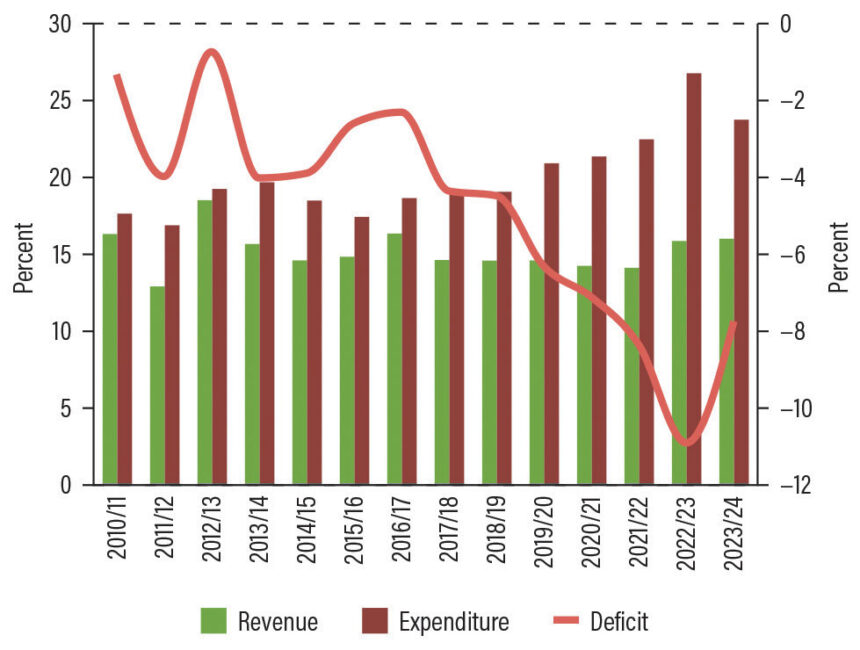
The Treasury planned to have the budget deficit to Gross Domestic Product (GDP) ratio reduced by one percent each year, a dream which is far from being met, at least in the 2023-24 fiscal year, as the gap is seen at K1.32 trillion or 8.7 percent of GDP.
- Advertisement -
The budget deficit has grown by about 30 percent from K1.01 trillion (or 8 percent of GDP) in the 2022-23 budget.
It will be financed through foreign borrowing amounting to K288.78 billion and domestic borrowing amounting to K1.19 trillion.
But industry captains and economists say the private sector has the capacity to contribute towards increasing the public revenue through taxes if they are capacitated for enhanced production.
In an interview Tuesday, National Planning Commission Director General Thomas Munthali said in a business-as-usual scenario, the unsustainable budget deficits will never go away.
- Advertisement -
- Advertisement -
He said the government needs to meaningfully and genuinely engage the private sector in dealing with the prioritised binding constraints facing the private sector.
“The State needs to actively intervene in the market where market failures exist. It is high time government trailblazed investments in all strategic sectors of the economy to create the wealth we need for supporting our national budgets. This cannot happen overnight but we need to get started,” Munthali said.
He said there is a need for the government to enhance its intervention towards de-risking key sectors of the economy by working with the private sector.
In a separate interview, Malawi University of Business and Applied Sciences (Mubas) economist Betchani Tchereni said the developmental projects run by the government are not enough to transform the economy.
“The country is facing a challenge of meeting its developmental goals, especially those that could be spurred by the private sector, the government is almost doomed to take development projects ahead.
“With that then most of the development expenditure is just on infrastructure, which does not assist in taking the economy further,” Tchereni said.
Due to the widening budget deficit, the country has resorted to borrowing.
Malawi remains among countries in the sub-Saharan Africa region at higher risk of debt distress as interest burden on public debt continues rising.
The rising debt poses a risk to the country’s fiscal sustainability as debt servicing costs rise, thereby reducing space for discretionary spending.
Bretton Woods institutions, the International Monetary Fund and the World Bank, say the soaring public debt increasingly reduces fiscal space for development while crowding out private sector investment.
They say the interest burden on public debt is rising because of a greater reliance on expensive market-based funding combined with a long-term decline in aid budgets.
Malawi’s total public debt stood at K7.9 trillion as at December 2022, an equivalent of 69.93 percent of GDP, which is pegged at K12 trillion.
Of the debt stock, K4.43 trillion, about 114 percent of this year’s national budget, was secured domestically, while K3.47 trillion (an equivalent of 90 percent of the 2023-24 budget) is external debt.