




By now, the average resident of Zomba City and Zomba District understands that natural resource deprivation, soil degradation and increased rates of carbon dioxide emissions, among others, are factors fuelling the climate change crisis. To avert the problem, community members have been planting trees. However, as JARSON MALOWA writes, reforestation efforts face an onslaught from people that are hell bent at reducing Zomba Forest to stubs.
Chancy Kaliveni Simbi of Mpondabwino location in Zomba City will never forget the night of March 13 2023.
“I was deep asleep when I was awakened by a cold sensation all over my body. Astonished, I rose to my feet. That is when I realised that water had snaked into the house. Before long, the water was knee-high. Without hesitation, I rushed outside the house, climbed a tree and waited for daybreak,” Kaliveni Simbi, 52, said.
Mercy Alexander Merrick from Traditional Authority Chikowi in Zomba District has her own story to tell.
“I was deep asleep on the night of March 14 2023 when a part of my house collapsed. I rushed outside— where it was raining heavily and water was speeding— and held on to a big fig tree.
- Advertisement -
“Other villagers found me there and took me to safer ground. Later, we stayed at a flood survivors’ camp for a week or so,” she said.
Kaliveni Simbi and Alexander Merrick laud one unconventional “saviour” for their continued existence: Trees.
“That tree saved me,” Kaliveni Simbi, a father of two, said.
This sentiment is echoed by 49-year-old mother of six Alexander Merrick.
- Advertisement -
- Advertisement -
“That fig tree has remained etched on my memory. As a result, I do not take it kindly when I find someone felling down a tree. These trees play a key role in our lives. For instance, on hilly and mountainous areas, they prevent run-off by holding the soil together. They also block water, which would otherwise wash away fertile top soils,” she said.
Ironically, people from within and outside Zomba have been depleting some of the treasured trees there.
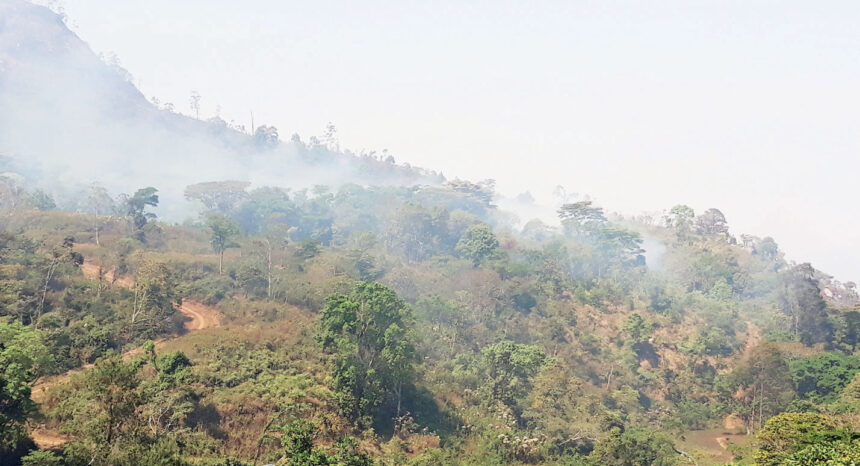
In fact, things escalated some three months ago when officials from the Forestry Department in Zomba woke up to the shocking spectacle of forest trees up in smoke.
It later transpired that loggers were behind the fire.
Days before, forestry officials had embarked on wood confiscation exercises in a bid to save what remains of Zomba’s forests.
After all, deforestation levels have been becoming worrying, with the Department of Forestry indicating that in 2023 alone, Zomba lost 121 hectares of natural forest.
This is equivalent to 94.9 kilotons of carbon dioxide emissions.
The department further indicates that between 2000 and 2020, Zomba City lost 255 hectares of tree cover.
Surely, this is unsustainable natural resource use.
It is that realisation that has, every now and then, been spurring forestry officials into action.
In the fire that ensued, 11 hectares of forest were damaged, according to figures that Zomba Forest acting Plantations Manager at the time Emmanuel Nkhoma provided.
“We have been working tirelessly [to address such issues],” he said.
Forestry officials are not the only ones that have been coming to the defence of Zomba forests; police, too, have been up to the task.

According to Zomba Police Station spokesperson Patricia Sipiliano, police are always ready to enforce the laws, which she described as one of their tasks—all of which are premised on protecting people and property.
She said, for example, that nine people were arrested for possessing forest produce without permit.
“As one way of preserving the environment and natural resources in Zomba Mountain,
the station, in conjunction with Forestry Department officials, conduct intelligence-driven operations.
“For instance, we carried one such exercise on September 18 this year, when we ended up arresting nine suspects,” Sipiliano said.
Some of the people who fall foul of the law are found with pine logs, which they obtain from Zomba Mountain.
Other natural trees have also been falling victim to such tendencies.
This has prompted Senior Chief Malemia to be mobilising community members so that, together, they can be saving what remains of Zomba’s forests.
“We have been holding talks on how to protect the environment,” he said.
Recently, environment management advocate Mathews Malata wrote on his Facebook page that forest degradation in Zomba could have disastrous consequences.
He said if the situation were not put under control, rights of animals could be infringed upon.
He also feared that free-for-all cutting down of natural trees could negatively impact Mulunguzi dam, which is one of the sources of water for Zomba and other Southern Region districts.
“Malawi has Mulunguzi Dam as one of the best sources of water to thousands of consumers. There are baboons in the mountain and they have been rendered homeless. We are very concerned about that,” Malata said.
Equally concerned are Kaliveni Simbi and Alexander Merrick who fear that, without trees, they will have nothing to hold on to— literally.