


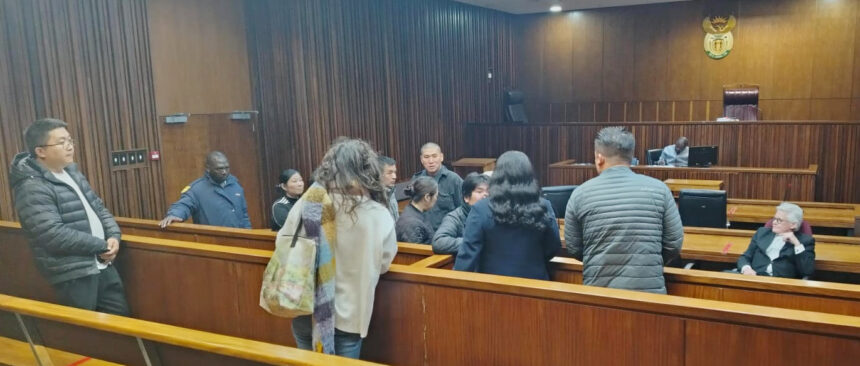
The Gauteng South Division Court in Johannesburg, South Africa, has convicted seven China nationals on 158 out of 160 charges related to human trafficking, kidnapping, debt bondage and multiple violations of that country’s immigration and labour laws.
The high-profile case, which has attracted international attention, uncovered the exploitation of 91 Malawi nationals—including 37 children—who were held and forced to work under appalling conditions at a factory owned by Beautiful City in Johannesburg.
The convicted individuals are Kevin Tsao Shu-Uei, Chen Hui, Qin Li, Jiaqing Zhou, Ma Biao, Dai Junying and Zhang Zhilian.
They were arrested on November 12, 2019 during a joint operation by South Africa’s Department of Employment and Labour, the Hawks (South African Police Service) and the Department of Home Affairs.
According to Advocate Valencia Dube, the lead prosecutor in the case, the factory where the Malawians were found had high steel gates, was heavily guarded and had limited access.
- Advertisement -
Inside, the authorities discovered undocumented workers—including children— working seven days a week under slave-like conditions.
“These individuals were not just working illegally; they were being held in locked premises without safety gear, no proper training, and for little or no pay. It was clear they were victims of human trafficking,” Dube said.
Teboho Thejane, spokesperson for the South African Department of Employment and Labour, described the case as a stark example of modern-day slavery.
“Victims were subjected to threats and intimidation. One worker even lost a finger and was denied medical attention. These were horrific, inhumane conditions,” he said.
- Advertisement -
- Advertisement -
Investigations revealed that the convicted China nationals were part of an organised trafficking syndicate. They reportedly lured Malawi nationals into South Africa with false promises of employment, only to trap them in debt bondage and forced labour.
The case has intensified calls for better protection for undocumented migrants, many of whom are vulnerable to trafficking networks across Southern Africa.
In Malawi, government officials and the country’s diplomatic mission in South Africa have been closely monitoring the case. They have pledged to support the safe repatriation and rehabilitation of the victims.
“This verdict sends a powerful message: South Africa will not tolerate human trafficking or the exploitation of vulnerable communities,” Thejane said.
The seven convicts are expected to be sentenced in the coming weeks.