





By Peter Makossah:
Justice is a delicate balance. In a constitutional democracy like Malawi, that balance must never be determined by the identity, political influence or public standing of the individuals who appear before the courts. It must be determined by the Constitution and the law.
Malawi is once again witnessing a legal controversy that invites her citizens to look beyond personalities and examine the constitutional responsibilities of public institutions.
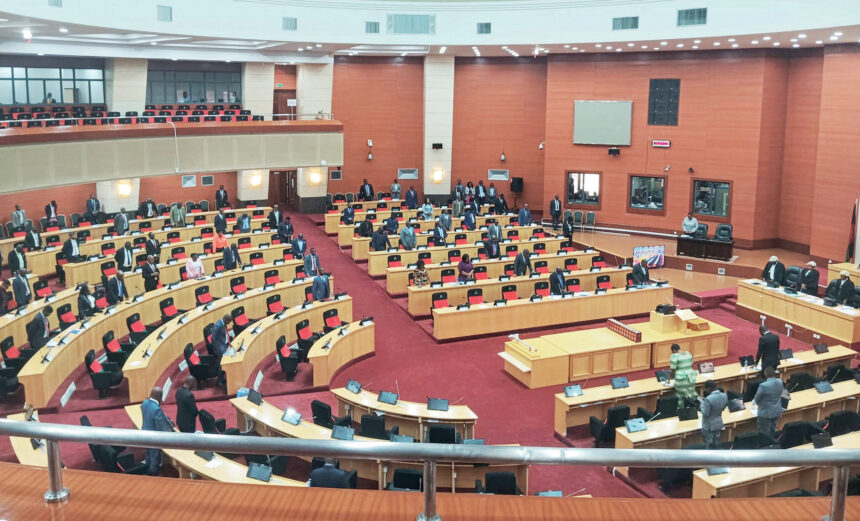
The Attorney General Frank Mbeta has joined the court proceedings involving Speaker of Parliament Sameer Suleman and a private citizen, Austin Mkoka, over an injunction the latter obtained stopping the formation of 12 parliamentary committees intended to investigate the affairs of certain statutory institutions.
According to The Daily Times report of Friday, October 9, 2026, Mbeta has joined as an interested party to address the constitutional and legal questions arising from the dispute, particularly those concerning the separation of powers.
- Advertisement -
For clarity’s sake, Mbeta is not appearing as the Speaker’s private lawyer. The Speaker is separately represented by Counsel Bright Theu. This distinction is very fundamental.
The real question, however, is not whether the Attorney General has entered the courtroom, but in what capacity, for what purpose and within what constitutional limits.
So, what does the Constitution say about the Attorney General in the prevailing circumstances?
Section 98(1) of the Constitution of the Republic of Malawi provides: “There shall be the office of Attorney General, who shall be the principal legal adviser to the Government.”
- Advertisement -
This provision establishes an institutional responsibility.
The Attorney General is not merely a legal representative for an individual officeholder, nor should the office be reduced to a political instrument for defending whoever happens to occupy a position of authority.
The Attorney General’s responsibility is to advise the Government on the law, protect constitutional governance and ensure that legal disputes involving public authority are addressed within the proper constitutional framework.
But there is an important qualification: Section 98 of the Constitution does not make the Attorney General the private lawyer of every Malawian simply because that person is a citizen.
The office of the Attorney General serves the Government in its institutional capacity, with duties informed by the Constitution and the public interest.
Furthermore, the Republican Constitution in section 12(1) reinforces this constitutional philosophy by establishing that state authority derives from the people and must be exercised in accordance with the Constitution and in their interests.
The people are therefore the ultimate source of state authority as a public office is a responsibility held in trust, not a personal entitlement to exercise power without accountability.
The supreme guidance
The highest court in the country, the Supreme Court of Appeal, has already provided important guidance on this matter and there is case law cast in stone.
The most relevant authority is the famous election case involving Professor Arthur Peter Mutharika and the Electoral Commission v Dr Saulos Klaus Chilima and Dr Lazarus McCarthy Chakwera, MSCA Constitutional Appeal No. 1 of 2020.
This landmark constitutional litigation addressed, among other matters, the proper role of the Attorney General when proceedings that began as litigation between parties developed into a constitutional reference.
In its decision, the Supreme Court of Appeal held that, once the proceedings became a constitutional referral, the Attorney General should have “stepped back and ceased to represent the second appellant.”
What was the reasoning behind the Supreme Court’s decision?
In their legal wisdom the Justices of Appeal who are also senior Counsels of the bench aptly interpreted the law by declaring that the Attorney General’s responsibility in constitutional proceedings is not simply to secure victory for the party whose interests the office initially represented.
The Attorney General must also assist the court in resolving the constitutional questions before it.
The Supreme Court’s reasoning draws a critical line between two roles: acting as an advocate for a particular litigant and appearing as a constitutional law officer to assist the court. Those roles cannot always be performed simultaneously without creating a conflict of interest.
However, this legal principle is straightforward: when partisan representation conflicts with the Attorney General’s constitutional responsibility, the latter must prevail.
That is not an invitation for the Attorney General to abandon constitutional litigation. It is a reminder that the manner of participation matters.
So, the question is, does the Attorney General joining the Speaker’s case as an interested party violate that principle?
On the available reported facts, I think not.
I must emphasise, though, that there is a material difference between representing the Speaker as his personal advocate and joining proceedings to address constitutional questions concerning the respective powers of public institutions.
The Speaker has his own legal representation. I believe that Mbeta’s reported intervention is only directed at the constitutional and legal issues arising from the dispute.
That distinction is supported by the reasoning in Jam Willem Akster v Attorney General, Constitutional Referral No. 2 of 2021, [2021] MWHC 208.
In that case, the High Court considered Order 19, rule 8 of the Courts (High Court) (Civil Procedure) Rules, 2017, which requires service of constitutional proceedings on the Attorney General whether or not the Attorney General is already a party.
The Court explained that the Attorney General may exercise discretion about whether to join the proceedings.
More importantly, it reaffirmed that, once participating in the constitutional matter, the Attorney General must assume a neutral role and assist the court rather than take sides.
This is directly relevant to the present controversy.
Where a case raises substantial questions about the constitutional boundaries of public power, the Attorney General’s participation may be entirely consistent with the responsibilities of the office.
Indeed, refusing to participate in a significant constitutional dispute could deprive the court of a useful legal perspective that the office is institutionally placed to provide.
Of separation of powers and constitutional mandate
Of course, the actual application and submissions remain important. An interested-party label cannot, by itself, excuse partisan conduct or cure a genuine conflict of interest. The substance of Mbeta’s participation must remain consistent with the constitutional duty he is expected to discharge.
Separation of powers is not a slogan; it is a constitutional safeguard
Sections 7, 8 and 9 of the Constitution recognise the distinct functions of the Executive, the Legislature and the Judiciary.
The Executive implements the law and conducts government policy. The Legislature enacts laws. The Judiciary interprets, protects and enforces the Constitution and the law independently and impartially.
These institutions have different responsibilities, but none exists beyond constitutional restraint.
In Section 10(1) the Constitution identifies the Constitution as the “supreme arbiter and ultimate source of authority” in the interpretation of laws and resolution of political disputes.
The supreme law of the land in Section 12 further establishes the principle that “no institution or person shall stand above the law.”
These provisions are not decorative constitutional language. They are safeguards against the concentration, misuse and abuse of public power.
Where the limits of parliamentary authority, judicial intervention or executive responsibility are contested, a constitutional democracy must allow those questions to be resolved according to law.
The Attorney General can have a legitimate role in that process, provided the office does not assume the position of a partisan combatant in a dispute where impartial constitutional assistance is required.
The office must help illuminate the boundaries of lawful power, not redraw those boundaries to favour the politically powerful.
Kafantayeni and the constitutional restraint
Malawi’s legal history offers another instructive example.
In Kafantayeni and Others v Attorney General, Constitutional Case No. 12 of 2005, [2007] MWHC 1, the High Court of Malawi examined the constitutionality of the mandatory death penalty for murder.
The judgment records that the Attorney General at the time, Justice Jane Ansah, JA, SC, now the incumbent Republican Vice President, informed the court during the hearing that the State would adopt a neutral position rather than advance oral arguments on the questions before the court.
Ansah chose the path of ultimate institutional humility. She declared to the court that she would neither argue for nor against, but would simply abide by whatever the court rendered. She never appealed.
The Court also acknowledged that written submissions opposing the action had previously been filed on behalf of the Attorney General. This detail matters.
Constitutional restraint does not necessarily mean that the State must remain silent throughout every proceeding. It means that the Attorney General must recognise when the proper performance of the office requires a different approach from ordinary adversarial representation.
The Court proceeded to determine the constitutional issues on their merits.
The lesson is enduring: the Attorney General’s duty is not exhausted by defending the State’s immediate litigation position. It also requires respect for the judicial process and the constitutional questions entrusted to the courts.
It is as clear as day that the danger lies not in participation, but in partisanship. We must, therefore, be careful not to confuse the Attorney General’s presence in court with an automatic breach of constitutional neutrality.
But we have to ask these more important questions here:
Is the Attorney General addressing genuine constitutional issues?
Is the office providing legal assistance that helps the court determine the relevant questions of law?
Is the Attorney General avoiding the conflict that would arise from acting as a partisan advocate for one side while simultaneously claiming to assist the court impartially?
These are the questions that should guide public scrutiny.
The Constitution does not require the Attorney General to be invisible whenever a politically sensitive dispute reaches the courts. Rather, it requires the office to act within its lawful mandate and to respect the independence of the Judiciary.
If Mbeta has joined to assist the court on the constitutional questions raised by the Speaker’s case, his participation is legally distinguishable from representing the Speaker’s personal interests.
If, however, his submissions turn into partisan advocacy or place the Attorney General in a position inconsistent with the constitutional duty of impartial assistance, legitimate questions about conflict of interest would arise.
That is the line the law requires us to examine.
Defending power and upholding rule of law
The Constitution establishes the Attorney General as the Government’s principal legal adviser.
The Supreme Court of Appeal has already explained that, in constitutional proceedings, the Attorney General may need to step away from representing a particular litigant and instead assist the court in resolving the constitutional questions before it.
That principle does not prohibit participation. It demands the correct kind of participation.
The Attorney General must not become the Speaker’s shield against a private citizen, just as the office must not become an instrument for undermining Parliament or any other institution. The duty is to the Constitution and the lawful administration of justice.
Ultimately, it is for the court to decide the dispute before it. The Attorney General may help illuminate the applicable law, but must never attempt to dictate the outcome.
Good people of Malawi, let us normalise reading court judgments. Let us study the Constitution, interrogate arguments carefully and distinguish political disagreement from genuine legal principle.
A constitutional democracy cannot survive on headlines, rumours or partisan loyalty alone. It requires citizens who understand that public power is limited by law and that the courts must remain free to determine disputes independently.
The ultimate question is not whether the Attorney General’s intervention pleases one political camp or frustrates another.
It is whether that intervention serves the Constitution.
And on that basis, my position remains: The Attorney General, Frank Mbeta, is not necessarily wrong to join the Speaker’s case.
The decisive test, however, is whether he participates as a constitutional law officer assisting the court, rather than as a partisan advocate for one side.
That is the difference between defending power and upholding the rule of law.
Now, as the battle lines are drawn in the current case, the ultimate test remains: Will the office of the Attorney General stand as a neutral constitutional anchor for all Malawians, or will it become an instrument of the powerful?