About 91 percent of Malawi’s population is not working and is being supported by the nine percent that is in the labour force, the Ministry of Finance has said.
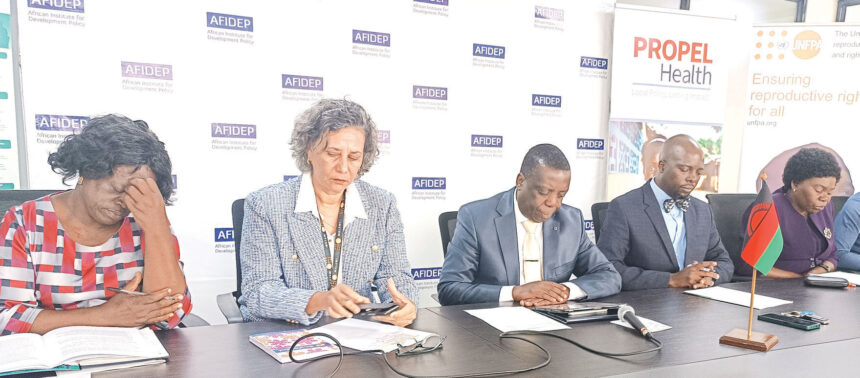
Secretary for Economic Planning and Development in the Ministry of Finance Patrick Zimpita made the revelation in Lilongwe Monday at the start of the Population Week, whose aim is to enable the country to have a deeper reflection on population matters and to raise awareness while celebrating progress made.
Zimpita said Malawi’s age dependency ratio, which is the ratio that measures people that are working versus people that are not working, is at 91 percent.
“I want to emphasise this point because it is extremely important for us to understand. What it means is that, in this country, only nine percent of the people are in the labour workforce while 91 percent are not working.
“It means that nine percent of our population is supporting 91 percent. It also means that one person in this country supports nine people in this country. So, I think these are some important statistics and we need to find some solutions on how we can use our age dividend to make our population productive,” Zimpita said.
- Advertisement -
According to Zimpita, Malawi’s population is currently seen at 20,959,238, out of which 51 percent represents the female population while 49 percent represents the male population.
The average fertility rate calculated as births per woman is 3.9 and, by 2024, the Malawi population will reach 21,298,322.
Zimpita said, this year, the Malawi population policy looks at the link between population and socio-economic growth.
National Planning Commission Director General Thomas Munthali hailed the government for having the Ministry of Economic Planning and Development to be the policy holder of population issues in the country.
- Advertisement -
- Advertisement -
Munthali said population is beyond health and cuts across all sectors of the economy.
“If you are talking about the workforce, in terms of productivity, where we are having one person supporting nine people, it means all the sectors have to do their part in order to ensure that we have a quality population which is not just offering a good market but also is productive towards the same,” Munthali said.
The NPC chief was quick to note that the Malawi 2063 is centred around the new narrative of wealth creation and that one cannot talk about wealth creation if the quality and size of the population cannot contribute to the same.
United Nations Population Fund Country Representative Nelida Rodrigues hailed Malawi for allocating a week to reflect on population issues.
Rodrigues also hailed the coordinated approach by the Malawi Government in addressing population issues.
African Institute for Development Policy Director of Research for Sustainable Development Policies and Head of the Malawi office, Nyovani Madise, said, at the current growth rate, Malawi’s population would have doubled to 42 million by 2050.
Madise said the population growth is not matched with economic growth and the resources that the country has.
She was quick to note that Malawi cannot become prosperous with a growing population where one person is supporting eight to nine people.
The Population Week will be celebrated under the theme ‘Harnessing Gender-Centred Human Capital Investment for Inclusive Socio-economic Transformation’.
The special emphasis of the theme of this year’s celebrations is on gender upon recognition of the fact that gender equality is key for Malawi to achieve Sustainable Development Goals and aspirations in Malawi 2063.