




By Imam Wali:
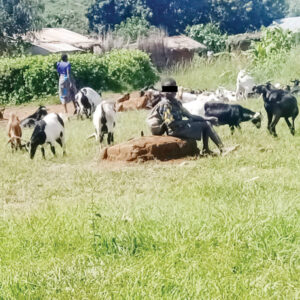
The spectacle of children herding cattle and other animals is not a new phenomenon in Dedza District.
Just that, these days, what is glaringly obvious is the increase in the number of children who are doing so.
Such is the extent of child labour that, according to the 2015 National Child Labour Survey (NCLS), 2.1 million children, or 38 percent of children aged between five and 17, are involved in child labour in Malawi.
Out of these, 39 percent are boys while 37 percent are girls.
- Advertisement -
Child labour is more prevalent in rural areas, at 39.3 percent, than urban areas, at 30.3 percent, with the Southern Region having the highest proportion of children in child labour (43.5 percent) compared to Central and Northern regions (33.3 percent and 33.8 percent, respectively).
According to the International Labour Organisation and United Nations Children’s Emergency Fund (Unicef), 38 percent of children work in the agriculture sector, out of whom 11.2 percent are boys while girls make 7.8 percent of the population.
Among the boys is 10-year-old Welemu Phiri from Mwawa Village, Traditional Authority Kasumbu, in Dedza District.
On September 12 last year, he dropped out of school to search for employment.
- Advertisement -
- Advertisement -
However, the hope he had of landing a job vanished when he arrived at Dedza Boma.
“When I arrived at the Boma, I could not find a job, such that I was sleeping at Dedza Bus Depot without blankets to cover myself with.
“In the end, the job I landed is that of a cattle and goats herder,” he said, resignedly.
He wishes he could stay put in standard six at Kanyenda Primary School.
Today, Welemu spends all his days at Dedza Mountain, where he watches over grazing animals. He works from Monday to Sunday, with his typical day starting at 5am and ending at 5pm.
“My day starts early in the morning and ends around 5pm. The worst part is that I only take one meal a day,” explained Welemu, barefooted and clad in torn clothes.
Welemu’s wage is based on the number of animals he cares for.
Initially, it was pegged at K1,000 per cow but his boss fails to fulfill the promise.
“I look after 12 cows. The agreement is that I should be getting K1,000 monthly per cow. That translates to K12,000 but I have worked for eight months without getting paid. The boss says he is keeping the money for me,” he pointed out.
He is not the only one in that predicament.
Ngwisa, from Katsekaminga Village in the same district, is another child victim of poverty, which has pushed him into child labour
“Life is tough and we are struggling. For example, with a group of friends, I look after close to 100 goats but no one is paid. When it rains, it soaks us to the bone, such that we sometimes fall sick— but that [sickness] serves as no justification for not reporting for work,” Ngwisa explained.
Adolescent girls have not been left out of the child labour net, with 12-year-old Tiyanjane Jailos serving as a clear testimony.
As her peers debate on theories, she sells fizzy drinks at, of all places, Chipalukwa Primary School, where she watches age mates get in and out of classes.
“I dropped out of school because of poverty and secured this job because I want to be supporting myself. I know I am young and that I am supposed to be in class but I had no one to support me,” Jailos pointed out.
Such cases have become a thorn in the flesh of Senior Chief Chilikumwendo of Dedza District.
“I am a worried person. To make things worse, a lot of children from my area are trekking to Mozambique, where they are working in farms. Others are into mining. All this means they have set their aspirations aside for immediate pleasure,” Chilikumwendo says, hands akimbo.
The traditional leader cited Mateme as one of the areas his people are trekking to in Mozambique.
“As a result, school dropout rates are rising, more so because most schools in my area are along the border with Mozambique,” he said.
Surely, children such as Welemu, Ngwisa and Tiyamike and many others are forgoing rights, notably the right to hygiene, education, health, protection, recreation and relaxation.
Instead, they endure stress and fall victim to violence, which can be in such forms as verbal, physical and sexual.
They are sometimes exposed to drug abuse, too.
This is happening at a time the National Action Plan (Nap) II expires in the next two years while the National Child Labour Policy (NCLP) remains in draft form.
The delay jeopardises the attainment of Sustainable Development Goal 8.7, which is premised on ending all forms of child labour.
The total cost of implementing Nap II over the five-year period between 2020 and 2025 is estimated at $44.7 million (approximately K32,572,500,000). Nap II will be financed by the Government of Malawi, development and cooperating partners and stakeholders, including civil society organisations.
Meanwhile, six child-focused organisations, namely Save the Children, World Vision, SOS Children’s Village International, Terre des Hommes International Federation and Educo are implementing a project called ‘Joining Forces For Africa: Acting to End Child Labour (JOFA-ACTE)’ in Malawi, Burkina Faso, Mali and Madagascar.
In Malawi, there are two implementing organisations, namely Save the Children International and Plan International Malawi.
On its part, government— through the Ministry of Labour— has said it is doing its best to address the problem and free children from the bondage that is child labour.
The ministry’s spokesperson Nellie Kanyemba said they realise that child labour can reverse development gains.
“Child labour is a critical issue affecting countries and the world at large. In Malawi, child labour remains a problem, as revealed by the National Child Labour Survey conducted in 2015. It showed that the rate among those aged between 5 and 17 years was at 38 percent. Out of these children, 72 percent work in the agriculture sector, 23 percent in domestic sector while the rest are in other sectors.
“That said, Malawi has since engaged an extra gear to reverse the situation so that we can have a child labour-free Malawi by [the end of] 2025, as set by Sustainable Development Goal 8, specifically 8.7,” Kanyemba emphasised.
As part of efforts to improve the situation, the country has ratified two critical conventions: International Labour Organisations Conventions 138 and 182, along with national pieces of legislations such as the Constitution, Child Care Protection and Justice Act of 2010, the Employment Act of 2000 and the Education Act of 2012.
All of these contain provisions that promote child education and prohibit child labour.
Child labour itself is happening at a time the country is a signatory to a number of conventions that protect children from abuse, including the United Nations Convention on the Rights of the Child, which is a human rights treaty which sets out the civil, political, economic, social, health and cultural rights of children.
The current situation has riled child labour expert Lucky Crown Mkandawire.
“We must do something about the situation so that children can have a bright future. What is happening makes me angry,” he said.
The problem is, many people are angered by reports of child labour; very few act.
Indeed, it is such inaction that keeps Welemu, Ngwisa and Tiyamike stuck in the pit of child labour— and no one knows till when.