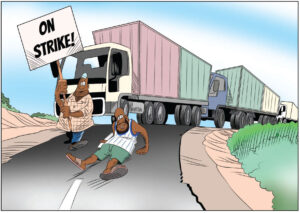
 For years now, truck drivers have exhibited a false sense of entitlement, issuing absurd threats and engaging in irrational actions simply because of their profession.
Given their role in transporting strategic commodities such as fuel, the drivers often leverage this to make demands which are, unfortunately, frequently directed at the wrong party.
For example, despite the government introducing new minimum wage regulations for the drivers, they went on strike from Wednesday because some individual employers, not the government, were failing to implement the new salaries.
It seems as though they expect the government to intervene directly with every truck owner to ensure compliance with the new wage laws.
The strike has obviously disrupted the economic activities of truck owners, who have repeatedly shown a lack of resolve in dealing with employees who embark on unreasonable strikes.
- Advertisement -
It is puzzling why a private individual should have their vehicles grounded due to a strike by an employee who will, in any case, need to return to the same employer when the strike concludes.
It is even more ridiculous to witness striking drivers forcing everyone, including non-members of their associations, to abandon their vehicles.
Laws regarding freedom of assembly and picketing stipulate that individuals not involved in an industrial action should not have their rights infringed upon.
Previously, it took military intervention to drive fuel tankers to filling stations after authorities realised that the strike was severely disrupting fuel supply.
- Advertisement -
- Advertisement -
What is stopping security agencies, such as the Malawi Police Service, from taking action against the striking drivers who are obstructing everyone, including foreign nationals who are not members of their associations?
Why should businesses unrelated to the strike suffer simply because some individuals want their actions to have a wider impact?
It is akin to students protesting against a rise in university fees by forcing everyone, including those from unaffected institutions, to join their demonstrations.
It is perplexing that authorities seem to overlook the absurdity of the truck drivers’ actions, despite the clear legal violations and infringement on the rights of others who do not wish to participate in the strike.
We may soon face a transportation crisis due to this strike.
The last time this occurred, a notable consequence was a shortage of fuel at pump stations, as tankers were grounded while drivers blocked roads, almost preventing smaller vehicles from using them as well.
Motorists spent hours at filling stations before authorities managed to reach an agreement with the drivers to end the strike.
The current strike is already having significant impacts on the economy.
In the Shire Highlands, where most of Malawi’s milk is produced, farmers have been severely affected.
Processors’ tanks could not collect the milk and in the absence of adequate storage facilities, it has gone bad and been discarded.
Farmers invest heavily in the cows they milk, only to see the milk wasted.
This is all due to a strike that should be addressed by the drivers’ employers.
Moreover, in private employment, if employees are dissatisfied with their benefits, they can easily leave their jobs and seek better opportunities.
Truck owners—unless they are playing politics— must also defend their rights as employers, as they clearly have them.
They should not allow their businesses to be disrupted by employees who still wish to keep their jobs but threaten the businesses simultaneously.
Regarding passports, where drivers seek preferential treatment, they must understand that they are not unique.
They are like all other Malawians. Many cross-border traders frequently travel and have their passport pages filled up quickly.
These individuals have never stormed the Immigration Department demanding larger passports or prioritised issuance.
Perhaps it is time for the government to significantly reduce reliance on road transportation for fuel and other crucial commodities.
This would ensure that even during a strike by truck drivers, essential goods continue to flow into and within the country.
Such a measure would also address the issue of truck owners who allow their businesses to be disrupted by their employees.
Regardless of how the strike concludes, the economic disruptions have already occurred and the lost revenue cannot be recovered.
All this because of drivers who harbour an unreasonable sense of entitlement and believe they deserve special treatment.
They are simply employees and are free to leave their jobs if they feel they are not adequately compensated.
Regarding passports, many other individuals who frequently cross the country’s borders would also be justified in requesting the travel documents with more pages.