STAGE—Mkumbwa
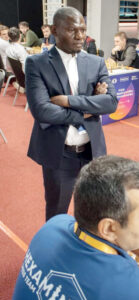
Malawi’s international arbiter Gilton Mkumbwa made a mark at the 2025 Fide World Rapid and Blitz Team Championships in London, United Kingdom where he was one of the two African arbiters out of 20 officials. Mphatso Malidadi of The Sunday Times spoke with Mkumbwa on his trip.
You were recently appointed as an arbiter at the recently concluded 2025 Fide World Rapid and Blitz Team Championships in London, United Kingdom: what was your reaction following your selection?
I was excited to be officiating World-class players, having such elite players listen and respond to your decisions is not a small achievement. It was both an honour and a testament to the respect and authority the role of an arbiter carries and holds at the highest level.
Being one of the two African arbiters, how intimidating was the stage and how did they welcome and work with you two?
Well, the Arbitration Team comprised arbiters from all Fide continents. We worked in unison not only with fellow arbiters but with all stakeholders who were involved with the organisation of the event including organisers, media, volunteers etc. We had a pleasant and warm welcome from the event organisers straight from the moment we touched down in the UK and for the duration of the event. There was a splendid working environment with the whole team and we enjoyed the event, same goes to the players. As arbiters we used to have meetings an hour before the start of the games each day to review and plan for the next games which brought satisfying team spirit and encouragement to perform even better.
- Advertisement -
How challenging was arbitrating the UK games?
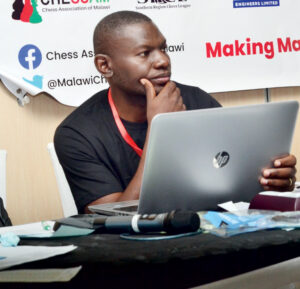
Making quick judgements was critical because any delay would give an advantage to the other opponents to use this time to think on better moves.
Physical fitness played a key role too as I had to be attentive and on my feet for most times and over seven hours on each day.
What experience are you cherishing from the games and why?
- Advertisement -
- Advertisement -
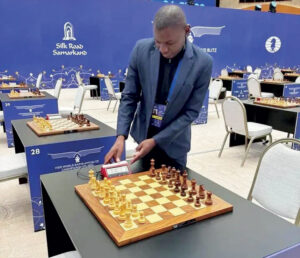
It was a valuable and great learning experience. For example, in one match, I had to penalise a player for making an illegal move, something that requires both firmness and precision, and had to adjust the clock readings accordingly to add extra time to the other player. This required my dexterity to handle the clock in the least time possible so that the game can get underway and not affect the events playing schedule. In another instance, a player claimed a draw without meeting the required conditions as per the regulations, and I had to correctly analyse the claim and refute it as it was a wrong claim.
When did you become an arbiter and what does it take to become one?
I became a Fide Arbiter in 2007 after passing the Fide Arbiters’ Seminar examinations in Windhoek, Namibia and attained the International Arbiter title in 2016 as Category D. In the year 2023 I upgraded my classification Category from D to C after gaining the much-needed experience in International, Continental and World events.
The Arbiter title structure consists of three main levels:
- National Arbiter (NA)– Recognised only by the national federation.
- Fide Arbiter (FA)– Recognised by the World Chess Federation (Fide).
- International Arbiter (IA)–The highest level, subdivided into four categories: A, B, C, and D.
To become an International Arbiter, one must pass Fide examinations and officiate at a minimum of five national and international events, meeting specific norm requirements.
Since you started arbitrating international events, which tournament do you count the best and worst? Explain your answer.
The best event was at the World Amateurs Chess Championships in Singapore in 2013 where the player admitted that he made a mistake and he deserved to be punished. With that attitude I only gave him a warning otherwise I could have penalised him by deducting time.
The worst I did say was during World Individual Rapid and Blitz in Uzbekistan in 2023 where I penalised a player due to dress code after the player wore sneakers which was not allowed as per the Dress Code Regulations of the event and he was fined 200 Euros.
Any remarks?
Chess is becoming increasingly dynamic with the integration of sophisticated technology. My critical guiding principle as an arbiter is to never penalise a player without tangible evidence. In today’s chess environment, where the game is becoming increasingly dynamic and integrated with sophisticated technology, this principle is more important than ever.
Many games are broadcast live, and every decision made by an arbiter is subject to immediate public and professional scrutiny. Therefore, maintaining accuracy, fairness, and professionalism is not just expected—it is essential.
A single incorrect decision can be challenged, potentially affecting both the integrity of the tournament and the reputation of the arbiter. This is especially true in high-profile events such as Fide World Championships, where the stakes are high and standards must be impeccable.