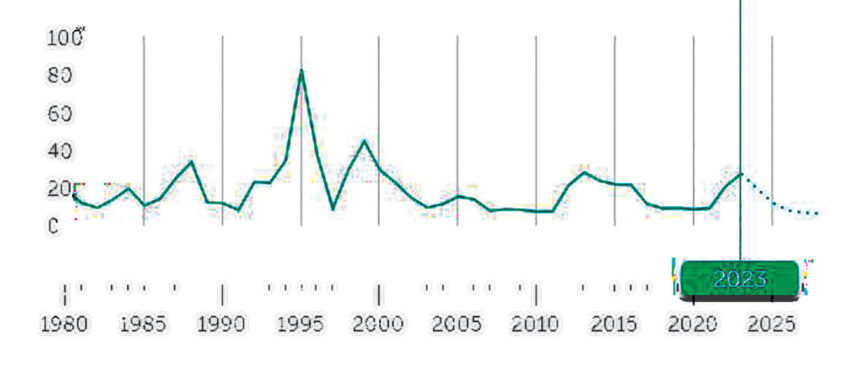
Figures from the International Monetary Fund (IMF) website, the IMF Data Mapper, indicate that the Breton Woods Institution sees Malawi’s inflation registering a downward trend in the medium to long-terms, reaching an average of 6.9 percent in 2026.
The data suggest that Malawi’s general increase in prices and fall in the purchasing value of money will average 27.7 percent in 2023, 19.8 percent in 2024, and 12.2 percent in 2025.
The IMF 2023 inflation projection is 1.8 percentage points lower than the recent Reserve Bank of Malawi (RBM)’s outlook, at 29.5 percent.
This means that inflation may stabilise or drop in the remaining months of the year.
In its latest staff report published in July, the fund also said, at the time, inflation was driven by both food and non-food items, reflecting pass through from a 25 percent currency devaluation in May 2022, high global prices for fuel, fertiliser and food, as well as prolonged supply disruptions.
- Advertisement -
It called on the country’s central bank to remain vigilant to safeguard financial sector stability, given the banking sector’s large exposures to government and associated potential risks.
But in an interview Wednesday, economist Exley Silumbu said rising food prices would continue piling pressure on headline inflation.
“Apart from natural shocks, a key factor is how forex generation or supply will be and, hence, how the exchange rate will behave. It’s quite an uncertain path for inflation to converge to the target rate or range,” Silumbu said.
In an earlier interview, Economics Association of Malawi (Ecama) Executive Director Frank Chikuta said inflation for 2023 and possibly 2024 should be significantly lower than the average for 2022 because of base effects.
- Advertisement -
- Advertisement -
“Prices for 2022 and the most part of 2023 were very high, so one would expect that inflation has picked and, therefore, that prices would not continue rising. From that angle one would expect inflation to come down because of the two factors that it has picked but also that the base to compare with is that of very high prices,” Chikuta said.
The Economic Intelligence Unit (EIU) projects that inflation for Malawi will average 30.5 percent in 2023.
A recent Malawi Economic Indicator Projection by Bridgepath Capital Limited highlights that weather shocks, exchange rate depreciation and the Russia-Ukraine war have put pressure on both food and non-food inflation, hence the recent upward trajectory in inflation.