By Dumbani Mzale, contributor:
The country’s second national long-term development blueprint, the Malawi 2063 (MW2063), articulates the aspiration of Malawians of becoming an inclusively wealthy and self-reliant industrialised upper-middle income country by 2063.
This has become almost synonymous with a national hymn.
The overarching national strategy is anchored by three pillars, namely Agricultural Productivity and Commercialisation; Industrialisation; and Urbanisation.
But there is something interesting about this blue-print.
- Advertisement -
It articulates the enablers that will propel the country towards achieving economic independence, inclusive wealth creation, self-reliance and a high quality of life for all its citizens.
Overall and above, human capital development forms an integral part of the document.
No wonder that it is one of the seven enablers of the Malawi 2063 vision.
Economic experts contend that human capital allows an economy to grow and, apparently, crafters and master-minders of the blueprint knew this pretty well.
- Advertisement -
- Advertisement -
Their logic is that when human capital increases in areas such as science, education, and management, it leads to corresponding increases in innovation, social well-being, equality, increased productivity and improved rates of participation, all of which contribute to rapid economic growth, as measured by the generic gross domestic product (GDP).
As an extension, a healthy and educated nation leads to increased productivity, better income distribution and a generally improved standard of living.
A deteriorating health situation will always undermine the ability of individuals to lift themselves out of poverty and will lead to a general decline in productivity.
According to a human development index (HDI), a child born in Malawi today will be 41 percent as productive when she or he grows up as she could be if she or he enjoyed complete education and full health.
“The rating speaks volumes of the need for the country to hugely invest in human capital development because, globally, countries which have invested in human capital have witnessed massive development within a short time as human capital development is a key ingredient of economic development,” says health economist Gowokani Chijere-Chirwa, who teaches economics at the University of Malawi (Unima) in Zomba.
On the flip side, an uneducated population generally does not understand and appreciate better the need and means for achieving higher incomes, reducing infant mortality and population growth as well as improving nutrition and health.
Makanjira tales
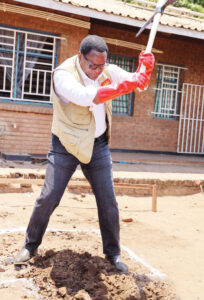
It is against this background that President Lazarus McCarthy Chakwera became a center of attraction when he cunningly linked a health sector infrastructure boom to the country’s vision.
The President spoke with passion about how his government is tirelessly investing in healthcare provision as one quick panacea to expediting the transformation of Malawi into a lower middle income country by 2030.
He said this during the launch of Makanjira Centre for Comprehensive Emergency Obstetric and Neonatal Care (CEmONC) on October 16, 2023.
The new facility, situated 1010 kilometres from Mangochi Boma, is deemed as the epitome of serious political will and is billed to help uplift the welfare of the rural masses through massive infrastructure projects of critical social amenities.
For example, once completed, the new facility is expected to save the lives of many while improving the lives of women and children traditional authorities Makanjira, Lulanga and Namabvi, whose population includes over 53,000 women of child-bearing age and over 46,000 children under the age of five.
The overall goal is to increase both access and quality when it comes to healthcare service provision in these areas.
But there is one interesting catchy statement which the President uttered when he addressed a gathering at a rally soon after launching the project.
“We are doing all these things to put money where our mouth is, when it comes to enabling the Malawi 2063 vision, because we cannot turn Malawi into a wealthy nation without ensuring that Malawians are healthy citizens,” he said.
And it is not just general healthcare provision that is taking centre-stage under the Chakwera-led administration.
Minister of Health Khumbize Kandodo Chiponda says the government is also massively investing in the management of specific illnesses through the development of specialised facilities.
“This is why we now have infectious disease treatment centres completed in Zomba and underway in Mzuzu, all at the same time that we are pursuing the completion of the Cancer Centre Project,” she says.
Similarly, the government has lined up several initiatives towards malaria control, immunisation and reducing the overall disease burden that is being undertaken, including procurement and distribution of drugs, medical supplies, and key pieces of equipment.
Projects ‘not mere show’
There is an emphasis from Chakwera and this has been repeatedly communicated in several official public engagements.
“We are not here to launch this project [the Makanjira upgraded health facility] as a mere show as has been the practice in the past. It is the policy of my administration that no construction project be launched unless the material, monetary, and technical wherewithal for commencing works is well in hand and ready for execution,” said the Malawi leader.
As such, the President proclaimed that his office would be monitoring closely the Makanjira and similar projects unfolding across the country to see that there is progress being made on time and within budget.
“This is our approach across the health sector, where we have either completed key health projects in several districts or where projects are under construction.
“These include health centres in Nancholi (Blantyre), Makina Health Centre in Zomba and Chilinde Health Centre in Lilongwe. Additionally, we have health posts in Dedza, Mwanza, Neno, Phalombe, Thyolo, Mzimba and Ntchisi that are about to be completed. Then there are also dilapidated health facilities in Chitipa, Dowa, Kasungu, Likoma, Balaka, Chikwawa and Mzimba that we are rehabilitating at the same time,” he said.