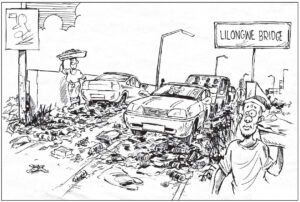
 Three months after motorists began gliding across the newly constructed Lilongwe River Bridge, its surroundings were already scarred by litter.
Plastic bottles caught in grass. Discarded food containers hugging the riverbank. Wind-blown debris gathering along the edges of a structure that cost billions of kwacha to build.
It is difficult to overstate the embarrassment.
The bridge, funded by Japan through the Japan International Cooperation Agency (Jica), is a declaration that Malawi’s capital could rise above congestion, inefficiency and stagnation.
And yet, before the paint has even lost its sheen, we have already managed to undermine its dignity.
- Advertisement -
Recently, officials from Jica and the Malawian Government led a clean-up exercise around the bridge ahead of its formal handover.
The gesture was admirable. It was also revealing. That an external partner felt compelled to mobilise a cleaning campaign around a national asset speaks volumes about the state of our civic culture and our leadership.
It should not take foreign diplomats with gloves and bin bags to remind us that littering is unacceptable.
The truth is painful. Lilongwe has a waste problem. A chronic one. And it is getting worse.
- Advertisement -
- Advertisement -
The capital city of a country is its shop window. It is the first impression for investors, diplomats, tourists and even our own citizens from the districts.
It is meant to showcase order, ambition and pride. Instead, too often, Lilongwe presents a different image; that of uncollected garbage at trading centres, clogged drainage systems, plastic waste in rivers and roadside dumping that has become normalised.
Normalised. That is the word that should trouble us most.
When litter becomes background scenery, when plastic bags trapped in trees no longer shock us, when drains blocked by waste are accepted as inevitable, we have surrendered to mediocrity.
The bridge’s deterioration into a litter-stained corridor within three months is not merely an aesthetic issue. It is symbolic. It tells a story about how we treat public goods.
We celebrate ribbon-cutting ceremonies. We applaud speeches about development. We share photographs of modern infrastructure on social media. But once the cameras leave, so does the sense of responsibility.
Infrastructure without stewardship is decay in slow motion.
Of course, responsibility is shared. Citizens must stop treating open spaces as dumping grounds.
Traders must manage refuse around their premises. Motorists must stop throwing rubbish out of car windows. But leadership sets tone. Leadership sets standards. Leadership enforces consequences.
And here is where the frustration deepens.
Where was the proactive response from city authorities when waste began accumulating around this flagship project?
Why are routine waste collection systems so visibly inconsistent in parts of the capital?
Lilongwe cannot continue to operate on crisis management.
The pattern is familiar. We react when embarrassment looms. We mobilise when dignitaries are coming. We clean when cameras are rolling. But sustainable systems? Regular enforcement? Continuous public education? Those are less visible, less glamorous and therefore too often neglected.
This is not simply about optics. Waste mismanagement has environmental consequences.
Lilongwe River is not a decorative feature; it is an ecosystem. Plastic and other refuse threaten water quality and downstream communities.
During heavy rains, blocked drainage exacerbates flooding. Public health risks follow.
The cost of inaction far exceeds the cost of maintenance.
It is particularly disheartening because the bridge represented something hopeful. It symbolised cooperation between Malawi and Japan.
It symbolised trust. Trust that the resources provided would be valued and protected. When the Japanese Government, through Jica, invests in infrastructure, it is extending confidence in our capacity to manage what we receive.
If three months of public access are enough to transform a landmark into a litter hotspot, what message are we sending?
There is also a deeper psychological dimension. Cities reflect collective identity. When a capital city appears neglected, it chips away at national pride.
Young people growing up in Lilongwe should see order and possibility, not unmanaged waste. Visitors should not need to look past rubbish to appreciate progress.
We often compare ourselves to other capitals on the continent and ask why they appear cleaner, more organised, more functional.
The answer is not mystical. It lies in consistent enforcement, proper waste infrastructure and civic discipline reinforced from the top.
Leadership cannot afford to be passive.
If the mayor and city authorities are perceived as sleeping on duty, as some critics have charged, it is because visible problems persist without visible solutions.
Residents see garbage. They do not see systematic change. They see sporadic clean-ups. They do not see long-term strategy.
Lilongwe deserves better. Malawi deserves better.
We need a comprehensive urban waste management plan that is funded, monitored and enforced.
We need clear accountability within the city council. We need penalties for illegal dumping that are actually applied.
We need public awareness campaigns that go beyond slogans and become sustained education. We need partnerships with private waste collectors that are regulated and reliable.
And perhaps most importantly, we need to cultivate a culture of ownership.
Three months should not be enough to tarnish a national symbol.
Lilongwe is our capital city. It must begin to look like one.