




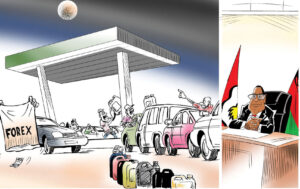
 President Lazarus Chakwera’s announcement that he will travel to the United Arab Emirates (UAE) to secure a government-to-government fuel deal amid Malawi’s current fuel crisis has raised concerns about his leadership and priorities.
While Chakwera presents the trip as a strategic effort to address the country’s fuel shortages, it seems more likely to be an opportunity for him to indulge his frequent appetite for foreign travel rather than providing real solutions to the crisis at hand.
Forget his claim that the UAE government is sponsoring the trip — our taxes will be diverted to the Middle East and the sums involved will be considerable.
Since taking office, Chakwera has developed a habit of making frequent international trips, often at the taxpayers’ expense.
Although international diplomacy and trade deals are undoubtedly important, the sheer frequency of these overseas visits—especially during a time of economic instability—raises questions about his commitment to addressing pressing domestic issues.
- Advertisement -
In a moment when the country is facing several challenges, one might expect the President to prioritise solving problems at home.
The timing of this trip casts doubt on whether his focus is genuinely on resolving the fuel crisis or on something else entirely.
Chakwera’s fondness for foreign travel is well-known.
His administration has been characterised by numerous international trips, often accompanied by large delegations and promises of trade partnerships and foreign cooperation.
- Advertisement -
- Advertisement -
While some of these trips have led to agreements or pledges of aid, many are more about creating political appearances than about delivering tangible benefits to the people of Malawi.
This is particularly concerning at a time when Malawians are struggling with escalating economic instability.
The optics of a president flying abroad to negotiate fuel deals while his country faces a domestic crisis are hard to ignore.
Malawi’s fuel crisis is not a new issue. For years, the country has faced recurring fuel shortages that have disrupted multiple sectors of the economy.
Given the long-standing nature of this problem, Malawians would understandably expect their president to focus on finding sustainable, long-term solutions to reduce the country’s vulnerability to fuel shortages.
However, Chakwera’s response has been more reactive than proactive, relying on short-term measures such as securing fuel imports rather than addressing the deeper, structural issues within the energy sector.
While a government-to-government fuel deal with the UAE may offer temporary relief, it will do little to tackle the root causes of the fuel crisis.
The President’s portrayal of this trip as a high-stakes diplomatic mission to resolve the fuel shortage may create the illusion of a leader taking direct action, but in reality, his administration has failed to implement the long-term reforms needed to ensure fuel security.
Political decisions have also contributed to the crisis, particularly interference in the management of fuel prices and supply, especially at the Malawi Energy Regulatory Authority.
Another concerning aspect is Chakwera’s prolonged silence regarding the crisis.
For nearly two months, Malawians have endured hardships—long queues at petrol stations, rising transport costs and businesses struggling to operate.
Yet the President has remained largely silent, offering no public addresses, no clear interventions to alleviate public anxiety and no policy measures to ease the economic pressure.
Instead, the country seemed to be left to fend for itself, with the government appearing disengaged.
Given the seriousness of the situation, it is troubling that Chakwera waited until the crisis had reached its peak before announcing any action.
The proposed fuel deal with the UAE, while promising in theory, is unlikely to provide immediate relief.
Fuel imports take time to process and negotiating new agreements with foreign governments is often a lengthy and bureaucratic process.
Addressing the fuel crisis requires more than flying abroad to negotiate new contracts—it demands a long-term, systemic approach to energy policy that protects the sector from political interference.
Adding to the frustration is Chakwera’s announcement of austerity measures to address the nation’s economic challenges.
Unfortunately, this is not the first time such promises have been made and his administration’s track record on austerity has been unimpressive.
Previous attempts to implement austerity measures have yielded little result, with government inefficiencies and wasteful spending continuing unabated.
True austerity should involve prioritising essential services, reducing unnecessary expenditure and tackling the budget deficit.
However, the current government has shown little inclination to address the root causes of Malawi’s fiscal problems.
Instead, austerity measures have often appeared superficial—such as cutting foreign travel for officials on paper, while they continue to travel abroad when out of the public eye.
While such measures may generate short-term political goodwill, they do little to address the underlying inefficiencies within the public sector.
Chakwera has repeatedly promised to reduce government spending and prioritise development but the government continues to face criticism for overspending on lavish projects, such as the purchase of luxury vehicles for senior officials.
This raises questions about whether the austerity measures are merely a political tool, designed to placate public frustration without bringing about any substantial changes.