
By Charles Mpaka:
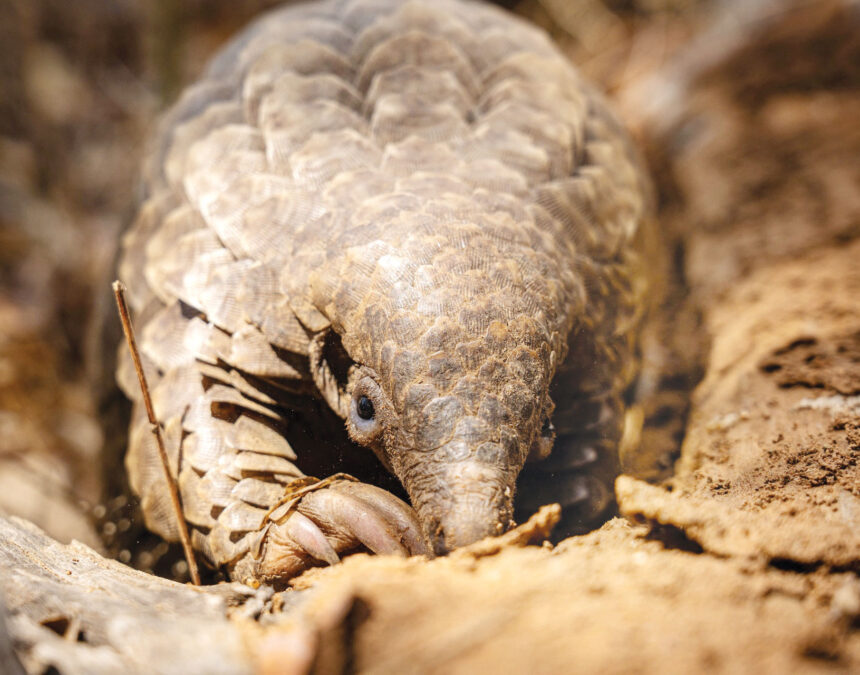
Sometime in 2021, a pangolin was admitted to Lilongwe Wildlife Trust veterinary clinic.
She had arrived without the back left foot, cut off possibly in a poacher’s snare.
At this Malawi’s only specialised wildlife medical centre, specialists performed a surgery that removed an exposed bone on the cut-off foot.
Daily for six good weeks, staff cleaned the animal’s wound aiding its quick healing and eventually enabling the pangolin they named Peggy to walk again.
- Advertisement -
This is one of the accounts of how medical care at the clinic is giving pangolins a chance to live again.
Endangered species
The need for this service is growing.
Shy, often solitary and harmless to humans, pangolins around the world face the threat of extinction.
- Advertisement -
- Advertisement -
Over the past 20 years, their global population has declined by 80 percent, according to research.
This decline is largely driven by illegal trading of the species to satisfy a surging demand in Asian markets for meat and scales for medicine.
Today, pangolins are now considered the most trafficked mammal in the world.
Owing to escalation of threats for the species, CITES (the Convention on International Trade in Endangered Species of Wild Fauna and Flora) has banned all pangolin species from international commercial trade.
In Malawi, pangolins are highly protected under the National Parks and Wildlife Act. Being found in possession of a pangolin can earn one a jail term of as long as 30 years.
Given police data, threats on pangolins in Malawi have not necessarily died down despite the high degree of protection government has accorded them.
From 7 arrests of people found in possession of pagolins in 2017, the number rose to 25 in 2019 and then 83 in 2020.
In January this year, Department of National Parks and Wildlife (DNPW) reported that 72 people were arrested in 2021 and 64 in 2022 for pangolin trafficking.
The rise in arrests positively demonstrate a heightened law enforcement; but they also show that pangolin smuggling is still flourishing in Malawi.
And as illegal pangolin trade thrives, so are rising the numbers of pangolins referred to LWT clinic for medical attention.
In 2018, the clinic received one pangolin.
In 2019, the number rose to six, to 24 in 2020 and 33 in 2021.
Last year, the clinic received 39 pangolins.
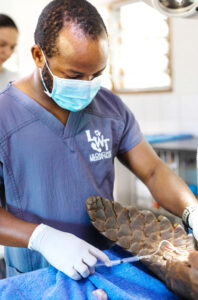
rescued pangolin
Dr Laston Chimaliro, LWT’s veterinarian, says since 2019, the clinic has cared for more than 100 pangolins.
“The majority of pangolins that we support are victims of the illegal wildlife trade. They are brought to us by law enforcement authorities after they have been confiscated from wildlife traffickers,” he says.
Medical care at LWT vet clinic
According to Chimaliro, pangolins rescued from traffickers come to the centre with bouts of stress and trauma.
Sometimes they arrive with life-threatening injuries such as missing limbs.
Often they are starving, malnourished and dehydrated or carrying infections.
At the clinic, specialists provide intensive medical care that can involve things like providing fluids, treating wounds, giving antibiotics and pain relief and performing surgeries on broken limbs and on other conditions.
Beyond medical operations, they need to eat. Pangolins only feed on ants and termites; so staff take the patient out into the bush for a few hours each day so she can fetch food.
The length of time a pangolin takes on medical care varies.
“It can take months to stabilise a pangolin’s weight and health to the point at which it can be safely released back into the wild. If we receive a baby, it can take over a year until they are old enough and healthy to be released back into the wild,” Chimaliro says.
Conservation practice
This veterinary work which LWT does is globally acknowledged as an essential practice in conservation biology –a science-driven discipline whose focus is maintenance of the world’s biodiversity.
Two Portuguese veterinary scientists, Diana Raquel Neves Fernandes and Maria de Lurdes Ribeiro Pinto, say not only do veterinarians have a broad education in comparative medicine; they are also highly trained in recognising, diagnosing and understanding impact of disease on public health and on individuals, populations and whole ecosystems.
“Their skills and expertise turn them into valuable key players in planning, implementing and effectively assisting both in-situ [within natural range of wildlife] and ex-situ [off the natural range] conservation projects,” they say.
At LWT clinic, for instance, the pangolins are more or less captive. This is not their natural range. It was never meant to be. It is only an emergency home for their rehabilitation.
In their chapter, ‘Veterinarian’s Role in Conservation Medicine and Animal Welfare’ in a peer-reviewed volume, Veterinary Anatomy and Physiology published in 2019, Fernandes and Pinto observe that confining animals to a cage or enclosure reduces the complexity of their environment.
It narrows their natural control over their environment, they say. It also restricts the range of behaviour they are able to exhibit according to their nature.
“Where animals have very limited choices, we are the ones planning almost all aspects of their life (e.g., feeding schedules, what to eat, where to sleep, who to live or to reproduce with),” they say.
This requires high-level expertise.
In the case of pangolins, LWT admits that rescuing and rehabilitating the species is highly specialised work, especially considering that these animals arrive at the facility with their health severely impaired.
Rising to this challenge, LWT has had to invest in new projects in first aid skills training, pangolin health assessments, medicine requirements, diet analysis, rehabilitation techniques and post-release tracking.

Boost to DNPW work
Joseph Nkosi, spokesperson for the Ministry of Tourism under which the DNPW falls, says the LWT vet clinic plays “a really big role” in the department’s conservation work.
“In our law enforcement, we find all sorts of animals in need of care. Veterinary services are an integral part of wildlife conservation but we do not have adequate expertise in the department. So we refer the animals to LWT clinic,” he says.
Nkosi says demand for wildlife veterinary service is substantial in Malawi.
“Sometimes, animals are found roaming in communities. Once we rescue them, we don’t release them back into the wild immediately. We need to asses them in case they have contracted diseases that might be transmitted to other animals once they return to the wild. The clinic helps us to make such assessments,” he says.
Contribution to ecosystem
Ultimately, this hustle isn’t just about making a pangolin live.
Pangolins are vital for healthy soils, Chimaliro says. They dig up soils to find ants.
They make burrows which helps to aerate soils and provide home for other animals.
They strip rotting logs and tear down termite mounds to find food. This helps to break them down quickly and add nutrients to the soil.
Returning home
After four months of care, Peggy the pangolin was released back into the wild. LWT ensures that the released pangolin provides data that helps Malawi to understand their habitats.
According to Chimaliro, there is little that is known about pangolin ecology in Malawi. So, on release, the pangolins are tagged with remote tracking devices, which allows specialists to monitor their movements.
“The data we collect through this type of post-release monitoring helps us to understand how pangolins adapt to their new environment, where they are moving and if they are staying safe.
“This helps us build up a picture of what kind of habitats and conditions are needed for the long-term protection and conservation of pangolins,” Chimaliro says.