



By Pemphero Malimba:
Twenty-six-year-old Christina Pearson from Senti—a densely populated residential area near Area 18B in Lilongwe City— wipes her sweaty forehead with the back of her left hand.
She cannot do otherwise under the scorching heat of October.
With the right hand, she holds a green 10-litre bucket, waiting for a turn to draw water from a communal commercial kiosk, which stands at a distance of about a kilometre from her home.
But today is another unlucky day for her. The taps have been dry since morning. And it is now almost mid-day.
- Advertisement -
After a two-hour wait in vain, Pearson and peers turn to the nearby Nankhaka River.
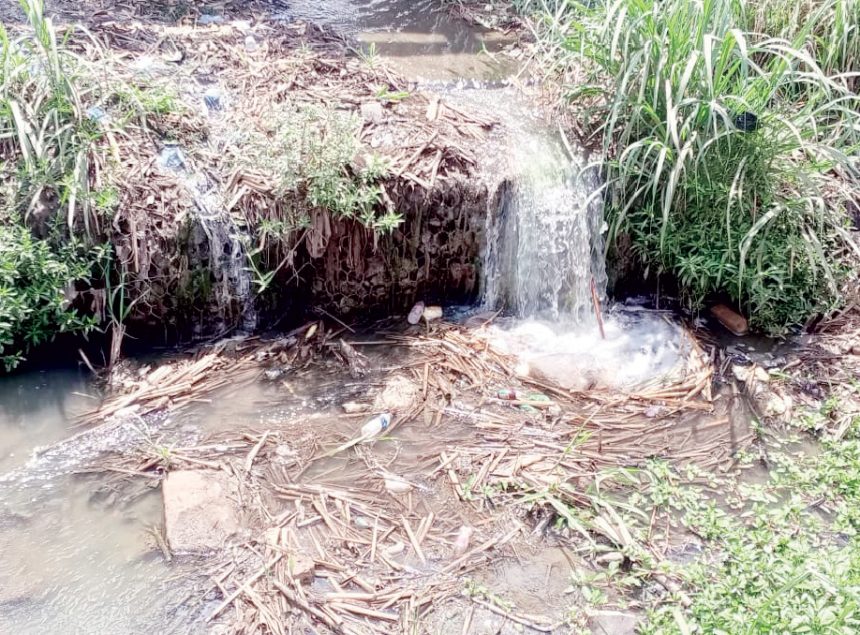
The river is a polluted stream choked with floating rubbish, plastic waste, murky water and foul-smelling sewage, turning what should be a life-giving waterway into a filthy, toxic channel that threatens both human health and aquatic life.
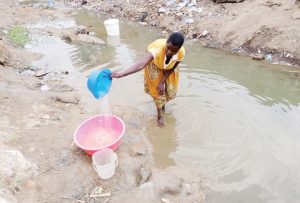
“People from various places come here to dump their waste,” Pearson confesses, “…[but] the water kiosks are not reliable. Sometimes, we have no water for a week. Our only hope is found here, Nankhaka River, although the water is not good for use.”
Tereza Moffat, another Senti resident, knows that the water is not safe.
- Advertisement -
- Advertisement -
But she is forced to use it anyway as she has not accessed potable water for awhile.
“We don’t have boreholes. If the kiosks have no water, we don’t have anywhere to fetch water beside the river,” Moffat says.
On our visit to the river during lunch hour, we found a glaring filthy picture.
Upstream, some people were dumping waste.
Downstream, others were drawing the water, while children swam on the other side, and some urinated therein.
The improper disposal of waste is not only affecting people who fetch water from the river, but also those conducting business at Senti Bridge, which connects Senti and Area 18.
The situation poses a challenge to both the community’s access to clean water and the livelihoods of local business owners, according to Janet Grant, who sells zigege near the river.
“Some customers stop buying from me because sanitation levels are poor on the bridge,” she says.
Those travelling from Lilongwe Town or Lilongwe City Centre to Senti, areas 49, 50 and 25 are welcomed by the scenery of waste dumped beside the bridge and it seems nobody cares.
The tendency of dumping waste anyhow is not only happening in Senti; it is also rampant in Chigoneka in Area 47, Phwetekere in Area 36, Kaliyeka and Chipasula in the city.
For example, at Chipasula, residents dump waste in a water stream on the roadside.
Year in year out, Malawi registers cases of waterborne diseases such as cholera due to lack of hygiene and sanitation.
Malawi recorded 3,200 cases of cholera between December 11, 2025 and August 30, 2026.
Out of the cases, 3,013 were locally acquired, with 25 deaths, and 187 were imported cases, with two deaths.
Of the locally acquired cases, 319 were laboratory confirmed cases and 88 of the imported cases were laboratory confirmed. 18 districts were affected, with urban areas of Lilongwe and Blantyre some of the hotspots.
Lilongwe City Council spokesperson Tamara Chafunya attributed the tendency of dumping waste in streams and undesignated areas to several reasons beyond rapid urbanisation.
Chafunya said the problem was coming in due to inadequate waste collection vehicles and equipment, insufficient staff and working tools, financial constraints, low public awareness, weak enforcement of bylaws, vandalism of waste facilities, poor road access in informal settlements and noncompliance by some private waste operators.
“To address this, the council is intensifying waste collection and hotspot clearing, strengthening enforcement and patrolling, conducting public awareness campaigns and engaging block leaders and councillors,” she said.
In addition to this, she said the council plans to formalize informal waste pickers, promote community-based waste collection models and expand recycling and composting initiatives to reduce waste reaching dumping sites and waterways.
She said the council currently collects and transports solid waste from public markets, promotes strategies such as reduce, reuse, recycle through waste transfer stations and recycling businesses, among others.

“However, due to rapid urbanisation, population growth and limited operational capacity, the council currently collects only about 30 percent of the estimated 600 tonnes of waste generated daily, with informal settlements largely unserved,” she said.
The tendency of dumping waste unnecessarily into rivers is not limited to water streams in Lilongwe alone.
The tendency is also taking place in Mudi and Lunyangwa rivers in Blantyre and Mzuzu City, respectively.
Water and Environmental Sanitation Network Executive Director Safari Mbewe warns that, if not addressed, the problem would put many Malawians at risk of suffering from waterborne diseases.
“There are so many dangers. It means those using water from those rivers are using polluted water, which can cause several diseases,” Mbewe said.
He said the development served as evidence of low efforts to promote proper waste management.
“Most areas have no proper structures where people can dump their waste properly. [Going forward], proper structures for waste management should be provided in all the areas, and communities should be given civic education on proper waste management practices,” he says.