



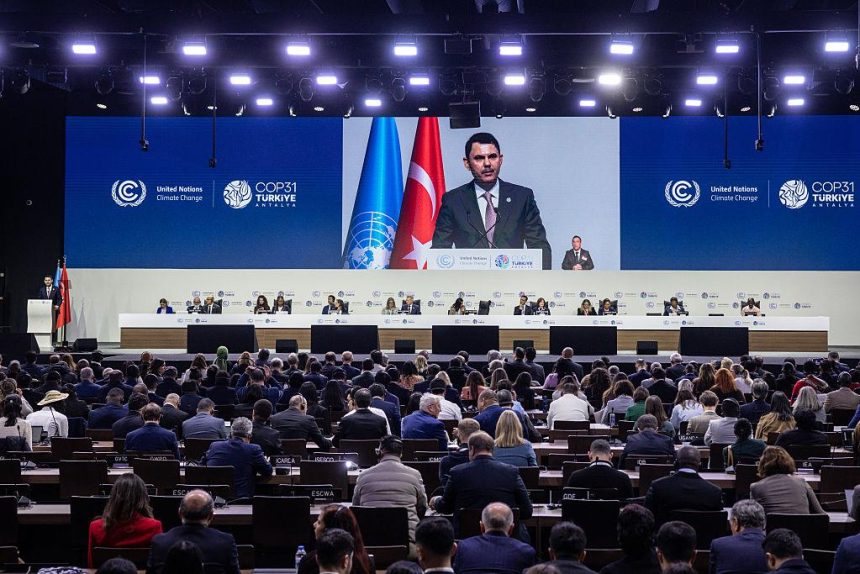
African countries face renewed uncertainty over climate financing after CoP31 negotiations in Türkiye collapsed without securing the predictable financial support vulnerable nations need to tackle the impacts of climate change.
The negotiations ended in disarray in Antalya on Sunday, more than 24 hours behind schedule, after governments failed to agree on a final cover decision addressing climate finance, the phase-out of fossil fuels and a just transition.
Disagreements over adaptation finance and the proposed Just Transition Mechanism have raised fresh concerns about developing countries’ ability to respond to escalating climate threats.

Speaking on behalf of the African Group of Negotiators on Climate Change, Ghana’s Minister of Environment, Science and Technology, Zanetor Agyeman-Rawlings, criticised the outcome, saying commitments on adaptation finance lacked clear targets and implementation mechanisms.
She said the final text reaffirmed the goal of at least tripling adaptation finance by 2035 but failed to establish a baseline or specify the amount required.
- Advertisement -
On loss and damage, she said the text merely welcomed and encouraged support without setting concrete funding targets. Provisions on a just transition also lacked the substance needed to reflect Africa’s development realities.
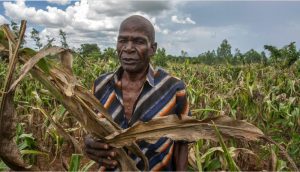
“These are not small gaps. For millions of children, youth, women and men in communities already facing floods, droughts and food insecurity, a commitment without a baseline cannot be called finance,” Agyeman-Rawlings said.
She added that African countries had attended the summit seeking concrete delivery on climate commitments but were leaving without the financial assurances vulnerable communities urgently need.
Malawi’s climate financing gap
- Advertisement -
The challenges facing African countries are reflected in Malawi, where the government estimates that implementing its climate commitments will require $7.06 billion between 2025 and 2035.
According to Malawi’s Third Nationally Determined Contribution, submitted in June 2026, approximately $4.28 billion is expected from international climate finance, representing about 61 percent of the total.
The remaining $2.78 billion is expected to come from domestic and other unconditional resources.
Of the total requirement, approximately $2.84 billion is earmarked for adaptation and $4.21 billion for mitigation.
Malawi’s National Adaptation Plan financing strategy estimates annual adaptation needs at approximately $916 million, against existing financing of about $203 million. This leaves an annual shortfall of roughly $700 million.
Concerns have also emerged over the country’s reliance on debt-based financing for climate-related investments.
A Unicef Malawi Climate Financing Budget Brief for 2025-26 indicates that 61 percent of public climate financing in the national budget comes from blended financing, comprising loans and grants, while 39 percent comes entirely from grants.
The brief warns that although concessional loans may offer favourable repayment conditions, they still add to the country’s debt burden.
These figures reflect concerns raised at CoP31, where developing countries argued that they cannot be expected to finance the transition away from fossil fuels and strengthen climate resilience while grappling with debt and limited access to affordable capital.
Debt and the just transition
Disagreements over climate finance also stalled the operationalisation of the Belém-Antalya Mechanism, a proposed framework for advancing international cooperation on a just transition away from fossil fuels.
Many developing countries had expected the mechanism to be finalised in Antalya, but it faced resistance during consensus negotiations.
Developed countries, particularly members of the European Union (EU), were accused of blocking progress.
The failure to reach agreement means vulnerable countries must wait for further discussions on a framework intended to support workers, communities and economies affected by the transition.
The deadlock comes as many low- and middle-income countries spend significant public resources on debt repayments and interest, leaving limited fiscal space for climate adaptation, disaster preparedness and renewable energy investments.
According to the Fossil Fuel Treaty Initiative, some developing countries face growing pressure to expand fossil fuel extraction to generate revenue for servicing debt owed to wealthier nations.
The initiative argues that without predictable, grant-based climate finance, lower borrowing costs for renewable energy and access to investment, developing countries will struggle to move away from fossil fuels without compromising their development priorities.
Amiera Sawas, Head of Research and Policy at the initiative, accused wealthy countries of failing to demonstrate credible commitments to a fair global transition.
She said some developed countries continued to expand fossil fuel extraction while demanding stronger commitments to phase out fossil fuels during international negotiations.
“While Global North countries rejected the outcome on the basis that there was no language on transitioning away from fossil fuels, these same countries have not themselves presented serious or credible phase-out plans, nor do they intend to support others in their transitions,” Sawas said.
She also criticised the EU and some of its most powerful member states for apparently resisting progress on climate finance while advocating stronger commitments to phase out fossil fuels.
The EU’s position came under further scrutiny after its Climate Commissioner, Wopke Hoekstra, reportedly said that “any conversation on new fresh money is dead in the water”.
Several European delegations also promoted national roadmaps for transitioning away from fossil fuels.
However, the Fossil Fuel Treaty Initiative said its analysis found few new policy commitments in the roadmaps, which remain voluntary and lack binding international obligations or agreed milestones.
Fossil fuels and energy access
The negotiations ended without an explicit reference to fossil fuels in the final cover text, despite pressure on governments to agree on a clear pathway to phase out coal, oil and gas.
Environmental campaigners also criticised the emphasis on carbon capture and storage, arguing that the technology could prolong dependence on fossil fuels rather than address their extraction and production.
Friends of the Earth International described the outcome as a failure to confront the main causes of the climate crisis. The organisation accused wealthy countries and corporate interests of promoting technological solutions while avoiding their financial responsibilities towards vulnerable nations.
It also criticised a proposed target to increase electrification by 35 percent by 2035, arguing that expanding electricity access without addressing affordability, renewable energy and inequality could deepen existing energy injustices.
Siphesihle Hopewell Mvundla of groundWork and Friends of the Earth South Africa said the target failed to address the needs of millions of people without electricity.
Citing an estimated 655 million people globally who remain without access, he argued that electrification commitments must guarantee universal access, affordability, renewable energy and public accountability.
Calls for a Fossil Fuel Treaty
The collapse of the CoP31 negotiations has strengthened calls for international cooperation outside the consensus-based UN climate process.
A bloc of 30 countries is developing a proposed Fossil Fuel Treaty aimed at ending the expansion of new coal, oil and gas projects, managing an equitable phase-out of existing production and mobilising financial resources for a just transition.
The proposed treaty would complement the Paris Agreement by focusing on ending new fossil fuel expansion, ensuring wealthier and less economically dependent producers move first and providing financial support, debt relief and cooperation to countries facing the transition.
Countries involved in the initiative are also participating in the Santa Marta Process, launched in Colombia in April 2026 to advance international cooperation on transitioning away from fossil fuels.
Its second conference, co-hosted by Tuvalu and Ireland, is scheduled for July 2027 in the Pacific. Participating countries hope to secure a negotiating mandate for the proposed treaty.
Tuvalu’s Minister for Home Affairs, Climate Change and Environment, Maina Talia, said vulnerable countries could no longer afford to wait for international negotiations to deliver meaningful action.
He said the next conference would focus on practical plans for a global transition away from fossil fuels while complementing, rather than replacing, the UN climate negotiations.