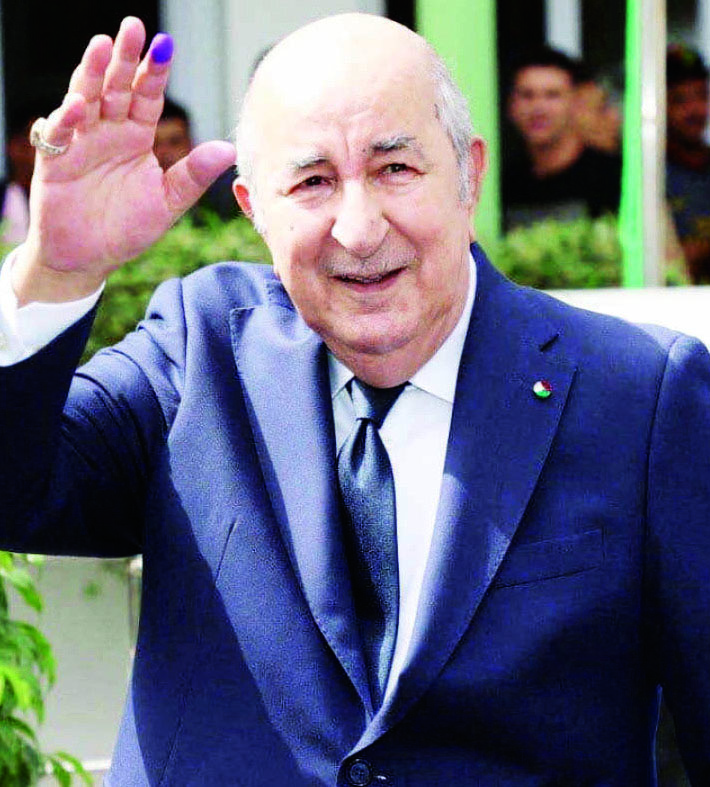
Algerian authorities declared President Abdulmadjid Tebboune the overwhelming winner of Saturday’s election on Sunday, but a rival candidate alleged irregularities in the count and fewer than half of registered voters cast ballots.
Official preliminary results gave Tebboune 95 percent of the vote, enough to avoid a second-round run-off, with Abdelaali Hassani Cherif getting three percent and Youcef Aouchiche two percent. Turnout was 48 percent.
Tebboune, backed by the military, was facing only nominal opposition from Hassani Cherif, a moderate Islamist, and Aouchiche, a moderate secularist, both running with the blessing of Algeria’s powerful establishment.
Hassani Cherif’s campaign said polling station officials had been pressured to inflate results and alleged failures to deliver vote-sorting records to candidates’ representatives, as well as instances of proxy group voting.
“This is a farce,” said Hassani Cherif’s spokesperson Ahmed Sadok, adding that the candidate had won far more votes than had been announced, citing the campaign’s own tallies from regions.
- Advertisement -
Reuters could not immediately verify those tallies or reach Tebboune’s or Aouchiche’s campaign for comment.
However, electoral commission head Mohammed Charfi said when announcing the results that the body had worked to ensure transparency and fair competition among all candidates.
Late on Sunday, three presidential candidates, including Tebboune and Cherif, issued a joint statement in which they objected to the provisional results announced by the electoral commission.
“We inform public opinion of the ambiguity, contradiction, vagueness and conflicting numbers recorded with the announcement of the provisional results of the presidential elections,” the joint statement said.
- Advertisement -
- Advertisement -
Tebboune’s re-election means Algeria will likely keep on with a governing programme that has resumed lavish social spending based on increased energy revenues after he came into office in 2019 following a period of lower oil prices.
Hassan has taken some steps to ease restrictions on the media and opposition since coming to power, but rights groups say arbitrary detentions have continued.