



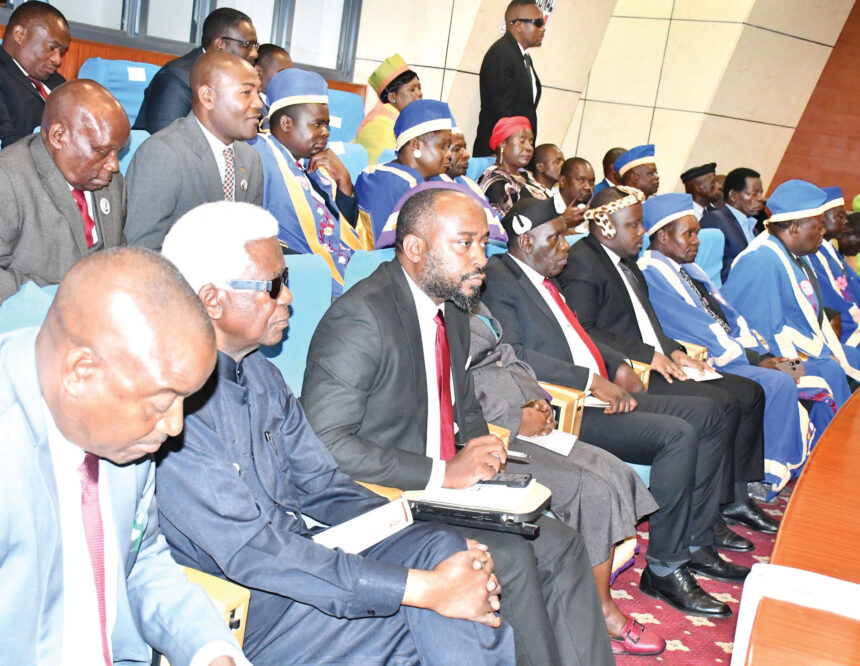
The Special Law Commission has recommended that traditional authorities on government payroll start declaring their assets.
The Commission has also recommended that land officers, auditing personnel, operators of critical information infrastructure and officers from the Malawi Bureau of Standards be included on the list.

Deputy Chairperson of the Commission, Reyneck Matemba, said the Commission has come up with the recommendations to curb corruption, among others.
“The Commission has noted that traditional leaders who are on government payroll are exposed to the risk of corrupt practices and illicit enrichment as they have the power to make determinations on critical matters such as those to do with land,” reads part of the proposed act.
The Commission has resolved that besides police officers, investigative officers at the Malawi Human Rights Commission, the Anti- Corruption Bureau, and the Ombudsman should also start declaring their assets.
- Advertisement -
Benedicto Kondowe, chairperson of the National Advocacy Platform (Nap), a consortium of civil society organisations, has said recommendations put forth by the Special Law Commission on who else should be included on the list of those to declare assets mark a significant stride towards enhancing transparency and accountability within the government.
“By requiring traditional authorities to declare their assets, alongside land officers, auditing personnel, operators of critical information infrastructure, and officers from the Malawi Bureau of Standards, the Commission aims to instill a culture of accountability and integrity in governance,” Kondowe said.
He said the measures not only promote transparency by providing insight into the financial interests of government officials but also serve as a deterrent against corruption and unethical conduct.
This, he said, will ensure that public servants uphold the highest standards of integrity in their roles.
- Advertisement -
- Advertisement -
But he said the successful implementation of these recommendations poses several challenges that must be addressed.
One major hurdle lies in the effective enforcement of asset declaration requirements, requiring robust mechanisms to verify declarations and ensure compliance.

Kondowe has further said that overcoming potential resistance from traditional authorities and other personnel who may view asset declarations as intrusive or burdensome is also crucial.
He has suggested that building capacity through training and resource allocation will be essential to supporting the implementation process, ensuring that stakeholders are equipped with the necessary tools and knowledge to comply with asset declaration requirements effectively.
He further said that despite these challenges, the commitment to transparency and accountability demonstrated through these recommendations underscores the government’s dedication to fostering good governance practices and strengthening democratic institutions in Malawi.
Recently, during the presentation of the report, the Special Law Commission on the Public Officers Declaration of Assets recommended amending the country’s Constitution, Chapter 63, so that it should have the power to remove members of Parliament from their positions if they fail to declare their assets.
Presenting the findings during the review of the Public Officers Declaration of Assets Act, Commissioner Patrick Zaipa said the Special Law Commission is of the view that Section 63 of the Constitution does not include non-compliance with disclosures as a ground for the removal or dismissal of a Member of Parliament.
However, the removal of MPs is still subject to standing order procedures, giving the house the power to vote either way; hence, the laws should be amended.
“The Commission recommends that Section 63(1)(f) of the Constitution be amended to include failure to declare assets as a ground for declaring a vacant sea,” said Zimpita.
The annual declaration report on compliance by listed public officers for the 2020–21 financial year showed that state-owned companies ranked the lowest on compliance with the asset declaration law.
According to the report dated April 12, 2023, signed by James Chiusiwa, Director General of Office of The Director of Public Officers’ Declarations, and submitted to the Minister of Justice, parastatals that have scored a zero on compliance include Lilongwe Handling Company, the Medical Council of Malawi, Malawi Housing Corporation, Kamuzu University of Health Sciences and the Green Belt Authority.
Other parastatals that have scored lowest on compliance are Admarc (5 percent), Smallholder Farmers Fertiliser Revolving Fund of Malawi (11 percent), National Audit Office (30 percent), Competitions and Fair Trading Commission (23 percent), Cannabis Regulatory Authority (27 percent), Escom (42 percent) and Malawi Communications Regulatory Authority (43 percent).