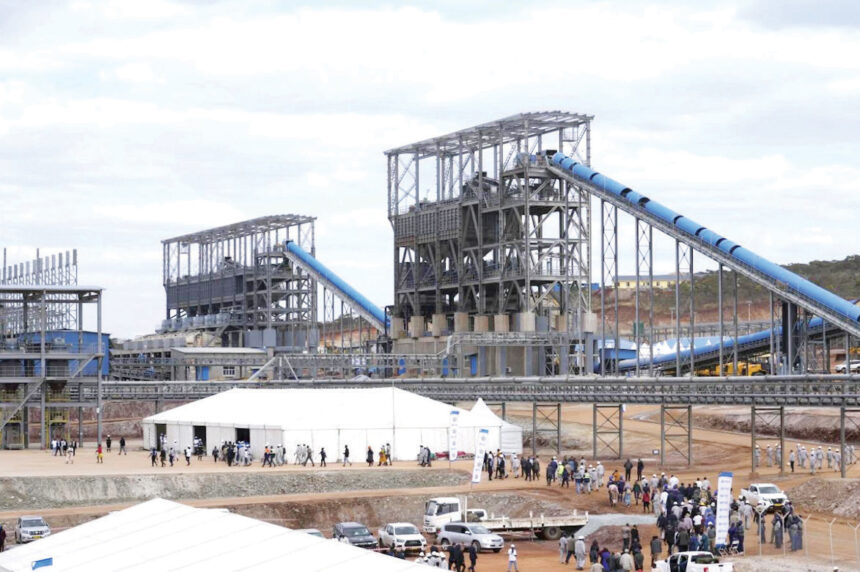
In this second of two-part series, we explore how China is supporting African countries to achieve energy independence with solar and wind farms.
By Charles Mpaka:
In the outskirts of a quaint, windswept coastal town of Lüderitz in Southwestern Namibia, there spans a 50MW wind farm under construction –a project that’s set to cut the country’s heavy reliance on power imports from Zambia, Zimbabwe and South Africa.
Scheduled to get into commercial operation in July 2025, the US$96.4 million project is an investment of the state-owned power utility, NamPower, and a joint venture between a local firm and Energy China which describes itself as “one of the largest comprehensive solution providers for the power industry in China”.
In 2018, Kenya commissioned the largest grid-connected solar power plant in East and Central Africa – a 50MW infrastructure constructed by the China Jiangxi Corporation for International Economic and Technical Co-operation (CJIC) and targeting to supply power to up to 70,000 households in Garissa town.
- Advertisement -

Beyond off-grid home solar system products for which it is also a leader, China is bolstering electricity supply in Africa not only with hydropower plants but also solar and wind farms either as standalone stations or to feed the main grids through power purchase arrangements.
- Advertisement -
A database, by Development Reimagined, of China’s climate footprint in Africa since the 2021 Forum on China-Africa Cooperation (Focac) tracked 155 projects by the end of 2024. Of the total traced, 102 of them were renewable energy projects, constituting 66 percent of the total. If all the renewable energy projects on the table were to be installed, Africa would generate over 40GW of green energy.
Of the projects whose funding arrangement details were available, the tracker found 60 being financed by African entities while 57 projects received Chinese funding in form of investment, aids and loans.
Over the past 20 years or so, China has stolen the march over other global powers on both trade and green energy investments in Africa. On energy in particular, with global climate crisis, attention is increasingly turning to renewable energy technology like wind and solar to reduce reliance on energy sources that pollute the environment, according to Lauren Johnston, Associate Professor at the China Studies Centre at the University of Sydney.
“China saw some years ago it had a chance to lead in such a new industry,” Johnston says.
- Advertisement -
Africa has particularly emerged as an attraction because it is home to a wealth of mineral resources such as copper, cobalt and lithium, the very minerals the world needs to develop those renewable technologies, she observes.
Among some, this China’s ‘rush’ for African minerals is likely to resurrect the age-old “resource curse” ghosts – where Africa sinks into poverty and conflict while the external forces exploiting the mineral resources on the continent rise in prosperity.
However, analysts say the past is for Africa to learn from, better so now because there are models demonstrating how China’s rush for minerals can be turned into a benefit. Johnston cited Indonesia as offering a reference point for leveraging Chinese interest in minerals.
“May be ask the Indonesians to invest too? Follow their model?” She said.
So what did Jakarta do?
In 2014, the Indonesian government banned nickel exports, a move that led to the withdrawal of a large supply of nickel from the global chain. Instead, with China’s financing, Indonesia invested in processing the mineral, leading to the country rising to be the world’s top refined nickel producer.
Indonesia is reaping the rewards of its tough action. In 2013 when it supplied raw nickel ore, it made only around US$6 billion. Since the ban and following the refinement, the export value has surged to US$30 billion by 2022.
Vincent Tawiah, assistant professor in International Financial Reporting at the Dublin City University in Ireland, also believes that China’s mineral rush is a golden opportunity for Africa.
He said Africa’s historical experience with mineral resources ought to be a critical learning point for the continent to formulate robust regulatory frameworks, establish strong institutions and develop skills for savvy negotiations for partnerships that maximize this resource-based relationship and develop the energy sector on the continent.
“The resources are meant to be extracted for development; so I think it is an advantage for those countries who have the minerals,” he said.
In any case, some developed countries, including Australia and USA, have demonstrated that it is possible to benefit from your natural resources. The Middle East countries such as Qatar, United Arab Emirates and Saudi Arabia are classic examples of how extraction of natural resources can build economies.
“I acknowledge the case has not been the same for Africa, hence the need for strong institutions and regulations to turn the resource curse into a blessing,” he said.
Tawiah also tips Africa to look into domestication of resource companies.
“This can only be achieved through a conscious, systematic strategy to encourage local partnership from foreign companies. This local partnership will help local firms to build the capacity to take over in the future,” says Tawiah, one of the researchers in a study that assessed the impact of Chinese investment on energy independence in Africa.
In the study, Tawiah and two other researchers analysed data generated over a period between 2003 and 2022 from 28 African countries, 26 of those in the Sub-Saharan Africa. The aim of the study was to examine the relationship between Chinese investments and energy independence in Africa – a situation where a country is able to meet its energy demands mostly from domestic output.
They found that Chinese cash is indeed increasing capacity in domestic energy production in African countries and that the results are more pronounced in resource-rich countries, “which is consistent with the expectation that China is attracted to resource endowed countries”.
“The results imply that, contrary to the negative publicity on China-Africa engagement, China may be good partner for promoting energy independence and attainment of sustainable development goals and commitment to sustainable energy for all initiative,” reads the study.
However, the researchers caution that there is a set of potential pitfalls for Africa to watch out for. These include the risk of shifting attention away from other equally important traditional sectors and creation of dependence on Chinese suppliers while technology transfer and knowledge sharing with local industries remains insufficient.
In addition, an appetite for Chinese energy loans –with their favorable terms –could lead to debt sustainability trap.
“Excessive borrowing to finance energy infrastructure projects may burden African countries with high levels of debt, potentially compromising their fiscal stability and economic sovereignty,” the researchers say.
Tawiah therefore urged policymakers to implement robust monitoring and evaluation mechanisms to assess the socio-economic and environmental impacts of these investments.
This is particularly critical because China’s investment in renewable energy in Africa is set to grow. At the Forum on China-Africa Cooperation summit in 2024, African countries and China pitched energy development as one of the factors that cements China- Africa cooperation.
In the resulting action plan for the period 2025-2027, China committed to encourage investments in renewable energy projects across Africa, including solar, wind, green hydrogen, hydroelectric and geothermal power initiatives.
China and Africa also agreed to promote the exchanges of expertise, best practices, innovative solutions in renewable energy and capacity building programs to empower African professionals, entrepreneurs and communities in the sector of renewable energy.
Johnston said Africa can leverage this cooperation. She challenged regional blocs such as Southern African Development Community (Sadc) and the East African Community (EAC) to undertake own reviews and consultation on relevant experience to ensure “the African end is well advised” in these agreements.
“Africa is well positioned to utilise China-USA tensions to get good deals,” she said.