By Joel Phiri:
Before the birth of his third and fourth children, Nicholas and Maria, John Mwale, 46, from Group Village Head Mandala in Traditional Authority (TA) Mzikubola in Mzimba, was a successful farmer in his home village in Mzimba South.
“I would grow and harvest hundreds of bags of maize, some of which I sold for my family’s needs. I also had livestock, such as goats and pigs, which made our lives easier,” Mwale recalls.
His life has changed dramatically.
The resurgence of attacks on persons with albinism in 2022 turned Mwale’s life upside down.
- Advertisement -
“My wife and I have four children, Samuel and Anita, who were born without albinism and Nicholas and Maria, who were born with albinism.
“The birth of Nicholas and Maria brought uncertainty to our lives because of the increasing attacks on people with albinism across the country,” he says.
Mwale explains that hearing about the brutal attacks on people with albinism filled him with fear for the safety and future of his children.
“I love all my children, but with the rise in attacks, I began to fear for Nicholas and Maria’s safety. This fear led me to stop my maize business and reduce my farming activities to focus on securing my children,” he narrates.
- Advertisement -
- Advertisement -
This concern led Mwale to start escorting Nicholas, 10, to Kaulankhutu Primary School, located two kilometres from his village.
He had lost trust in everyone, especially strangers, despite no attacks occurring in his village.
The income from his wife’s work alone was insufficient to support their family of six.
Before the attacks, Mwale had even built a four-bedroom iron corrugated house, but he could not complete it due to the halt in his farming activities.
“Several things remain unfinished, such as plastering, window fittings and door installations. This incomplete state poses a risk to my children, as I fear that intruders might break in,” he laments.
Mwale’s fears are grounded in reality.
The murder of Talandira Chirwa, a three-year-old girl with albinism from Kasungu, who was attacked by assailants in November 2022, highlights the danger faced by people with albinism.
Talandira was stabbed and had her arms chopped off while sleeping with her grandmother in an insecure home.
People with albinism in Malawi have faced severe human rights abuses, including abductions, killings and mutilations, under the false belief that their body parts have magical powers.
To address this, President Lazarus Chakwera pledged four years ago to construct secure homes for people with albinism.
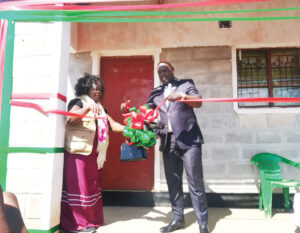
This week, there were celebrations in Mwale’s village as Minister of Lands and Housing, Deus Gumba, presided over the handover of a new house to his family.
This house is one of 47 completed out of 69 planned.
“The handover of this house fulfils President Chakwera’s promise to construct homes for people with albinism, providing them with dignity and security,” Gumba said as he handed over the keys.
He added that Chakwera was motivated to improve housing for people with albinism, who had been neglected in terms of security by previous administrations.
“For the past 26 years, people with albinism lived in fear and discrimination. When the President took office, he directed that they be protected, including through the construction of houses in consultation with the Ministry of Gender, Community Development and Social Welfare,” Gumba said.
The government has planned to build more houses in all districts and has allocated K600 million this financial year for an additional 15 houses.
Minister of Gender, Community Development and Social Welfare, Jean Sendeza, urged the Ministry of Lands to expedite the construction process by streamlining procurement procedures that are causing delays.
“Sixty-seven houses have been completed, but there are many more people with albinism in need of homes. We need to speed up the process,” Sendeza said.

Maynard Zakaria, National Coordinator for the Association of Persons with Albinism in Malawi, commended the government for building 67 houses, emphasising that these homes provide protection against potential attackers.
He also called for quicker utilisation of funds.
After receiving their new house, Mwale and his children, Nicholas and Maria, were overjoyed.
The father expressed his gratitude, noting that as a subsistence farmer, he could not have built such a house on his own.
“This house provides a secure and comfortable environment for my children. I hope the government will continue to build such houses for others,” Mwale said.
Nicholas, 10, expressed how the new house has given him a sense of security and shared his ambition to become a teacher.
“I work hard at school to achieve my dream, and I am grateful to my father for escorting me to school. Without his support, I might have dropped out due to the distance and potential dangers,” he said.—Mana