





By Nomsa Maseko
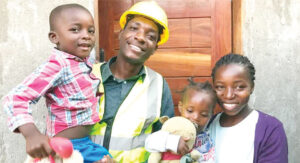
Mozambican builder José Joaquim is determined to never again put his family through the terror of living through a cyclone in a flimsy house.
When Cyclone Idai crashed on to Mozambique’s coastline five years ago, he was living with his wife and new-born baby in a shelter with corrugated iron roofing in the city of Beira.
“When the winds intensified, we were inside. Because of the noise, we couldn’t be sure what was happening outside. But then, suddenly one of the metal roof sheets blew away,” Joaquim told the BBC.
- Advertisement -

“And then our door cracked in half because of the wind. We realised that we had to get out of there.”
- Advertisement -
They struggled through winds that kept knocking them down until they reached an evacuation centre at a local school, where for safety everyone packed into the one room that had a concrete roof until the gales subsided.
“As a father, I felt the responsibility to protect my child and his mother, and thank God! I made a wise decision to leave, to abandon the house so I could save my family,” the 27-year-old says.
Idai caused massive devastation and a heavy loss of life – 1,500 people died and another three million were affected across three countries.
Since then, other storms have hit the region and with climate change, scientists predict they will only get stronger and more dangerous.
- Advertisement -
This could be catastrophic for a country with the third longest Indian Ocean coastline.
Now, whenever clouds gather, people here become visibly worried about the possibility of deadly floods brought on by tropical cyclones.
This has forced people, like Joaquim, to adapt by building stronger houses and learning safe evacuation methods.
He had already been studying civil engineering at the time of Idai, but after surviving the cyclone, Joaquim enrolled on a resilience construction course offered by a college called Young Africa.
He has graduated but comes back to teach some of the current crop of students. Tall, friendly and wearing a high-viz waistcoat and yellow hard hat, he is happy to pass on his skills.
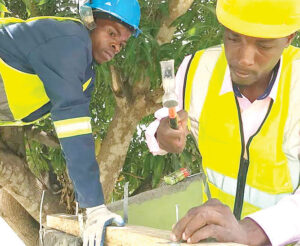
A group of building apprentices dressed in blue overalls and safety boots have gathered around a small demonstration house.
They are learning how to build a roof that has been specifically designed to withstand the extreme winds and torrential rains that come with cyclones.
“Because of the risk of the roof being blown away, we use metal fixtures to reinforce the roof,” Joaquim says.
“With these resilient construction techniques, we think it can resist at least the force of winds and heavy rains that we saw during Cyclone Idai.”
As part of his course, Joaquim helped Young Africa build more than 130 houses across two sites, all designed to provide better protection during a strong cyclone. These “resilient” homes were given to people who lost theirs during Cyclone Idai.
Joaquim is now putting those skills to use, offering his services to build houses for others in his community and for his own family. He showed me round his half-built house which he is hoping to complete before the next cyclone season.
“Me and my family will be safe. Because of the resilient techniques I used here, we’ll be safe,” he tells me.
A stronger house provides better shelter during a storm, but there are some areas around the coastal city of Beira which are so vulnerable that people need to evacuate when a strong cyclone is predicted.
The local council has set up a series of local disaster management committees.
These are volunteers who work tirelessly year-round to prepare communities for emergencies, and help them evacuate safely when they arrive.
One of these areas is Praia Nova, a fishing neighbourhood of the city set right on the beach.
I met up with one of the volunteers that help with evacuations in the event of a storm.
“We work together whenever there’s an emergency. Especially when cyclones appear suddenly, we’re right there, in the community, working with them,” says Liria Charomar in a bright orange T-shirt with a colourful wrap around her waist.
She knows the importance of a safe evacuation. I noticed a scar on her leg which she says she’s had since they were evacuating people through high water during Cyclone Idai.
“There were a lot of metal sheets under the water but I couldn’t see them, and then when I was lifting my foot, one of them cut my leg,” she explains.
One way of providing protection to vulnerable coastal areas is replanting mangrove forests that have been cut down over the years for building materials and firewood.
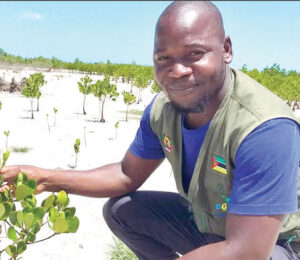
Alberto Santos and his volunteers have planted 1,300 hectares of mangrove seedlings over the past 15 years.
Between the village and the ocean there is a vast sea of green, with trees ranging from a few centimetres high to a couple of metres in Nhangau, about an hour’s drive up the coast from Beira.
“The mangrove serves as a wind barrier,” says Alberto Santos who has been working with other volunteers who’ve been replanting trees.
“The most intense winds come from the ocean, because the cyclones themselves come from the ocean but then there’s a mangrove forest blocking the intensity of the wind.
“This is one of the protection mechanisms.”
His tree-planting association has planted 1,300 hectares (3,212 acres) of mangrove seedlings over the past 15 years.
But for these volunteers trying their best to help their communities, part of the solution lies far away from Mozambican shores.
The fact that Mozambique has caused just a tiny amount of the greenhouse gas emissions driving climate change is not lost on them.
“The residents of Beira are unhappy with this situation caused by other countries,” says Charomar.
“Here in Mozambique, we are already in trouble. We have serious problems like strong cyclones and those countries are still doing these negative things? It’s not helping anyone.
“They should let us live like we always did here in Mozambique.”
In the meantime, people in Beira will continue to do what they can to adapt to climate change, in the face of an uncertain future.
“It’s a good feeling knowing that I learned and I’m also passing on what I know to other people,” says Joaquim.
“There’s always a desire to look for a solution. So, being part of the solution is important for me, and I think it’s important for other people as well.”—BBC