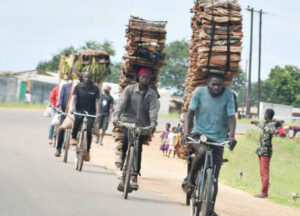
It is 5:30am on the Mitundu- Bunda Turn-Off Road in Malawi’s capital, Lilongwe. This is peak hour for charcoal and firewood vendors carrying the illicit merchandise on bicycles to the city’s townships.
The sizes and numbers of the charcoal bags are massive, such that they block half the road making it difficult for motorists to use it.
The charcoal peddlers easily cycle through police establishments near Bunda Turn-Off and Chitsime Police Unit on their way to Areas 36, 22, 23, Kaphiri, Biwi, Kawale and others.
The situation is similar in Blantyre, where charcoal vendors from the Shire Valley and Chileka flood the streets, rushing to townships of the commercial capital.
This is despite Parliament passing the Forestry Act Amendment 2019 in 2020, which outlaws the use and selling of charcoal unless one has a licence.
- Advertisement -
By enacting the law, Parliament acknowledged that forest crimes are serious offences. This is reflected in the new penalty provisions, which stipulate fines of up to K10 million and custodial sentences of up to 20 years.
Despite the enactment of such a powerful piece of legislation, it appears stakeholders have all connived to sweep it under the carpet.
Natural Resources and Climate Change Committee of Parliament Chairperson Werani Chilenga believes the police, as law enforcement agents, are to blame for looking away as the race for making charcoal intensifies.
According to Chilenga, Members of Parliament (MPs) played their role by enacting the law and that it is up to the police to enforce it.
- Advertisement -
- Advertisement -
“MPs are law makers and not implementers. Our role extends to oversight only to see that the laws are being implemented.
“In case of the Forestry Act, it is the police who are to blame for doing nothing and we have talked to them more than twice, but things are not changing. We hope to engage them for the last time during this meeting of Parliament,” Chilenga said.

Co-ordination Union for the Rehabilitation of the Environment Executive Director Charles Mkoka agrees that despite the enactment of the forestry law, enforcement has remained a challenge.
Mkoka says several factors have contributed to the current situation.
“Information from authorities at the Forestry Department indicates that many magistrates handling these cases continue to impose lenient fines, contrary to the revised provisions of the Forestry Act.
“Consequently, offenders often escape with minimal penalties, leading to the release of impounded vehicles used during the commission of these offenses, rendering the Forestry Department powerless once court decisions are made,” he says.
Mkoka adds that reports also suggest that illegal charcoal businesses thrive in the Southern Region, with some operators infiltrating both forestry and police enforcement systems.
He says vehicles transporting charcoal reportedly employ advance ‘sweepers’ to clear checkpoints using inducements ahead of their arrival.
“Another concern is the collusion between department staff and charcoal syndicates, with insiders leaking information on impending crackdowns and benefiting from syndicate profits,” Mkoka adds.

But National Police spokesperson Peter Kalaya insists that as far as the Forestry Act is concerned as a law, the police are enforcing it.
“You should know that almost on a daily basis, there are active cases in court being prosecuted by the police after being investigated and arrests made by the police. This attests to the fact that we are enforcing this law as it should be done.
“Malawians should know that we have a specialised branch that investigates wildlife and forestry produce crimes and it is very active. Almost all cases that the media capture in the country are success stories of police officers at work.
“Vehicles used in the commission of these crimes are being confiscated and forfeited to government now and again as a result of our endless efforts to thwart and end this vice,” Kalaya says.
He adds that the police are carrying out joint operations with forestry and Anti-Corruption Bureau officers on the same and that a week never passes without this team arresting and confiscating truckloads of charcoal.
“Primarily, enforcement of this act falls under the Department of Forestry and MPS as a main law enforcement institution, we are happy to jointly work with them in the enforcement of this law.
“That is why in most of our roadblocks, we have forestry officers who specialise in detecting forestry crimes,” Kalaya explains.
Wildlife and Environmental Society of Malawi National Chairperson Tiwonge Mzumara Gawa believes all Malawians, including environmental champions, are to blame for choosing to use unsustainable charcoal in their homes.
Gawa notes that some Malawians use charcoal because that is what they have been using from the past and they would not want to look at alternatives such as gas.
She adds that the fact that there is a law against the use of charcoal means that responsible citizens should say no to the use of unsustainably produced charcoal.
“But we choose to continue. So we must blame ourselves. The people who should curb the production, the supply side, so that the charcoal should not get to the people who want to use it are also users of the same charcoal.
“Either, they are choosing not to use an alternative or they don’t have an option for alternatives where they are,” Gawa says.
She wonders how people who strongly believe they should use charcoal as a form of energy should implement a law that says that energy is not legal when they themselves are using it.
According to Gawa, the people in the Executive, the Legislature, the Judiciary and the police are all users of charcoal, a development that has put Malawi in an awkward situation.
Malawi has in recent months seen courts meting out what are viewed by some stakeholders as lenient sentences to charcoal producers.
For example, early this year, despite the law spelling out stiffer punishments for offenders, a magistrate court handed down sentences of K50,000 and K80,000 to nine individuals found guilty of illegally cutting down trees and making charcoal in a protected reserve.
All the convicts paid the fines imposed by the court.
But delivering a judgement in an appeal case of Patrick Nkosa Hamba versus the Republic on July 16, 2021, High Court Judge Agnes Patemba observed that courts should strive as much as possible to enforce the intentions of the Legislature whenever they are meting out sentences on convicts.
“It wouldn’t be in the interest of justice that for an offence which attracts 10 years imprisonment, a court should impose a custodial sentence of six months to a convict who is a repeat offender. It is a mockery to justice.
“There is need for concerted efforts to ensure the forest produce is protected using the law which was put in place. A strong message ought to be sent out to the community that possession of charcoal is a serious offence. We cannot have beautiful laws on paper and yet fail to implement the same,” Patemba said in the judgement.
Of course, legal experts argue that every case is unique in its own right, but environmental conservation activists maintain some sentences are just too lenient.
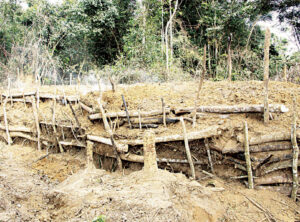
In the end, Malawi has a law which is slowly turning into a white elephant with nobody willing to respect it.
Today, charcoal vendors are everywhere, in villages, townships and cities and nobody seems to believe that is a crime; it appears not even the police.
It seems, again, the law enforcers beginning to select which of the crimes should be treated as such and which ones should not be.
For now, there are those who feel if the general feeling is that the forestry law was done in a hurry, when Malawi was not ready to scrap off the use of charcoal, the best way is to ask the lawmakers to review it.
As things stand today, one could not be faulted for concluding that all the key stakeholders, starting from the Executive, the Judiciary, the Legislature, the Police and the citizenry, have conspired to suffocate the law on charcoal.