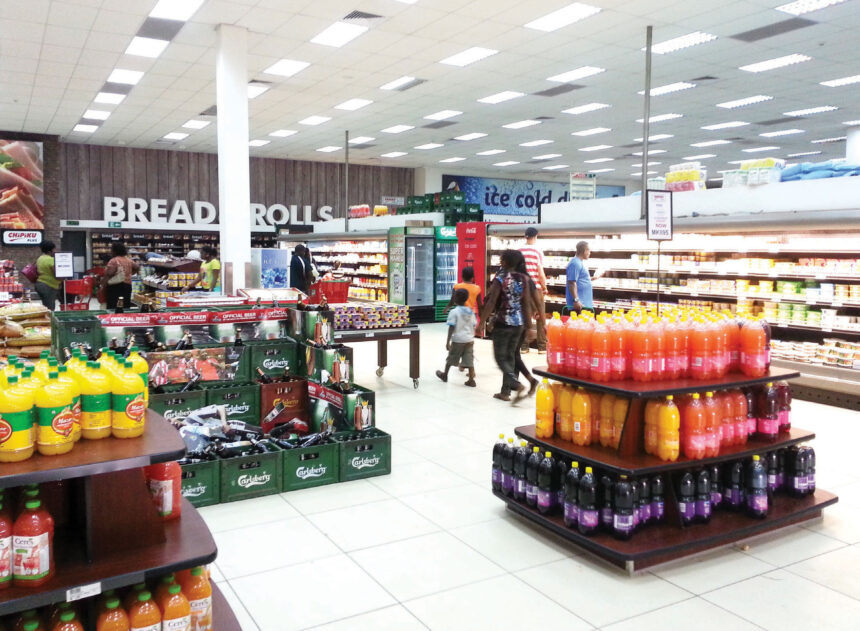
Consumers continue to spend more on basic needs as the cost of living—the level of prices relating to a range of everyday items—went up, albeit slightly, to K378,812 for a household of six in June from K377,892, figures from the Centre for Social Concern (CfSC) show.
Year-on-year, the cost of living increased by K108,013 from K270,799 in June 2022.
According to the CfSC figures, Blantyre remains the most expensive city where a family of six needs K446,610 per month while Mzuzu is least expensive, with the monthly cost of living at K365,031 for a family of six.
Ironically, headline inflation—the rate at which commodity prices change in an economy at a given period—went down in June to 27.3 percent from 29.2 percent in the preceding month, thanks to an ease in food prices.
Cumulatively, during the second quarter of the year, inflation increased to 28.4 percent from 26.5 percent recorded during the first quarter.
- Advertisement -
However, in its June 2023 Monthly Market Intelligence Report, the Reserve Bank of Malawi said it might be too early to conclude that lowering of headline inflation in June signals a turn-around as pressure persists.
“It is too early to conclude that such is the beginning of a downward trajectory for inflation. The observed deceleration could be a basal effect arising from the high prices of June 2022 following the reaction to the May 2022 exchange rate realignment,” the central bank says.

In an interview Thursday, Consumers Association of Malawi Executive Director John Kapito said consumers will have to brace for tough times ahead as commodity prices will maintain an upward trajectory.
“Our economy does not have any copying mechanism for consumers, and more especially the poor, but nothing can change for the better in the short to medium term,” Kapito said.
- Advertisement -
- Advertisement -
Malawi inflation rate has been rocketing since 2021 when it entered into double digits.
In its 2nd Quarter Malawi Country Report issued recently, global economic think-tank, the Economist Intelligence Unit (EIU) predicted Malawi’s headline inflation to average 30.6 percent in 2023.
The projection is 10.6 percentage points higher than the earlier projection of 21 percent.
The forecast is also higher than the revised 24.5 percent by the Reserve Bank of Malawi (RBM) from the earlier projection of 18 percent.
Year-on-year inflation in the first quarter of 2023 averaged 26.5 percent.
EIU says Malawi’s foreign currency shortages are making imports of food and fuel costly and could prompt currency devaluation, which will drive up inflationary pressure.
It says from 2024 onwards, there would be a decline in commodity prices and improved availability of foreign currency to import food and fuel which would lead to a fall in inflation.
EIU says lower input costs and increased fiscal discipline, which will reduce deficit financing through money printing, will also keep inflation contained going forward.
In its May 2023 Market Intelligence Report, the central bank hinted at maintaining a tight monetary policy stance and said there are a lot of factors that still threaten inflation rate stability.
The report indicated that prevailing high food prices are a cause for concern, as they could delay the disinflation process.