







Inside Mbulumbuzi Magistrate Court’s courtroom in Chiradzulu District, the air was thick with anticipation and quiet judgement, as though the walls themselves understood the weight of what was unfolding.
In the dock sat 50-year-old Nyson Eleson from Mwitha Village, Traditional Authority (TA) Chitera, in the district, a man whose story had become emblematic of a deeper national ailment.
The charge against him was blunt and unforgiving: vandalising Electricity Supply Corporation of Malawi (Escom) infrastructure.
Prosecutors laid bare the facts. Eleson was accused of cutting and stealing 3.2 kilometres of 100mm high voltage conductor wire valued at K8,540,800.00 from a newly constructed power line stretching from Chitera Trading Centre to Nkhanda Community Day Secondary School—a line meant to light classrooms, power dreams and stitch rural Malawi into the fabric of modern life.
His freedom had ended on November 17, 2025, through the coordinated efforts of Escom security teams and the Malawi Police Service.
- Advertisement -
When the trial reached its climax, the courtroom fell into a reverent hush. As the magistrate read the determination, silence gripped the courtroom, the kind of silence that precedes reckoning.
“This court hereby finds you guilty of vandalism Escom infrastructure and hereby sentences you to 76 months imprisonment.”
About 400 kilometres away, across geography but united by the same grim narrative, another magistrate in the Central Region border district of Mchinji was delivering justice of a similar tone.

Forty-two-year-old Mavuto Mbewe from Noti Village, TA Kazyozyo, stood accused of possessing Escom property.
- Advertisement -
- Advertisement -
Investigators suspected his involvement in the theft of Escom property in Chimuti Village on May 27, 2025.
Police prosecutor Sergeant Martin Kuliyani did not mince words, telling the court that the offence was highly serious, warning that such acts undermine development and pose extreme risks, including to the lives of patients who are dependent on reliable power supply.
When First Grade Magistrate Fred Chilowesa delivered his determination, the sentence mirrored that of Chiradzulu, 72 months (or six years) imprisonment.
However, not all stories of vandalism end in courtrooms.
On December 3, 2025, the price of recklessness was paid in flesh and blood.
Madalitso Samson, from Sojali Village, TA Ganya in Ntcheu District, was electrocuted while attempting to tamper with high-voltage electrical equipment at Chichiri in Blantyre.
He later died at Queen Elizabeth Central Hospital a day later, another life extinguished in the shadow economy of stolen copper and oil.
Days later, in the capital Lilongwe, the anger of powerless community members boiled over.
On the night of December 11, one suspected vandal Amon Maliko, 35, was stoned to death while another, Million Gideon, 21, sustained severe injuries after an angry mob apprehended them for allegedly vandalising an Escom transformer at Mbalame Primary School, TA Chadza, near Nathenje Trading Centre.
The suspects, who were part of a group, had allegedly pulled down a transformer from its structure and begun dismantling it to steal its parts, an act that ignited fury as much as it did darkness.
These four incidents, chilling as they are, represent only the tip of the iceberg.
Across Malawi, some unpatriotic citizens have turned national electricity infrastructure into hunting grounds for copper wires, transformer oil and other valuables which are sold for quick profit. The collateral damage is devastating and far-reaching.
Patients die in hospitals when life-saving machines fall silent. Expectant women deliver in darkness. Community members endure weeks without power, their economic and social rhythms shattered.
As of mid last year, Escom was losing about K3 billion annually to vandalism, a haemorrhage the country can scarcely afford.
Speaking during the 2025 World Public Relations Day, former Escom chief executive officer Kamkwamba Kumwenda revealed that the vandalism trend was predominant in the Southern Region districts of Phalombe, Mulanje and Chiradzulu.
And while some acts are driven by profit, others are far more disturbing; committed for fun or out of pure malice.
Imagine cutting down an Escom pole just outside the State Residence with the aim of cutting power supply to the State House.
That unsettling reality was echoed by former President Lazarus Chakwera when he launched the $20.2 million (about K35.3 billion) Battery Energy Storage System (Bess) Project at Kanengo in Lilongwe.
He warned that community members with electricity were increasingly being plunged into darkness by deliberate acts of sabotage.
“This is happening in different parts of the country and it is not even being done for commercial reasons. Escom is finding poles cut down and left abandoned by people whose only reason is clearly to sabotage the progress we are making to provide electricity to Malawians,” Chakwera said.
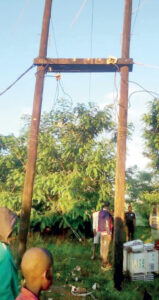
He cited the vandalism of 11 Escom poles between Kafere and Magomero inside Dzalanyama Forest, noting that nothing was taken, underscoring the malicious intent.
“So, today, I want to appeal to all Malawians to be vigilant against vandalism because the Escom assets that are being destroyed to sabotage development are assets that belong to all Malawians and their destruction negatively affects all Malawians.
“I also call on the Malawi Police Service to ramp up its surveillance of these assets and to double its efforts in investigating all acts of vandalism because we cannot have the rule of law if the people who are committing these crimes are allowed to go scot-free,” he said.
Escom spokesperson Pilirani Phiri says the institution loses an estimated K3 billion annually due to vandalism, resources that should have been channelled toward expanding the grid and improving the quality of power for every Malawian.
“Every time our infrastructure is vandalised, it triggers worsening power outages that ripple across the nation.
“We are deeply concerned that these acts are putting the lives of others at risk. When power fails in our hospitals, it disrupts life-saving equipment and emergency procedures. Similarly, vandalism affects both small businesses and large industries,” he says.
According to Phiri, while the courts are increasingly meting out stiff punishments on offenders, he urges all Malawians to join hands with Escom in fighting this vice.
“Community members must take ownership. We can only win this battle if communities take ownership. That’s why we are intensifying sensitisation campaigns across the country,” he says.
Ultimately, when Escom infrastructure is vandalised, everyone suffers. Welding shops fall silent. Maize mills grind to a halt.
Barbershops close their doors. Cold drinks disappear, music dies mid-note and television screens go dark.
Perhaps the most painful truth of all is this: the vandals do not come from distant places; they live among the very communities they plunge into darkness. People know them.
Malawians, therefore, face a stark and unavoidable choice, to accept the consequences of vandalised electricity infrastructure, or to stand up, report suspects and defend the lifelines of national development.
The light, it seems, depends on it.